
World leaders left Brazil Saturday having agreed to triple climate funding for vulnerable nations while conspicuously avoiding the question that dominated two weeks of contentious negotiations: when will humanity stop burning the fuels cooking the planet?
The COP30 summit in Belem concluded with a compromise text urging countries to “significantly accelerate and scale up climate action worldwide”—language ambitious in tone but carefully stripped of the fossil fuel phase-out commitments that dozens of states had demanded and oil-producing nations had blocked.
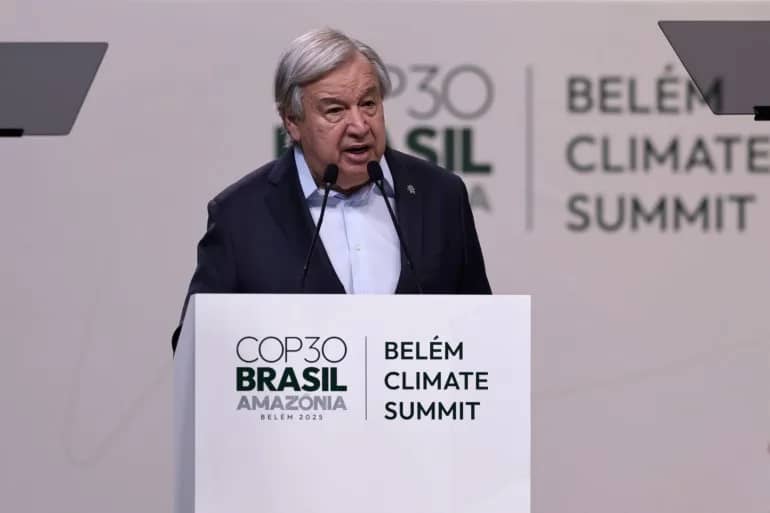
UN Secretary-General António Guterres captured the contradictions. “COP30 has delivered progress,” he acknowledged, pointing to the adaptation financing commitment and recognition that the world will overshoot the Paris Agreement’s 1.5 degrees Celsius warming limit. Then came his qualification: “But COPs are consensus-based—and in a period of geopolitical divides, consensus is ever harder to reach. I cannot pretend that COP30 has delivered everything that is needed.”
That diplomatic understatement barely conceals the summit’s central failure. Climate science is unambiguous: limiting catastrophic warming requires rapidly phasing out coal, oil and gas. Yet the final agreement emerging from Belem makes no mention of the substances driving planetary heating, producing a climate pact that discusses symptoms while ignoring causes.
The omission reflects political mathematics. UN climate negotiations operate by consensus, giving petrostates like Saudi Arabia and Russia effective vetoes over language threatening their economic foundations. Dozens of countries pushed for explicit fossil fuel transition frameworks—but several whose revenues depend on extraction pushed back harder, and consensus requires satisfying the most resistant participants.
Marina Silva, Brazil’s environment minister who chaired the summit, acknowledged the gap between ambition and outcome during Saturday’s closing session. “We know some of you had greater ambitions for some of the issues at hand,” she told delegates and observers. “I know that you, civil society, will demand us to do more to fight climate change.”
Read also: China Climate Leadership Rises As U.S. Skips COP30
Her response was to promise future action rather than present commitments. Silva pledged to create two “roadmaps” as COP30 president: one addressing deforestation, another on “transitioning away from fossil fuels in a just, orderly and equitable manner.” She invoked Brazilian President Luiz Inácio Lula da Silva’s opening remarks calling for pathways enabling humanity to “overcome its dependence on fossil fuels.”
That effectively punts the fossil fuel question to processes yet to be designed rather than resolving it through binding agreement—a move that frustrated campaigners who argue delay equals failure when atmospheric carbon concentrations keep climbing and warming accelerates.
What COP30 did produce is a commitment from developed countries to triple funding helping poorer nations adapt to climate impacts they didn’t cause. That addresses a longstanding grievance from Global South states bearing disproportionate consequences despite contributing least to historical emissions. Whether wealthy countries actually deliver remains uncertain—they’ve repeatedly failed to meet previous climate finance pledges.
Guterres directed his sharpest language toward those most affected by the inadequate outcome. “I understand many may feel disappointed—especially young people, Indigenous Peoples and those living through climate chaos,” he said. “The reality of overshoot is a stark warning: We are approaching dangerous and irreversible tipping points.”
Those phrases—”overshoot” and “irreversible tipping points”—carry implications the diplomatic language barely captures. Scientists warn that crossing certain warming thresholds could trigger cascading, self-reinforcing effects: ice sheet collapse, Amazon rainforest dieback, permafrost methane release. Once initiated, these processes become unstoppable regardless of subsequent human actions.
The gap between scientific imperatives and diplomatic outcomes has grown increasingly stark across successive climate summits. Nearly 200 countries convene annually, negotiate intensively for two weeks, then produce agreements so diluted by competing interests that they barely advance beyond existing commitments. Global emissions keep rising. Warming accelerates. Impacts intensify.
Young activists and Indigenous communities—the groups Guterres specifically acknowledged—have grown weary of a process that uses crisis language in speeches while avoiding transformative actions in agreements. For them, another summit producing another inadequate deal feels less like progress than institutional failure dressed in diplomatic niceties.
Silva’s roadmap promise may eventually produce transition frameworks, but climate breakdown operates on its own timeline regardless of diplomatic schedules. Every year without decisive action makes eventual transitions more disruptive and costly while increasing the likelihood of catastrophic impacts that no amount of adaptation funding can address.
The COP30 text includes various commitments on renewable energy expansion, nature-based solutions, and technology transfer—incremental steps that might have seemed ambitious a decade ago but now appear inadequate given acceleration of both warming and impacts. The agreement acknowledges problems while deferring solutions to future negotiations, future roadmaps, future summits.
What’s left unsaid in the final text often matters more than what’s included. By avoiding fossil fuel phase-out language, COP30 effectively endorsed continued extraction and combustion of the substances scientists say must be rapidly eliminated. That sends signals to investors, governments and industries that business-as-usual remains acceptable despite mounting evidence it’s incompatible with habitability.
Guterres’s assessment captured the deflating reality: “The gap between where we are and what science demands remains dangerously wide.” That gap didn’t narrow in Belem. If anything, it expanded as negotiators produced another agreement acknowledging crisis while avoiding the transformations required to address it.
Delegates departed Brazil with commitments to reconvene, develop roadmaps, and continue negotiations. The atmosphere continues accumulating carbon. The planet continues warming. And vulnerable populations continue experiencing intensifying impacts from a crisis the international community keeps promising to address without taking the actions science says are necessary.