
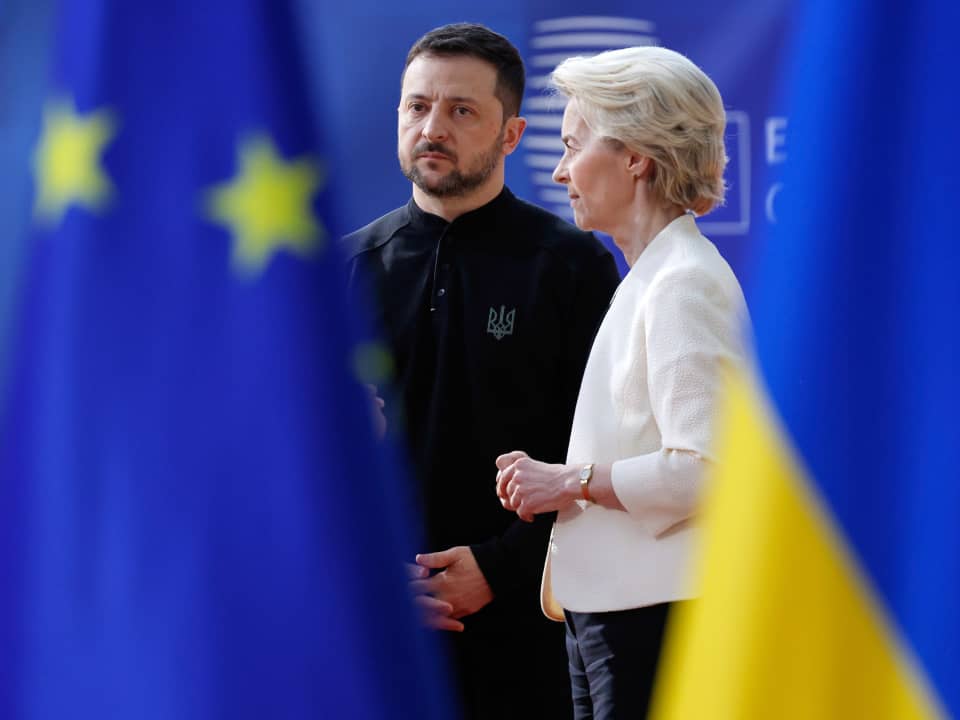
What’s billed as a high-stakes economic summit between European and African leaders risks becoming a sideshow Monday as EU officials scramble to coordinate their response to Donald Trump’s contentious Ukraine peace blueprint.
Dozens of heads of state—including France’s Emmanuel Macron, Germany’s Friedrich Merz and Kenya’s William Ruto—are descending on Luanda for discussions ostensibly centered on commerce, migration and mineral resources. Yet the real drama may unfold in hushed “special meetings” where European delegations plot strategy against an American-drafted plan many view as gift-wrapping territorial concessions to Moscow.
The timing couldn’t be more awkward. After U.S. and Ukrainian negotiators spent Sunday in Geneva revising Trump’s 28-point framework, EU leaders now gather in Angola’s capital trying to present a unified front while simultaneously wooing African partners who’ve watched Western powers fracture over Ukraine policy.
“There is still a lot of work to be done on the 28-point plan,” Finnish President Alexander Stubb acknowledged in Johannesburg Sunday—diplomatic code for deep European unease about proposals crafted without their input.
The two-day Angola convening marks a quarter-century of formalized EU-African Union partnerships, though analysts question whether the relationship has evolved much beyond its colonial-era power dynamics. Europe still supplies more foreign investment to Africa than any competitor and remains its largest trading partner, with bilateral exchanges topping €467 billion ($538 billion) last year.
But that dominance is eroding fast. China has locked up strategic mineral contracts across the continent. Russia has muscled into security arrangements previously dominated by France and other former colonial powers. Gulf states and Turkey have expanded their footprints dramatically, giving African governments options European capitals once monopolized.
“We don’t have that situation anymore where Europe was the only partner,” observed Geert Laporte from European think tank ECDPM. Brussels now faces actual competition requiring “an offer that is attractive enough to beat” rivals no longer content playing second fiddle.
That means moving beyond lofty declarations toward tangible projects creating African jobs and driving economic expansion—infrastructure Europe promises but too often fails delivering, observers note.
“Africa is looking not for new declarations but for credible, implementable commitments,” said AU spokesman Nuur Mohamud Sheekh, capturing continental frustration with rhetoric exceeding results.
Monday’s formal discussions will address migration pressures facing Europe, security collaboration, and African demands for stronger voices in international governance structures. Trade expansion likely dominates, particularly as Trump’s tariff policies hammer economies on both continents.
Read also: Germany Advances Conscription Plan To Build Stronger Military
Brussels plans showcasing expertise helping expand commerce between African nations, which currently accounts for merely 15 percent of the continent’s trade—a shockingly low figure revealing infrastructure gaps and regulatory barriers European assistance could theoretically address.
The EU also desperately needs African minerals for its green energy transition, hoping to reduce reliance on Chinese-controlled rare earth supplies essential for technology manufacturing. That creates mutual dependency Europe wants framing as partnership rather than the resource extraction that defined colonial relationships.
The bloc intends highlighting Global Gateway projects—Brussels’ infrastructure initiative positioning itself as alternative to China’s Belt and Road juggernaut. Angola itself hosts a showcase: the Lobito corridor railway backed jointly with Washington to move Congolese and Zambian minerals to Atlantic ports.
European diplomats insist such ventures benefit all parties, though critics note they follow familiar patterns—European and American capital funding infrastructure primarily serving resource extraction with limited transformation of African economies.
“Investment must move from PowerPoint to the factory floor,” said Ikemesit Effiong from Nigeria’s SBM Intelligence consultancy. “Europe’s credibility now depends on whether it can support the delivery of projects that create value in Africa, not just visibility for Brussels.”
The summit follows last week’s G20 gathering in South Africa, where conspicuous American absence highlighted geopolitical ruptures now complicating international coordination. That fracturing adds urgency to Europe’s African courtship as traditional alliances weaken and multilateral institutions struggle maintaining relevance.
For African leaders arriving in Luanda, the moment offers leverage. European anxiety about Chinese and Russian inroads, combined with desperate mineral needs and Ukraine distractions, creates opportunities extracting commitments from suitors competing for attention.
Whether those commitments materialize as transformative investments or merely refresh tired promises will reveal if 25 years of formalized EU-AU relations have produced genuine partnership or simply repackaged old dependencies with contemporary branding.
The Ukraine subplot adds surreal dimension. European officials traveled to an African summit ostensibly about continental cooperation but may spend substantial energy huddling over proposals crafted in Washington addressing a war in Eastern Europe—a dynamic unlikely escaping African hosts’ notice.
That Europe’s most pressing foreign policy crisis now overshadows its signature African summit speaks volumes about priorities African leaders have long questioned. Whether Brussels can walk the tightrope—coordinating Ukraine strategy while convincing African partners they remain valued allies rather than geopolitical afterthoughts—may determine if Monday’s gathering advances relationships or merely exposes their limitations.