
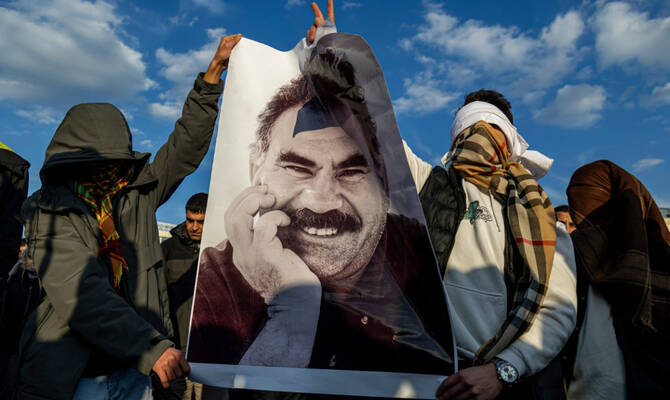
Turkey is moving deeper into a renewed Abdullah Ocalan peace process after three lawmakers met the jailed PKK founder on Monday, a rare step that shows Ankara’s push to end a conflict that has killed more than forty thousand people since the 1980s.
The visit came as the Kurdistan Workers Party continues to carry out a staged disarmament plan, months after announcing it would dissolve its armed units and withdraw fighters from Turkey. The group halted attacks earlier this year, raising hopes that the long war between Turkish forces and the PKK could finally be phased out.
Ocalan, who has been held on Imrali Island since 1999, has emerged again as the central figure in negotiations. According to the parliament speaker’s office, the lawmakers met him to collect statements on the PKK’s disbandment plan and on Kurdish groups in northern Syria, which Turkey views as aligned with the PKK.
President Tayyip Erdogan welcomed the visit, saying it “paves the way for the process” and would speed up efforts to remove armed groups from Turkey. The president has kept a low public profile during the latest talks, but analysts say he could benefit politically if progress wins over Kurdish voters ahead of any early election call or potential constitutional moves extending his time in power.
Ocalan, now seventy-six, maintains wide influence over the PKK’s senior commanders in northern Iraq’s Qandil mountains. A transcript of a May video call between Ocalan and top PKK figures, reviewed by Reuters, shows the depth of that authority.
“I saw it as a valuable opportunity. I prepared it myself,” he said of his decision to urge the PKK to disband. He added, “I wasn’t sad. I wasn’t emotional and won’t be. I founded it myself and I’m ending it myself.”
Moving the peace process forward requires careful coordination between Ankara, Ocalan, commanders in Qandil, and Kurdish groups in northern Syria. It also involves navigating Turkey’s internal politics, where public opinion around the Kurdish question has long been tense.
Read Also: All 20 Soldiers Killed In Turkish Military Plane Crash
Many Kurds remain wary of Ankara’s intentions. Erdogan’s government oversaw a sweeping crackdown on pro-Kurdish politicians over the past decade, removing elected mayors, jailing lawmakers, and detaining thousands of activists. Former HDP leader Selahattin Demirtas has been imprisoned since 2016.
The state paused major legal actions during the current peace push, and Bahceli recently said Demirtas’ release could be “beneficial” if it supports stability.
While the PKK’s halt in attacks marks the most significant shift in years, officials and observers note that a lasting agreement will require careful negotiation, legal guarantees, and trust that has been absent for decades.