
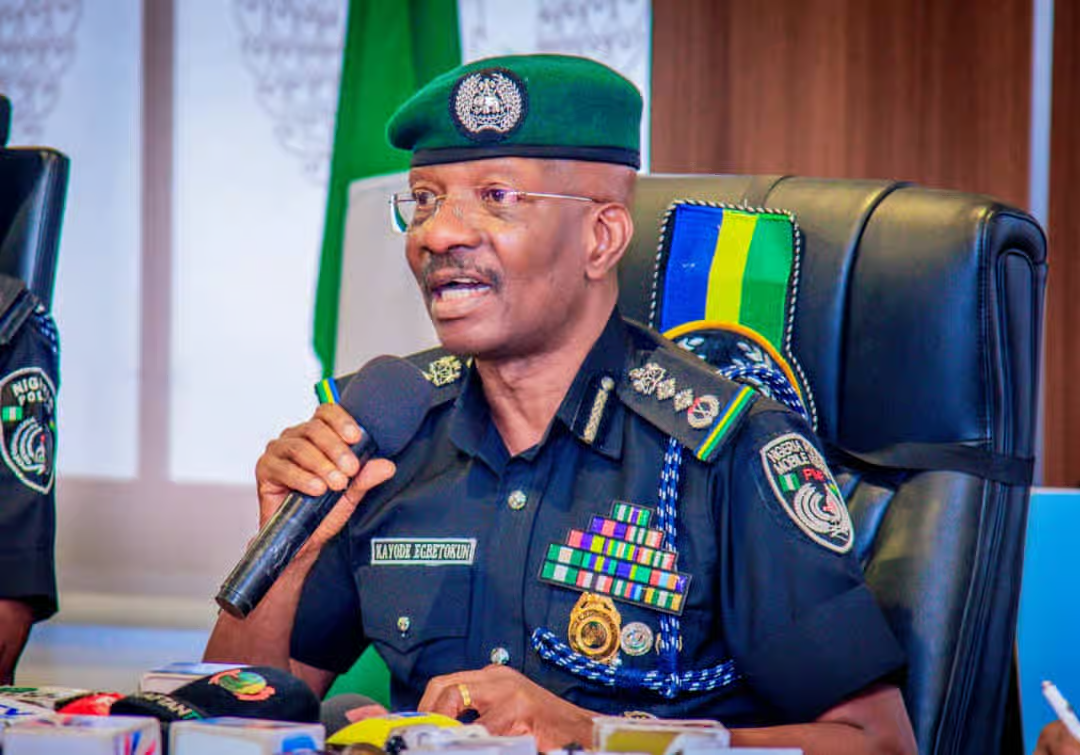
In a bold move to strengthen nationwide security, President Bola Ahmed Tinubu has ordered the withdrawal of 11,566 police officers from VIP protection duties. The redeployment aims to redirect manpower to regions grappling with escalating crime, including kidnappings in Kwara, Kebbi, Niger, and other northern states. Following the directive, several high-profile Nigerians are now seeking security support from the Nigeria Security and Civil Defence Corps (NSCDC).
Inspector-General of Police, Kayode Egbetokun, told journalists in Abuja that the reassignment of personnel is not a political maneuver but a strategic effort to focus law enforcement resources on crime-ridden communities. He explained that officers withdrawn from VIP duties would now reinforce rural and township security, enhance intelligence-led operations, and improve rapid-response capabilities. He also warned that criminals posing as police could exploit the transition.
Egbetokun highlighted recent successes, including the arrest of 451 armed robbery suspects, 356 kidnappers, 534 murder suspects, 129 culpable homicide suspects, 173 individuals for unlawful firearms possession, 312 rape suspects, and 282 alleged cultists. Despite these measures, insiders report that some officers have quietly returned to VIP assignments, signaling partial non-compliance on the ground.
Among those affected by the withdrawal are former SDP presidential candidate Prince Adewole Adebayo and suspended PDP National Secretary Samuel Anyanwu. While Adebayo was seen with NSCDC personnel and private security, Anyanwu confirmed the withdrawal of his police orderlies but supported the policy, urging the government to prioritize elder statesmen and national party officials. “The police officers engaged with VIPs have often mismanaged their positions. The government should focus on those who genuinely require protection,” he said, adding that he had applied to the NSCDC for trained personnel.
Read also: Yelwata Killings: 28 Arrested, IGP Reveals In Briefing
Lawmakers’ reactions have been mixed. APC Vice Chairman (South-East) Dr. Ijeoma Arodiogbu warned that stripping VIPs of protection entirely could expose them to heightened risks, noting that public officials remain prime targets of politically motivated attacks. Conversely, Senator Ali Ndume welcomed the measure, highlighting that excessive police attachments—including officers assigned to the families of ministers—are unnecessary and strain law enforcement resources.
The move has also sparked broader debates on security reform. Senator Francis Fadahunsi advocated for allowing responsible citizens to bear arms, arguing that it could deter criminals amid worsening insecurity. Meanwhile, the Senate introduced a bill sponsored by Senate Leader Opeyemi Bamidele to classify all forms of kidnapping as terrorism, mandating the death penalty upon conviction regardless of whether the victim survives. Senate President Godswill Akpabio emphasized the urgency of the legislation, instructing Bamidele to fast-track the amendment.
The Association of Licensed Private Security Practitioners of Nigeria (ALPSPN) sees the developments as a call to modernize the 38-year-old Private Guard Companies Act. Maj. Gen. Elvis Njoku (retd.), chairman of ALPSPN’s Interim Caretaker Committee, stated that reforms are needed to professionalize private security, integrate modern surveillance technologies, and ensure coordinated contributions to national security. He praised President Tinubu’s reforms, describing them as a step toward addressing Nigeria’s complex security challenges.