
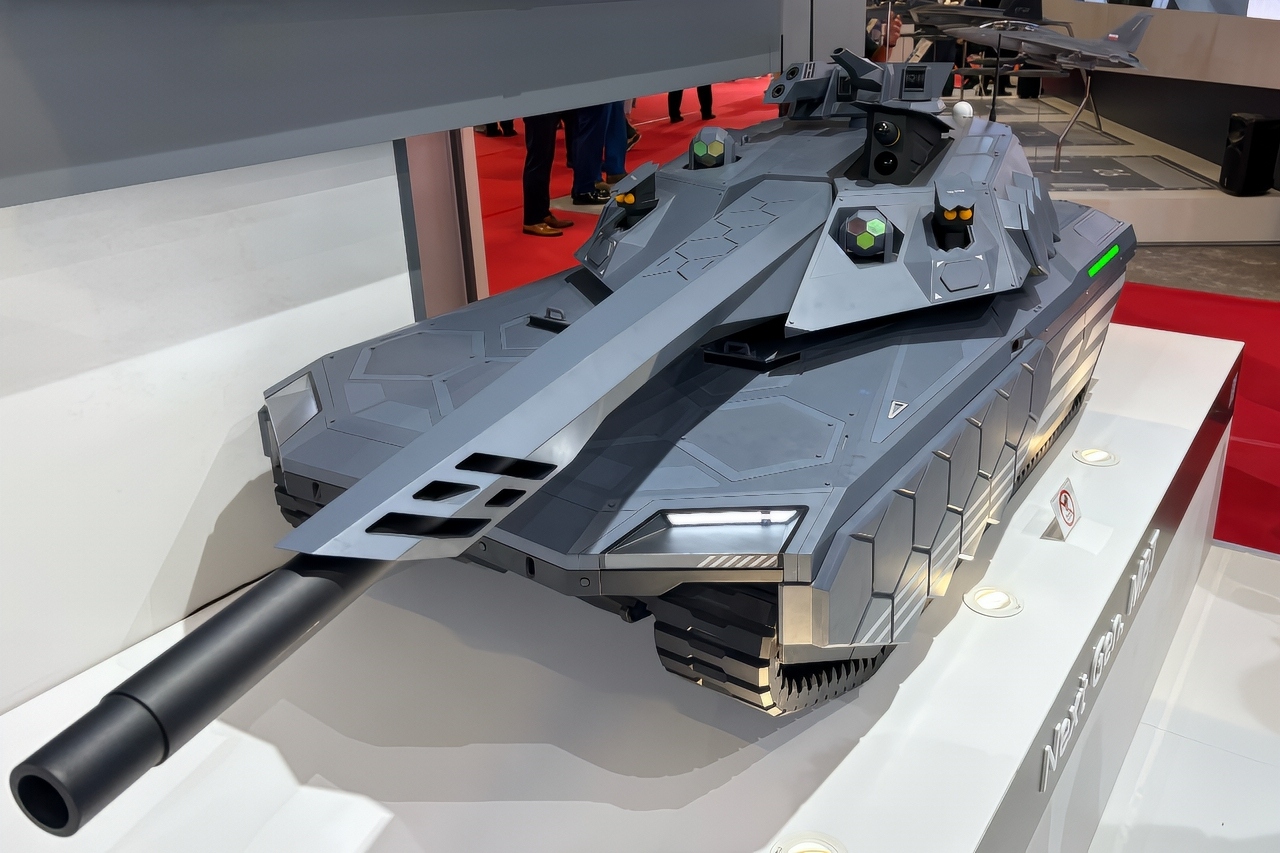
Hyundai Rotem’s K3 tank introduces hydrogen fuel cells, near-silent mobility, AI targeting and a futuristic stealth design aimed at redefining battlefield operations.
The K3’s design immediately sets it apart. Its smooth, seamless exterior shell—reminiscent of the U.S. B-21 Raider stealth bomber—reduces radar, acoustic and thermal signatures. The tank also bears similarities to DARPA’s RACER autonomous vehicle program, with a futuristic profile that hints at increased automation and remote capabilities.
Central to the K3’s concept is its hydrogen fuel-cell powertrain. The system enables near-silent movement and dramatically lowers heat emissions, boosting survivability on the battlefield. Early production models, however, will rely on a hybrid hydrogen-diesel arrangement before transitioning to full hydrogen once storage and refueling challenges are resolved. Engineers note that hydrogen storage remains a significant logistical obstacle, given the large quantities the tank will require.
Read Also: China-Japan Tourism Dispute Boosts South Korea Travel
The K3 also incorporates a fully unmanned turret, topped with a 130mm smoothbore gun designed for long-range engagements. An AI-driven fire-control system supports automated target tracking and battlefield coordination, aligning the vehicle with South Korea’s broader push toward autonomous and robotic combat platforms. The crew compartment is physically separated from ammunition stores, enhancing protection in the event of penetration.
Hyundai Rotem says the tank is engineered to exceed the capabilities of current main battle tanks by combining mobility, stealth, advanced sensors and real-time battlefield connectivity. Its multi-layer active protection system, infrared sensor suite and network-centric mission systems are intended to boost survivability and situational awareness in rapidly changing conflict environments.
The K3’s development reflects a wider shift in global military technology, as armed forces experiment with hybrid engines, autonomous vehicles and remote-controlled weapons platforms. The United States, for example, is moving toward a hybrid-powered M1E3 Abrams, while several militaries are deploying robotic ground vehicles and unmanned submarines.
Full production of the hydrogen-powered K3 is expected to begin in 2040, though hybrid variants will enter service earlier. For South Korea, the project underscores a long-term commitment to next-generation defense systems designed to meet the demands of increasingly high-tech warfare.