
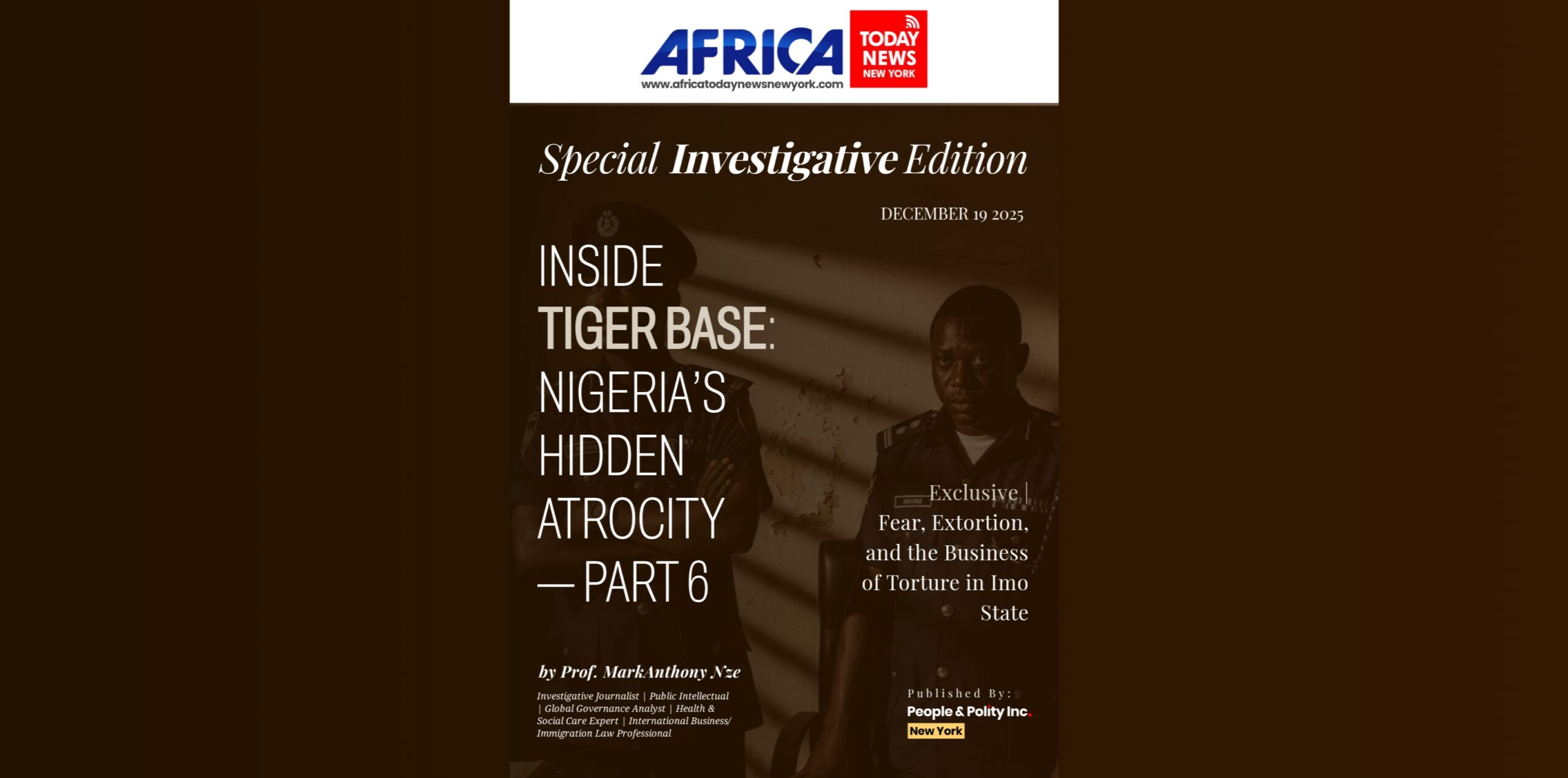
In a system where brutality masquerades as efficiency, the men who torture and kill are not exiled — they are decorated.
The air inside the banquet hall shimmered with ceremony. The floor smelled of polish, the brass railings caught the light, and the flags along the wall stood so still they looked ironed into obedience. Cameras clicked in unison as a voice over the loudspeaker announced the winner — Assistant Commissioner of Police Oladimeji Adeyeyiwa, commander of Tiger Base. He rose from the front row, posture military, expression vacant, and crossed the stage beneath a rain of applause. A plaque waited for him on a velvet cushion: Best Crime Buster of the Year.
The flashbulbs burned white across his face. At that same moment, across Owerri, a widow stood outside the city morgue clutching a document stamped “pending autopsy.” Her husband had died two months earlier in Tiger Base custody. The coroner’s order remained unsigned. The smell of disinfectant drifted through the corridor as she waited for someone to tell her the truth.
Inside the hall, Adeyeyiwa raised the plaque to the cameras. The applause swelled again. The inscription caught the light — a polished reflection of the system that birthed him.
That is the true architecture of policing in Imo State: ceremony above, burial below. The medals gleam because the graves remain unmarked; the higher the praise, the deeper the silence.
The Currency of Violence
At Tiger Base, brutality is not a deviation from duty — it is the language of advancement. Inside the hierarchy, the measure of loyalty is not how many suspects you bring to court, but how many you can make vanish. Officers who obey the code rise faster; those who hesitate are replaced.
Every complaint against the unit becomes a recommendation letter in disguise. Public outrage is reframed as validation. The more the people cry, the stronger the image of control. A former officer, now in hiding, explained it simply: “The system rewards noise. If they’re shouting your name, it means you’re doing the work.”
Within that perverse logic, death becomes a metric of performance.
The Commander
Adeyeyiwa inherited a command already soaked in blood and turned it into a self-contained republic. Under his tenure, at least two hundred detainees died or disappeared. Courts summoned him to answer for unlawful detentions; he ignored them. The National Human Rights Commission demanded access; he refused. When families filed petitions, he mocked them as “emotional.”
Yet each act of defiance earned him promotion. In June 2025, as protestors outside the Imo Assembly carried placards with the names of the missing, Adeyeyiwa was in Abuja receiving a commendation from the police high command. He was photographed smiling, plaque in hand, the caption reading Operational Excellence.
No one asked about the men who never returned from his custody. No one mentioned the morgue bills quietly paid by grieving families. The celebration was not oversight — it was endorsement.
The Machinery That Shields
The Police Service Commission, the body meant to discipline erring officers, has become an echo chamber. Every complaint against Tiger Base is routed back to Tiger Base for “internal investigation.” The Complaints Response Unit, when pressed by journalists, said the commander was “occupied with state assignments.”
The judiciary fares no better. Judges issue orders to produce detainees, but the police treat them as interruptions. Even the National Human Rights Commission, empowered under federal law, cannot pierce the wall of impunity. When the Commission ordered the transfer of torture victim Magnus Ejiogu to Abuja, Tiger Base ignored it. Weeks later, Magnus died. His death certificate listed “respiratory distress.”
The architecture of accountability now serves as camouflage. Each institution performs outrage, issues statements, files reports, then folds into silence.
The Politics of Reward
Promotion is not only institutional; it is political. The Imo State government publicly praises Tiger Base for “restoring order.” In private, the same machinery is used to intimidate opponents, journalists, and civic critics. The unit’s commander is often seen at state events, seated close to those who publicly disown his actions. He has become both weapon and ornament — proof that the governor can control chaos and command loyalty.
For officers, this proximity to power is career oxygen. Every act of violence performed in the name of stability becomes a political asset. Every body dropped in the night is a pledge of allegiance.
An insider in Owerri described it as “a marketplace of fear.” He said, “The police give security; the government gives protection. That is the exchange.”
The Illusion of Oversight
Even within the Force, men like Adeyeyiwa are untouchable. Their reputations travel faster than their files. They are seen as “field men,” necessary for dirty work the bureaucracy prefers not to acknowledge. The hierarchy needs them precisely because they operate without restraint.
When the Rivers State Judicial Panel indicted Deputy Commissioner of Police Akin Fakorede for torture and extrajudicial killings, he was not dismissed. He was later appointed to head the Inspector General’s Monitoring Unit — the department meant to investigate officers like him. It is a perfect circle: the violator becomes the auditor, and the audit becomes ritual.
The CAPTI report calls it “a system where wrongdoing is institutionalized through reward.” Each promotion not only erases the past but legitimizes it.
Read also: Part 5 — The Dead Don’t Testify
The Theater of Legitimacy
The ceremonies that honor these men are carefully choreographed. Speeches invoke courage, sacrifice, patriotism. The word human rights is never mentioned. The families of the dead are not invited. The applause is steady, the cameras flash, the plaques are polished to mirror brightness — a visual antidote to the rot beneath.
After every ceremony, the cycle resets. The commander returns to Owerri, the detainees return to silence, and the system continues its work — producing new victims for the next promotion.
The Hidden Economy
Behind every medal lies an unspoken economy. The extortion rackets inside Tiger Base generate money that moves upward. POS machines hum inside the compound; cash changes hands in the commander’s office. Portions of those collections sustain networks of loyalty that stretch to the Force Headquarters.
This is why the unit survives every scandal. It is not only protected; it is profitable. The same hands that sign promotion papers also benefit from the flow of ransom money disguised as “bail.”
Tiger Base is not merely tolerated — it is sustained because it pays.
Closing Reflection
The promotion of killers is not a clerical error. It is a declaration of policy. It tells every young officer that violence is the shortest route to recognition, that the law is not a boundary but a ladder.
Each plaque, each title, each handshake on a stage turns another death into performance. In this choreography of brutality, the state applauds itself for the very crimes it denies.
In Imo, power no longer hides its stain. It frames it, lights it, and hangs it on the wall.
Professor MarkAnthony Ujunwa Nze is an internationally acclaimed investigative journalist, public intellectual, and global governance analyst whose work shapes contemporary thinking at the intersection of health and social care management, media, law, and policy. Renowned for his incisive commentary and structural insight, he brings rigorous scholarship to questions of justice, power, and institutional integrity.
Based in New York, he serves as a full tenured professor and Academic Director at the New York Center for Advanced Research (NYCAR), where he leads high-impact research in governance innovation, strategic leadership, and geopolitical risk. He also oversees NYCAR’s free Health & Social Care professional certification programs, accessible worldwide at:
👉 https://www.newyorkresearch.org/professional-certification/
Professor Nze remains a defining voice in advancing ethical leadership and democratic accountability across global systems.