
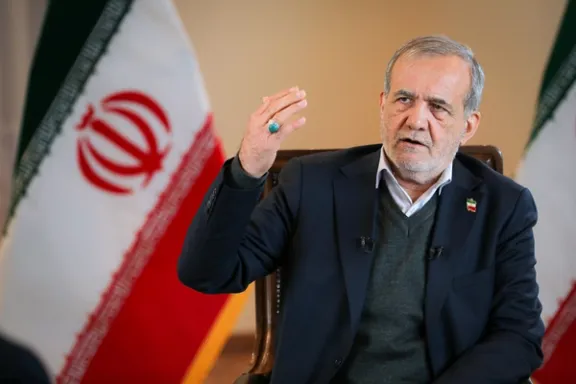
Iranian President Masoud Pezeshkian has accused the United States, Israel, and several European powers of jointly prosecuting what he described as an all-encompassing war against Iran, warning that any further aggression would be met with a stronger response.
Speaking in an interview published on the official website of Iran’s Supreme Leader, Ayatollah Ali Khamenei, Pezeshkian said the pressure campaign facing Iran goes far beyond conventional military confrontation. According to him, the country is being targeted politically, economically, and militarily by what he sees as a coordinated alliance determined to weaken Tehran’s independence.
The remarks come at a sensitive moment, just days before Israeli Prime Minister Benjamin Netanyahu is expected to meet U.S. President Donald Trump in Washington. They also follow months of heightened tensions, including joint U.S. and Israeli strikes on Iranian targets earlier this year and the reimposition of United Nations sanctions by France, Germany, and the United Kingdom over Iran’s nuclear activities.
Pezeshkian said Iran’s armed forces are prepared for any escalation, insisting that the country’s military capabilities have improved despite economic challenges. He stated that Iran is now better equipped and more resilient than it was during previous attacks, adding that any new strike would trigger a more forceful reaction.
Describing the current confrontation as unprecedented, the president compared it unfavorably to the eight-year war between Iran and Iraq in the 1980s. He argued that today’s conflict is more complex, involving sanctions, intelligence operations, cyber warfare, and diplomatic isolation, making it more difficult than past battles fought on conventional frontlines.
Tensions between Iran and Israel escalated sharply in June following a surprise Israeli assault on Iranian military and nuclear facilities, as well as civilian areas. Iranian authorities reported more than 1,000 casualties from the strikes. The United States later joined the offensive, bombing several Iranian nuclear sites, an action that effectively stalled nuclear negotiations that had resumed earlier in the year.
Washington continues to accuse Tehran of pursuing nuclear weapons, allegations Iran has repeatedly rejected. Since returning to office in January, President Trump has reinstated his maximum pressure strategy, expanding sanctions aimed at crippling Iran’s economy and limiting its ability to sell oil on global markets.