
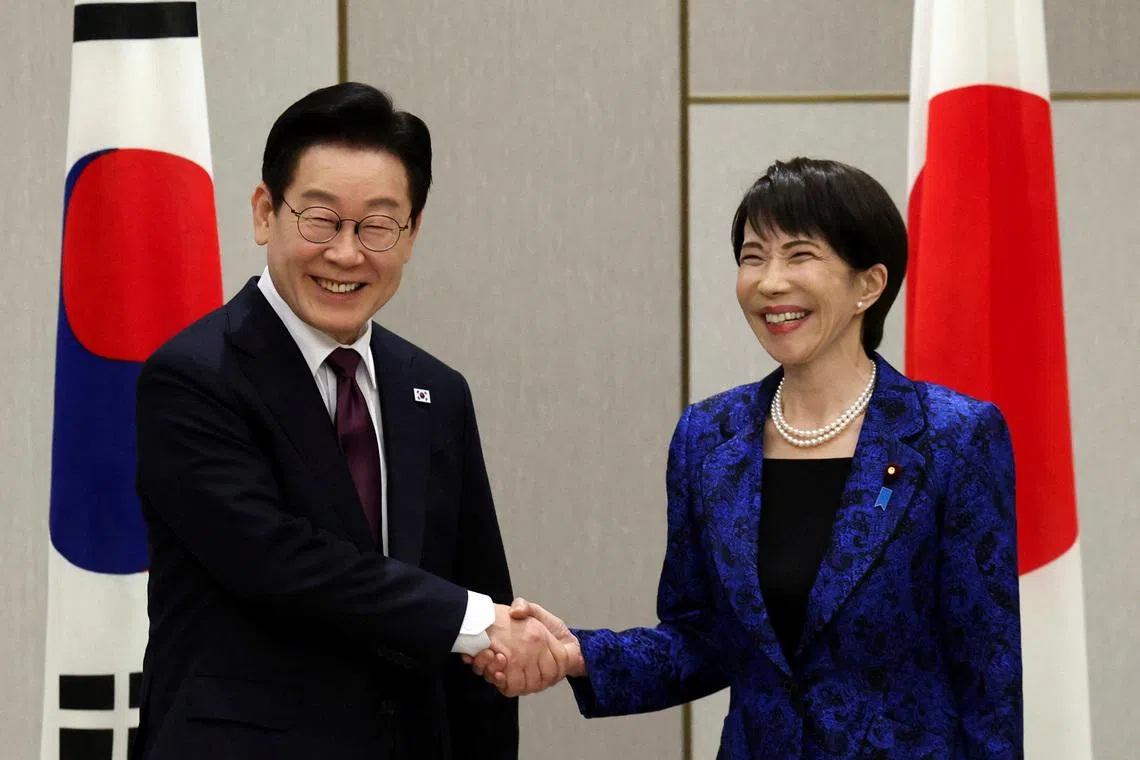
Japan and South Korea agreed to strengthen security and economic cooperation on Tuesday, signaling a renewed push to stabilize relations as tensions rise across East Asia.
The commitment followed a summit in Japan between Prime Minister Sanae Takaichi and South Korean President Lee Jae Myung, where both leaders stressed the growing urgency of closer coordination amid regional uncertainty and shifting power dynamics.
The talks highlighted a shared concern about security risks in Northeast Asia and the need to align policies with mutual ally the United States.
“The importance of Japan South Korea relations, as well as cooperation among Japan, South Korea and the United States, continues to grow,” Takaichi said in a joint statement delivered in her home region of Nara.
According to officials, discussions covered supply chains, emerging digital technologies, denuclearization of the Korean Peninsula, and trilateral coordination with Washington. Lee also said both governments agreed to expand cooperation against cross border online fraud schemes that have targeted victims in both countries.
The summit came shortly after Lee met Chinese President Xi Jinping, a visit that drew attention as Tokyo and Beijing remain at odds over regional security. Tensions have been heightened by remarks from Takaichi suggesting Japan could deploy its forces if a conflict over Taiwan posed an existential threat. China claims Taiwan as its territory, a position rejected by the island’s government.
Speaking alongside Takaichi, Lee acknowledged the diplomatic strains but emphasized the need to prioritize bilateral cooperation. “The current international environment and trade order are unprecedentedly volatile,” Lee said. “It is an urgent task of our time to deepen bilateral relations.”
Read Also: North Korea Drone Incident Sparks Call For Seoul Probe
Despite recent diplomatic progress, relations between Tokyo and Seoul have long been burdened by disputes linked to Japan’s colonial rule of the Korean Peninsula from 1910 to 1945. Contentious issues include the treatment of women forced into wartime brothels and Koreans conscripted as laborers.
Takaichi said she welcomed progress in identifying human remains found at an abandoned coal mine in western Japan, where a collapse in 1942 killed 136 Koreans and 47 Japanese workers. South Korea maintains that the remains of up to 10,000 Korean forced laborers are still in Japan, while Japanese authorities say about 3,000 have been identified.
Both leaders said they would maintain their so called shuttle diplomacy, with Takaichi expected to visit South Korea for their third meeting. No date was announced.