
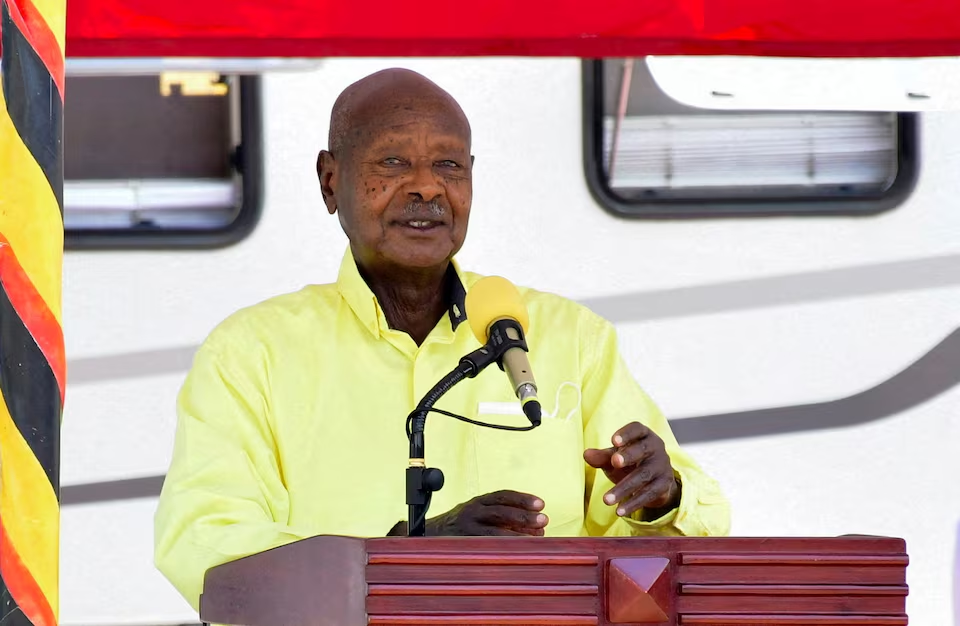
Ugandans cast their ballots on Thursday in a tightly controlled and highly charged national election, as President Yoweri Museveni sought to extend his nearly four-decade rule amid security crackdowns, an internet shutdown, and widespread delays at polling stations.
The vote pits the 81-year-old incumbent against several challengers, most notably opposition leader and pop star Bobi Wine, in an election seen as a critical test of Museveni’s political dominance and Uganda’s stability at a time of rising unrest across East Africa.
Museveni, who has ruled since 1986, campaigned on preserving stability and economic progress, pledging to “protect the gains” of his long tenure and steer Uganda toward middle-income status. His government has emphasized peace and continuity, even as questions intensify about succession and democratic space.
Analysts say Museveni is widely expected to win, but the vote is closely watched for signs of public dissent in a country where frustration over unemployment and the cost of living is growing, particularly among young people.
Bobi Wine, 43, whose real name is Robert Kyagulanyi, has positioned himself as a voice for marginalized and younger Ugandans. Nicknamed the “Ghetto President,” he has drawn support from voters angered by limited economic opportunities in a nation with one of the world’s youngest populations — the average age is just over 16.
Security forces have repeatedly disrupted Wine’s rallies during the campaign. At least one person was killed and hundreds of his supporters were arrested after police opened fire at opposition events, according to rights groups and local media.
Polling began under heavy police deployment in the capital, Kampala, but reports from across the country indicated widespread delays. Uganda’s NTV said many polling stations failed to open on time due to malfunctioning biometric voter verification machines, despite an official start time of 7 a.m. local time.
Earlier in the week, authorities shut down internet access nationwide, citing concerns over election-related “misinformation.” The move drew criticism from civil society groups and forced many Ugandans to rely on an offline messaging app developed by Twitter co-founder Jack Dorsey to communicate.
At a polling station in Kasangati, north of Kampala, voter Ronald Tenywa, a 45-year-old university researcher, expressed frustration with Uganda’s political culture.
Read Also: Uganda Restricts Starlink Imports Ahead Of January Election
“Leaders here cling on for too long,” he said after voting. “If we elect someone who truly cares, the country can move forward.”
Beyond Wine, six other opposition candidates are challenging Museveni, while voters are also electing more than 500 members of parliament. Polls are scheduled to close at 4 p.m., with preliminary results expected within 48 hours.
Museveni’s previous election victory in 2021, when he defeated Wine with 58% of the vote, was condemned by the United States as neither free nor fair. Similar criticism appears unlikely this time after U.S. diplomats were instructed last year not to comment publicly on the integrity of foreign elections.
Uganda remains a key Western ally in the region, contributing troops to peacekeeping missions in Somalia and hosting millions of refugees from neighboring countries.