
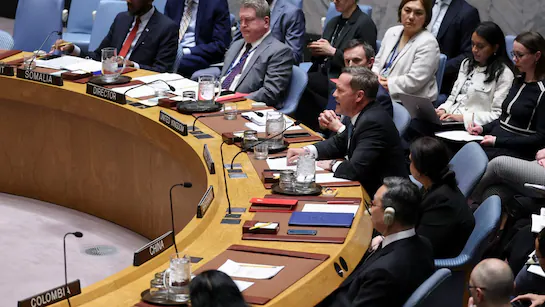
The United Nations Security Council convened an emergency session on Thursday to address the deadly unrest unfolding in Iran, as tensions sharpen over repeated warnings by United States President Donald Trump that military intervention remains an option.
During the closed-door meeting, Iran’s deputy ambassador to the United Nations, Gholamhossein Darzi, rejected claims that Tehran was seeking confrontation, while accusing Washington of playing an active role in fueling instability. He told council members that Iran had no desire to escalate the crisis, but would respond if attacked.
“Any act of aggression, whether direct or indirect, will be met with a decisive, proportionate and lawful response under Article 51 of the UN Charter,” Darzi said, adding that responsibility for any fallout would rest with those who initiated such actions.
The U.S. delegation took a sharply different tone. Speaking for Washington, Ambassador Mike Waltz criticized Iran’s handling of the protests and pointed to the nationwide internet shutdown as a deliberate effort to obscure the scale of the crackdown. He said Iranians were demanding freedoms unseen in the country’s modern history and dismissed Tehran’s claims of foreign orchestration as evidence of fear within the ruling establishment.
Waltz avoided direct reference to Trump’s recent military threats, which the president appeared to soften in the hours leading up to the meeting.
Read also: France Greenland Deployment Follows Macron Emergency Talks
The council also received a briefing from UN Assistant Secretary General Martha Pobee, who described the demonstrations as having rapidly transformed from economic protests into nationwide upheaval marked by significant loss of life. She said the unrest began on December 28, 2025, when traders at Tehran’s Grand Bazaar protested the collapse of the national currency and rising inflation, grievances that quickly broadened amid worsening living conditions.
Pobee said human rights monitors had reported mass arrests, with estimates exceeding 18,000 detainees by mid-January, though the United Nations could not independently verify the figures. She urged Iranian authorities to ensure humane treatment of detainees, halt any executions linked to protest cases, and conduct transparent investigations into all deaths.
Iran’s Foreign Minister Abbas Araghchi publicly denied allegations of planned executions, telling Fox News that capital punishment for protesters was not under consideration.
The meeting also featured testimony from Iranian civil society representatives, including journalist Masih Alinejad, who called for concrete international action against those ordering violence. Addressing Iranian officials directly, she said she had survived multiple assassination attempts for amplifying the voices of victims inside the country.
The emergency session followed new U.S. sanctions targeting senior Iranian officials, including Ali Larijani, head of the Supreme National Security Council, whom Washington described as architects of the government’s response to the protests. Iran remains under extensive sanctions, pressures that have deepened the economic crisis now driving the unrest.