
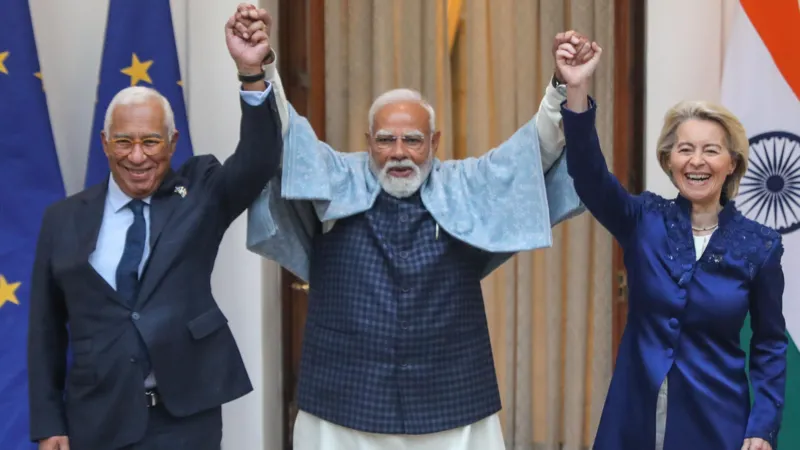
India and the European Union have agreed on a sweeping free trade agreement, ending nearly two decades of intermittent negotiations and creating one of the world’s largest trading partnerships as both sides seek economic stability amid rising global trade tensions.
The agreement, announced Tuesday in New Delhi, will liberalize trade in goods and services between the EU’s 27 member states and the world’s most populous country, covering a combined market of roughly two billion people and nearly a quarter of global GDP.
European Commission President Ursula von der Leyen, speaking alongside Indian Prime Minister Narendra Modi, described the pact as transformative. “We delivered the mother of all deals,” she said, highlighting the scale of market access and tariff reductions involved. Modi called the agreement “historic,” saying it would expand opportunities for Indian exporters and manufacturers.
The India–EU trade deal is the largest free trade agreement ever signed by India, according to New Delhi, and one of the EU’s most ambitious accords with an emerging economy. It comes at a time when both sides are navigating economic uncertainty and strained trade relations with the United States.
Read Also: EU India Car Trade Deal Opens Market To European Automakers
According to the European Commission, the deal will eliminate or sharply reduce tariffs on most EU exports of chemicals, machinery, electrical equipment, aircraft, and spacecraft, following phased implementation. Tariffs on passenger vehicles—currently as high as 110%—will fall to 10% under a quota of 250,000 vehicles, significantly exceeding concessions India offered in its recent UK trade agreement.
India, in turn, will gain preferential or duty-free access for the majority of its exports to the EU, including textiles, leather goods, marine products, handicrafts, gems, and jewelry, the government said in a statement.
Beyond industrial goods, India agreed to cut tariffs on European wine, beer, and olive oil, while carefully shielding politically sensitive sectors such as dairy, cereals, poultry, and select agricultural products.
Read Also: Britain, EU Nations Stripped Of Measles-Free Designation
Officials in Brussels said the agreement would also strengthen investment flows, supply-chain integration, and regulatory cooperation, making it easier for European companies to expand operations in India.
A separate mobility framework was agreed to alongside the trade pact, easing short-term travel and professional movement between India and EU member states.
“This will make access to European markets easier for India’s farmers and small businesses,” Modi said, adding that the deal would also boost manufacturing, services, and innovation partnerships.
The agreement was finalized against a backdrop of escalating trade frictions involving Washington. India continues to face 50% U.S. tariffs imposed last year under President Donald Trump, while the EU has clashed with the U.S. over trade and geopolitical issues, including Greenland.
Without directly naming the United States, European Council President António Costa said the pact sent a clear message. The deal, he said earlier this week, shows that India and the EU “believe more in trade agreements than in tariffs.”
Von der Leyen framed the agreement as a broader geopolitical signal. Calling India and the EU “two giants,” she said their partnership demonstrated that cooperation—not protectionism—was the best response to global challenges.
The agreement must still be formally signed and ratified by the European Parliament and EU member states, a process expected to conclude later this year. While some recent EU trade deals have faced political resistance, experts say the India pact is less contentious because it balances sensitivities on both sides.