
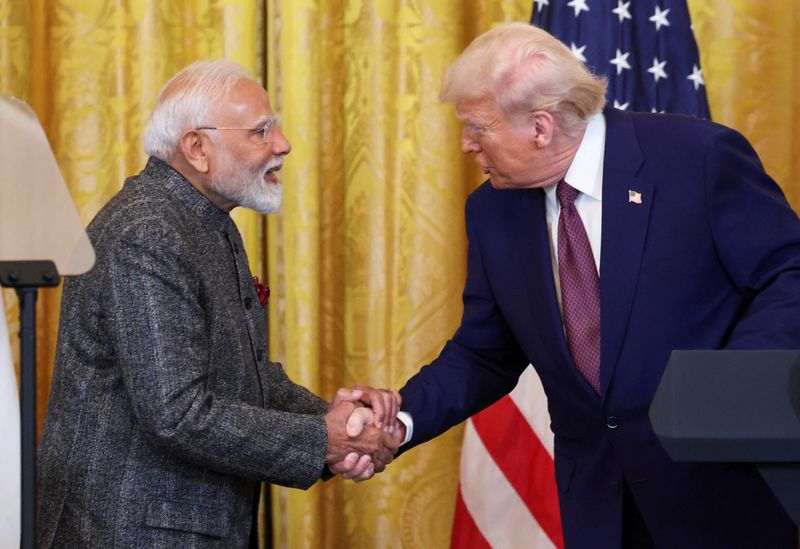
The United States has agreed to cut tariffs on Indian goods to 18% from 25% after President Donald Trump and Indian Prime Minister Narendra Modi reached a new trade deal, easing months of trade tensions between the two countries.
Trump announced the agreement on Monday in a post on his Truth Social platform, saying the deal followed a phone call with Modi that covered trade relations and the ongoing Russia–Ukraine war.
Under the agreement, Washington will remove an additional 25% penalty it had imposed on Indian goods over New Delhi’s continued purchases of Russian oil, according to Trump and U.S. officials. The move lowers the effective tariff rate to 18%.
A White House official confirmed to the BBC that the Russia-linked penalty would be dropped as part of the deal.
Trump said Modi committed to ending India’s imports of Russian oil and shifting purchases toward the United States and potentially Venezuela.
“He agreed to stop buying Russian oil, and to buy much more oil from the United States,” Trump wrote, adding that the Indian leader had also pledged to reduce India’s tariffs and non-tariff trade barriers to zero.
Read Also: UK Ex-Ambassador Mandelson Quits Labor Over Epstein Links
Trump said the agreement includes a pledge by India to buy more than $500 billion worth of American goods, spanning energy, agriculture, technology, and coal products.
Modi welcomed the announcement, describing the deal as a milestone for bilateral ties.
“Big thanks to President Trump on behalf of the 1.4 billion people of India for this wonderful announcement,” Modi said in a post on X.
“When two large economies and the world’s largest democracies work together, it benefits our people and unlocks immense opportunities for mutually beneficial cooperation.”
The U.S.–India trade relationship has been under strain since August, when Washington imposed tariffs of up to 50% on Indian exports—the highest rate applied to any Asian country—citing trade imbalances and India’s purchases of Russian oil.
Read Also: Judge Orders ICE To Free 5-Year-Old Child & Father
Those measures led to a sharp drop in Indian exports to the United States, prompting New Delhi to accelerate talks with other partners.
Less than a week ago, India and the European Union announced a sweeping free trade agreement aimed at cutting duties on nearly all goods traded between India and the 27-nation bloc. European Commission President Ursula von der Leyen described the deal as “the mother of all deals,” with the EU projecting that exports to India could double by 2032.
Market reaction to the Washington–Delhi agreement was positive, with U.S. stocks edging higher following Trump’s announcement.
Some analysts said the deal helps Washington reassert its influence in global trade negotiations.
Terry Haines, founder of policy analysis firm Pangaea Policy, said the agreement counters perceptions that the EU was moving ahead of the U.S. on trade.
However, U.S. small businesses voiced concern. We Pay the Tariffs, a coalition representing about 800 American companies, criticized the deal for locking in higher import costs.
“Before these tariffs, American importers paid an average of 2.5% on goods from India,” said Dan Anthony, the group’s director.
“This ‘deal’ locks in a rate six times higher. That’s not relief—it’s a permanent tax hike.”
Details of the agreement, including implementation timelines and enforcement mechanisms, have yet to be released. Officials on both sides are expected to finalize technical aspects of the deal in the coming weeks as India and the U.S. seek to stabilize trade ties amid shifting global alliances.