
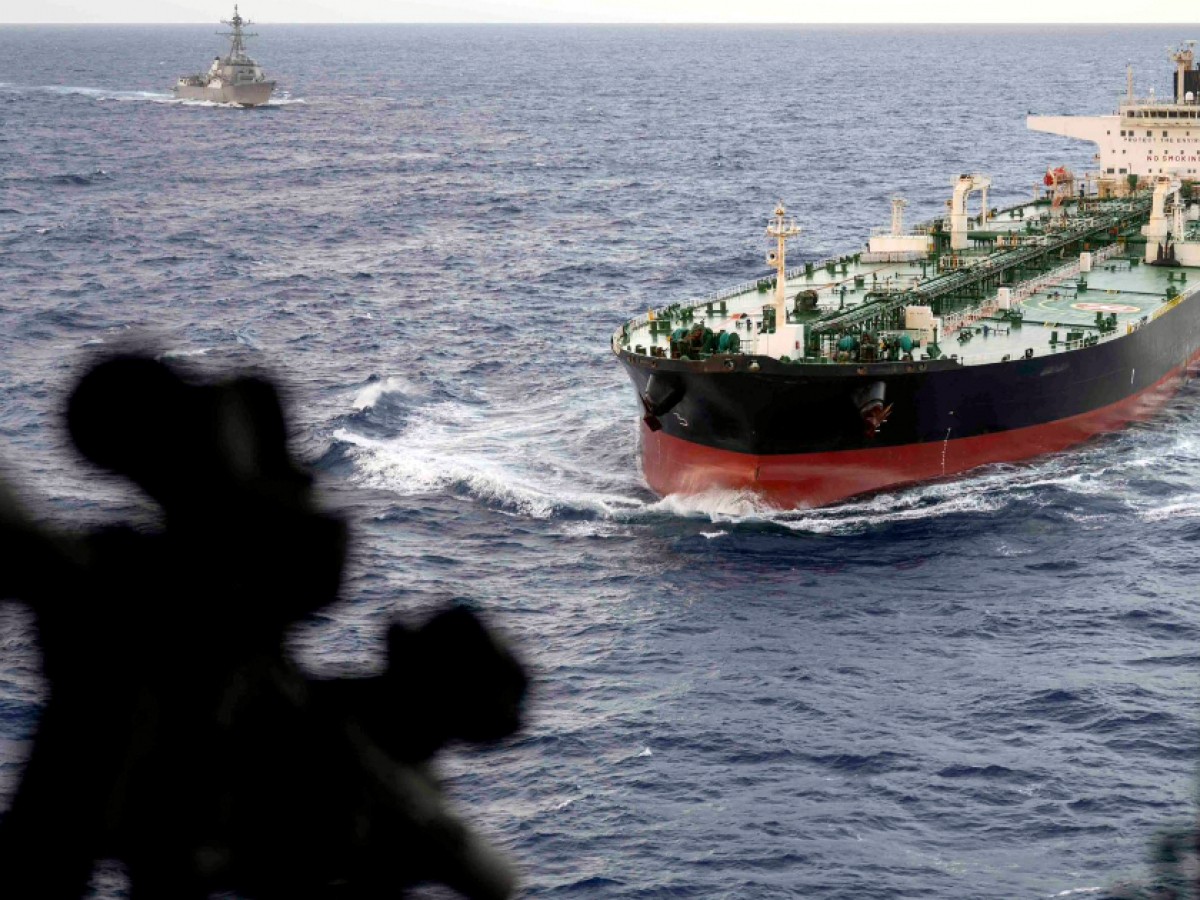
U.S. military forces have boarded the oil tanker Aquila II in the Indian Ocean after a prolonged pursuit that began in the Caribbean Sea, the Pentagon said Monday, in the latest escalation of Washington’s efforts to enforce sanctions on vessels tied to illicit oil shipments
In a brief statement posted on X, the U.S. Department of Defense said its forces carried out a “right‑of‑visit, maritime interdiction and boarding” on the vessel “without incident.” The department did not disclose whether the ship had been seized or provide public details on the precise location of the interdiction beyond identifying the general maritime region.
Defense Secretary Pete Hegseth described the operation as a long‑range tracking mission, saying the military had pursued the tanker from the Caribbean to the Indian Ocean. In his post, he said the Aquila II “ran, and we followed,” asserting that the vessel was operating in defiance of a U.S. “quarantine of sanctioned vessels in the Caribbean.”
The interdiction marks the furthest from the Western Hemisphere that U.S. forces have publicly reported boarding a vessel suspected of sanctions evasion in recent months. The Aquila II is a Suezmax‑class oil tanker that analysts and industry trackers have identified as part of what is commonly referred to as the global “shadow fleet” of vessels that obscure their identities, cargoes or movements to evade sanctions.
Read Also: ISIS: US Military Confirms Troop Deployment To Nigeria
According to automatic identification system (AIS) data and industry tracking groups, the Aquila II departed Venezuelan waters in early January as part of a flotilla of tankers after U.S. forces captured then‑President Nicolás Maduro on Jan. 3 in a military operation in Caracas. Although the Pentagon has not publicly linked the ship’s movements to Venezuela’s state oil company, PDVSA schedules showed the vessel had loaded approximately 700,000 barrels of heavy crude intended for delivery to Asia. Most of the flotilla’s tankers either returned to Venezuelan ports or have since been intercepted by U.S. forces.
Maritime tracking data shows the Aquila II is registered under the Panamanian flag and is sanctioned by the United States for its role in transporting Russian oil, which itself is subject to extensive Western sanctions following Moscow’s invasion of Ukraine in 2022. The ship has been documented spending much of the last year with its radio transponder turned off — a tactic known as “running dark” that is frequently used by vessels seeking to conceal their location or activities.
At the time of the boarding, data transmitted from the tanker indicated it was not carrying crude oil, U.S. officials said. Independent analysts said it was not immediately clear whether the vessel had offloaded its cargo elsewhere or was en route to rendezvous with another ship.
The operation underscores the Trump administration’s increasingly assertive enforcement strategy against what U.S. officials describe as illicit oil trafficking networks tied to sanctioned states and actors. Since late 2025, U.S. forces have publicly interdicted multiple vessels alleged to be carrying Venezuelan or other sanctioned crude, sometimes pursuing them across vast distances. Those actions have been framed by Washington as part of broader efforts to choke off key revenue streams for governments it considers hostile and to bolster enforcement of its sanctions.
Read Also: US Says It Shot Down Iranian Drone Near Aircraft Carrier
Under international law, warships and other government vessels may board foreign ships on the high seas under specific conditions, including with consent or where a right of visit is established by treaty or customary practices. The details of the legal rationale invoked by the U.S. for this operation beyond its sanctions regime have not been made public. No foreign government has issued an immediate statement on the boarding.
Analysts note that multinational sanctions regimes targeting Russian and Venezuelan oil shipments have added complexity to maritime enforcement, with overlapping lists of flagged entities and differing interpretations of international maritime statutes.
The Aquila II case also highlights long‑standing tensions around Venezuela’s oil export infrastructure and global crude markets. Venezuelan heavy crude has for years been marketed to buyers in Asia, including China and India, through intermediaries or vessels that obscure true ownership or cargo origins to skirt U.S. and European Union sanctions. Some of these vessels have been sanctioned by multiple jurisdictions, including the United Kingdom, Canada and Ukraine, as part of coordinated attempts to curb sanctioned crude flows.
Shipping industry sources say that “shadow fleet” tankers often employ false flags, spoofed AIS signals, and other techniques to conceal their operations and evade enforcement. They also frequently transfer cargoes at sea or meet other ships in remote maritime zones to mask cargo origins, complicating tracking and legal enforcement.
The Trump administration has indicated that intercepted vessels could be used to generate revenue, potentially by selling seized cargoes to support economic recovery efforts in Venezuela and other sanctioned jurisdictions. Officials said similar actions have been part of a larger policy to disrupt what they describe as systemic sanctions evasion. However, the formal disposition of the Aquila II — whether it will be seized, escorted to a U.S. port or otherwise handled — has not been publicly announced.