
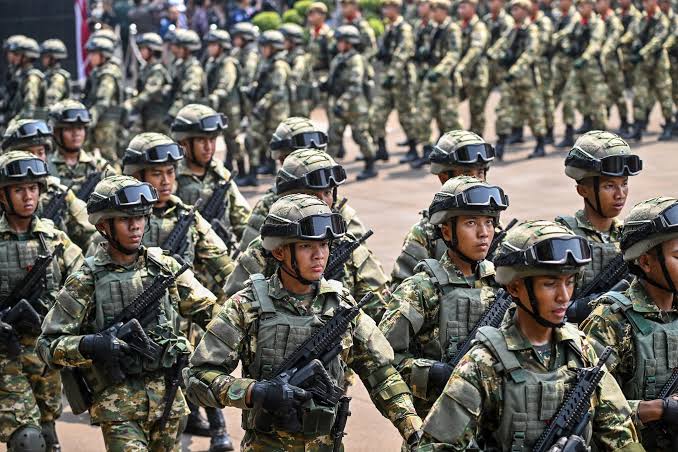
Indonesia is considering the deployment of several thousand troops to Gaza as part of a proposed multinational peacekeeping effort linked to a United States–backed initiative, a move that would make Southeast Asia’s largest country the first to publicly signal readiness to contribute forces to the mission.
The Indonesian army’s chief of staff, General Maruli Simanjuntak, said on Monday that preliminary planning was under way for a potential deployment of between 5,000 and 8,000 personnel, likely organised at the level of a single brigade. He stressed that the proposal remained provisional and that no final decision had been taken on troop numbers, timing or operational scope.
“Nothing is set in stone yet. So, the numbers aren’t final,” Maruli said, adding that any Indonesian contingent would focus on humanitarian assistance and reconstruction rather than combat activities. He did not specify where in Gaza the troops might be stationed or under what command structure they would operate.
Maruli’s comments followed a meeting at the presidential palace in Jakarta attended by President Prabowo Subianto, senior military officials and national police leaders, according to Indonesia’s state news agency Antara. The discussions coincided with confirmation that Prabowo had received an invitation from Washington to attend the inaugural meeting of what the United States has described as a “Board of Peace” for Gaza, scheduled for Feb. 19.
Indonesia’s State Secretary, Prasetyo Hadi, acknowledged the invitation on Monday but said it was not yet clear whether the president would travel to the meeting. “No information yet,” Prasetyo told reporters. “We will announce if there is certainty.” He added that Jakarta hoped any visit to the United States could also provide an opportunity to advance talks on a bilateral trade agreement.
Read also: Indonesia West Java Landslide Death Toll Rises To 49
The proposed troop deployment is tied to broader international discussions about stabilising Gaza following the current phase of the conflict. The Board of Peace, according to officials, was conceived as a mechanism to coordinate post-conflict reconstruction and security arrangements, including the possible establishment of a Gaza International Stabilization Force (ISF) under a United Nations mandate.
Indonesia has been positioning itself as a potential contributor to such a force for several months. In November last year, the Indonesian Armed Forces began screening personnel for possible deployment to Gaza, pending a final decision by the government and the outcome of deliberations at the UN Security Council. Military spokesperson Major General Freddy Ardianzah said at the time that candidates were being vetted based on prior experience in humanitarian and peacekeeping operations, both domestically and overseas.
Jakarta is one of the largest contributors to UN peacekeeping missions globally, with Indonesian troops serving in multiple conflict and post-conflict zones. Speaking at the UN General Assembly in September last year, Prabowo said Indonesia was prepared, in principle, to deploy as many as 20,000 peacekeepers to Gaza if requested under an international mandate, underscoring what he described as Indonesia’s long-standing commitment to UN peace operations.
US officials have said a future stabilization force for Gaza could involve up to 10,000 personnel drawn from multiple countries, according to reporting by The Wall Street Journal. Several regional states, including the United Arab Emirates, Egypt, Qatar and Azerbaijan, have been cited as weighing possible contributions. Other US allies in the Middle East, such as Saudi Arabia and Jordan, have publicly ruled out sending troops under any circumstances.
Read Also: Indonesia Plane Crash: Wreckage Found On Mountain
Despite Indonesia’s stated willingness, senior officials have emphasised that participation would be conditional. On Feb. 3, Foreign Minister Sugiono said the government reserved the right to withdraw from the initiative if its direction diverged from Indonesia’s core objectives. Those priorities, he said, included an immediate cessation of violence in Gaza, progress toward broader peace in Palestine, and, ultimately, Palestinian independence and sovereignty.
“If it does not match what we want, we could withdraw,” Sugiono told reporters, outlining the criteria Jakarta would use to assess continued involvement.
Domestic considerations have also featured prominently in the government’s deliberations. Earlier this month, Prabowo met with Muslim leaders and representatives of several Islamic organisations at the presidential palace to discuss Indonesia’s potential role in the Board of Peace and its implications for the Palestinian cause. According to officials familiar with the meeting, several organisations expressed support for engagement, though no formal endorsement was announced.
Indonesia does not have diplomatic relations with Israel and has consistently backed Palestinian statehood in international forums. Any overseas military deployment linked to Gaza would therefore be closely scrutinised at home, particularly if it were seen as aligning too closely with US policy or falling short of UN authorisation.
For now, key elements of the plan remain unresolved. Indonesian officials have not confirmed whether the proposed force would operate explicitly under a UN flag, how long a deployment might last, or what legal framework would govern the presence of foreign troops in Gaza. The government has also not said whether parliamentary approval would be required before troops could be sent.