
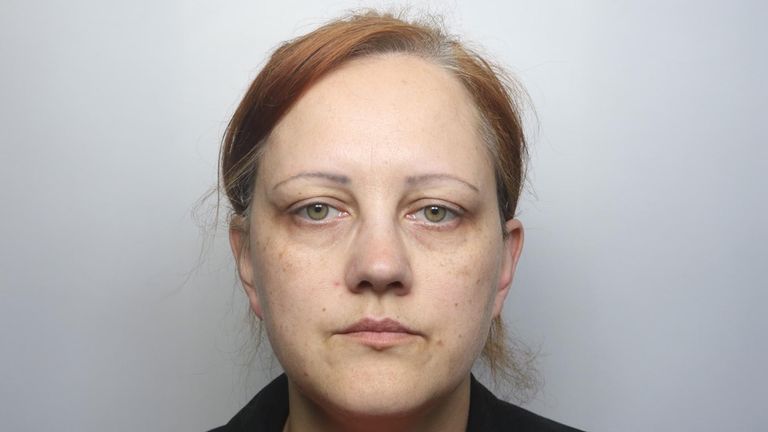
A butcher who murdered her girlfriend, dismembered the body and buried the remains under concrete in their garden was sentenced to life in prison Wednesday with a minimum of 20 years and 116 days before parole eligibility, ending a case that left a daughter searching for answers about her mother’s disappearance for 15 years.
Anna Podedworna, 40, killed Izabela Zablocka with a horse figurine in August 2010 before using her professional skills as a turkey butcher to cut the 30-year-old mother’s body in half, bind her legs with electrical tape, wrap the remains in bin bags, and bury them beneath concrete hardstanding in the garden of their Derby terrace house. A jury at Derby Crown Court convicted Podedworna Tuesday of murder, preventing a lawful burial, and perverting the course of justice after a three-week trial during which she claimed self-defense.
Mrs Justice Heather Williams, delivering sentence Wednesday, told Podedworna she murdered her partner “in anger and frustration rather than when you were attacked by her” and subjected Zablocka’s daughter Katarzyna to “untold misery and trauma” by concealing what happened. “Your crimes and Izabela’s gruesome fate only came to light in 2025,” the judge said. “As a result of your violent, manipulative and cruel actions, Katarzyna grew up not knowing what happened to her beloved mother. Your actions caused untold misery and trauma to Izabela’s family who were left with no idea where she was or what had befallen her.”
Zablocka, who presented as male but could not afford gender reassignment surgery, a source of tension between the couple, was reported missing after losing contact with family in Poland following a phone call to her mother August 28, 2010.
Polish authorities launched appeals and searched for her while devastated relatives believed she had simply vanished, unable to comprehend why a loving mother would abandon her young daughter without explanation or contact on birthdays and holidays.
Read Also: Jimmy Lai Receives Two-Decade Sentence In HK Case
The truth remained hidden until mounting pressure caused Podedworna to “crack” last year when a Polish television journalist flew to the United Kingdom to interview her about Zablocka’s disappearance, prosecutor Gordon Aspden told jurors. In May 2025, Podedworna emailed Derbyshire Police initially saying she wished to provide information before later telling officers where the body was buried. In June, authorities discovered severely decomposed human remains under concrete in the garden of 113 Princes Street in Normanton, the address Podedworna and Zablocka shared after moving from Poland in 2009. DNA testing confirmed the remains belonged to Zablocka.
Forensic analysis showed the body had been dismembered with considerable force required to sever the spine, placed in two plastic bin liners, and buried in what investigators described as a “filthy, makeshift grave” before being covered with concrete, actions that unfolded over several days according to evidence presented at trial. Electrical tape bound Zablocka’s legs together “like a chicken you would see in the supermarket,” the court heard, demonstrating methodical efforts to conceal the crime rather than panic following an accidental death or legitimate self-defense killing.
Podedworna worked at Cranberry Foods poultry factory in Scropton, Derbyshire, where her duties involved skinning, deboning, and portioning turkey carcasses using large knives. Employment records showed she took two weeks off work immediately after Zablocka’s final contact with her mother, time prosecutors argued she used to dismember and bury the body, then clean the property and establish a false narrative about her partner’s whereabouts.
Testifying through a Polish interpreter, Podedworna claimed Zablocka was “angry” on the day of her death and grabbed her before attempting strangulation. She said she struck Zablocka with the horse figurine in self-defense, believing her partner was going to kill her, then checked for a pulse and attempted resuscitation before accepting she was dead. “I was just terrified, I felt fear. I thought I will bury her. I took the decision I would bury her in the garden,” Podedworna told jurors. “I wanted to pick her up whole. I just did not have the strength to pick her up. I had an idea to cut her down. It seemed the only way… to cut her into two.”
When asked why she didn’t call an ambulance or police if the death was accidental or involved self-defense, Podedworna said, “I had no witnesses and no one would believe me that I was defending myself,” an explanation prosecutors rejected as implausible given the extreme measures taken to conceal the death.
Read Also: Life Imprisonment Imposed For Failed Trump Killing Scheme
The jury heard evidence of previous violence in the relationship, including an incident in Poland when Podedworna chased Zablocka from their flat with a knife, forcing her to take refuge in her car.
Crown Prosecution Service attorney Samantha Shallow said building a murder case proved challenging given the time elapsed since death made establishing cause impossible, forensic evidence that typically shows force used to inflict injuries was unavailable due to decomposition. Instead, prosecutors relied on Podedworna’s lies to investigators, family members, and charities searching for Zablocka; the inexplicable cessation of contact by a mother who phoned her daughter every few days; the methodical concealment efforts; and evidence of prior domestic violence demonstrating jealousy, arguments, and aggression.
Digital evidence recovered from Podedworna’s phone showed internet searches in the week before she contacted police including queries for “Izabela Helena Zablocka,” “reformed murderers,” “converted murderers,” “sinners who became saints,” a Catholic prayer, and whether those with criminal records still receive Universal Credit. Messages sent to a local church asked for help interpreting dreams about a dead woman, communications suggesting guilt and fear of consequences rather than the mindset of someone who killed in legitimate self-defense, prosecutors argued.
Phone searches also revealed Podedworna using street view to examine the Princes Street address where she lived with and killed Zablocka years after the murder, along with her reactions to public appeals for information about the disappearance and conversations with Missing for Years, the Polish charity assisting the family’s search.
Katarzyna Zablocka, who was a child when her mother moved to the United Kingdom, told the court in an impact statement that she spent her entire adult life “looking for answers” about what happened. “As a young child I was incredibly close to my mother. She was my whole world so the fact she suddenly vanished from my life without a single word of explanation was a horrific experience for me,” she wrote. “This sudden void left a deep wound in my psyche that has stayed with me to this day. In my heart I always felt that my mother did not leave me on purpose. I remembered how much she loved me when I was little. It was this certainty—that I mattered to her—that gave me the strength to spend my entire adult life looking for answers—what really happened that caused our contact to break off so suddenly?”
The sentencing brings closure to one of Derbyshire’s most disturbing murder cases, though questions remain about whether additional evidence might have emerged had Podedworna not eventually contacted police or whether the crime might have remained unsolved indefinitely without the Polish journalist’s intervention that apparently triggered her confession.