
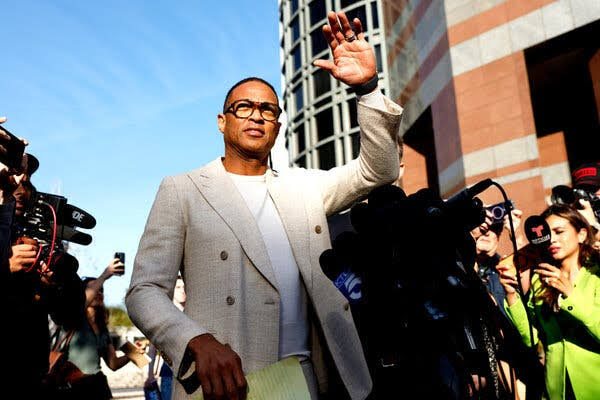
Several individuals charged in connection with a protest at a Minnesota church appeared in federal court in St. Paul on Friday and entered pleas of not guilty.
The demonstration targeted Cities Church, where one of the pastors also serves as a local Immigration and Customs Enforcement (ICE) official. Among those arraigned was journalist Don Lemon, represented by former Assistant U.S. Attorney Joe Thompson.
Lemon faces federal counts of conspiracy to violate the right of religious freedom at a place of worship and of injuring, intimidating, and interfering with the exercise of that right.
Court filings indicate the charges stem from the group’s interruption of services at Cities Church last month.
During Friday’s proceedings, Lemon’s legal team requested the return of a cellphone seized by federal authorities.
Judge Douglas Micko pressed prosecutors to expedite the device’s return, though Department of Homeland Security officials said the item remains under review as part of an active search warrant.
Two local activists, Chauntyll Allen and Nekima Levy Armstrong, also pleaded not guilty, along with two additional defendants whose names were not released.
Levy Armstrong, an ordained minister, told local media that her participation in the protest was motivated by her faith. “The reality is, as a Christian who is also an ordained reverend, in my tradition, it is important to speak up when you see injustice,” she said.
Court documents describe the group’s actions as deliberately targeting the church because of Pastor David Easterwood’s dual role as a religious leader and head of the St. Paul ICE office.
Prosecutors contend that the disruption violated the Freedom of Access to Clinic Entrances (FACE) Act, a federal statute that criminalizes interference with individuals exercising their constitutional rights to access certain facilities.
In this case, authorities have applied the law to protect the right to freely practice religion without intimidation or obstruction.
Read Also: Trump Immigration Chiefs Face Intense Congressional Spotlight
Legal experts have expressed skepticism over the application of the FACE Act in this context. Several former attorneys from the Department of Justice’s Civil Rights Division have told news outlets that the statute has not previously been used to prosecute disruption within a house of worship and may be constitutionally vulnerable.
Observers note that the case raises questions about the proper boundaries of religious freedom protections and the limits of federal enforcement.
Before the federal indictment, a Minnesota magistrate judge declined to approve a complaint charging Lemon. The decision reflected caution regarding whether the legal threshold for federal prosecution had been met.
Friday’s arraignment thus represents the formal commencement of proceedings in a case that has drawn attention for both its legal and civic implications.
Lemon, Allen, Levy Armstrong, and the two unnamed co-defendants now await further pretrial motions. Their attorneys have indicated plans to challenge the indictment on constitutional grounds, arguing that applying the FACE Act to a church protest could set a precedent with broad implications for civil and religious liberties.
The Department of Homeland Security’s seizure of Lemon’s phone has also become a focal point in pretrial discussions. Lemon’s attorneys contend that the device contains materials critical to his defense, including communications and notes relevant to his reporting and coverage of the protest.
Federal prosecutors have maintained that the phone remains part of ongoing investigative procedures and cannot yet be returned.
Independent journalist Georgia Fort, along with another individual charged in the case, is scheduled to be arraigned on Tuesday. At that time, the court is expected to enter pleas and consider additional procedural requests, including motions related to evidence and discovery.
Read Also: Minneapolis Immigration Crackdown Scaled Back By Trump Team
The protest at Cities Church involved participants entering the sanctuary during scheduled services and voicing opposition to Pastor Easterwood’s role with ICE. Court filings suggest that authorities viewed the demonstration as coordinated and aimed at directly confronting Easterwood in a religious setting, triggering the application of federal statutes designed to protect access and free exercise rights.
Federal law enforcement officials have emphasized that the charges reflect alleged conduct rather than any protected speech or journalistic activity.
“The indictment addresses specific actions that disrupted a congregation’s right to worship freely,” a spokesperson for the U.S. Attorney’s Office said, declining to elaborate on investigative details.
Observers note that while prosecutions under the FACE Act typically involve clinics or healthcare-related facilities, its language broadly protects against interference with constitutional rights, including religious exercise.
The defendants’ attorneys, however, argue that extending the statute to a church protest lacks precedent and may not withstand constitutional scrutiny if challenged.
As the case progresses, the court will address motions related to evidence, constitutional defenses, and potential dismissal.
The next scheduled proceedings will include the arraignment of Fort and the other pending defendant, with Judge Micko presiding over all initial pretrial matters.