
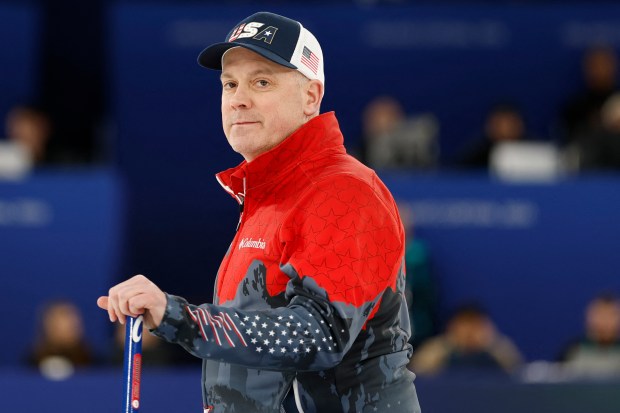
Rich Ruohonen spent nearly four decades falling just short of the Olympic dream. On Thursday, inside a curling stadium in the Italian Alps, he finally got there, stepping onto the ice at the Milan Cortina Winter Games to etch his name into U.S. Olympic history.
The 54-year-old personal injury lawyer from Brooklyn Park, Minnesota became the oldest American ever to compete in a Winter Olympics medal event when he entered Thursday’s men’s curling round-robin match against Switzerland as a substitute in the seventh end, replacing lead Aidan Oldenburg. In doing so, Ruohonen broke a record that had stood for 94 years, surpassing figure skater Joseph Savage, who was 52 years old when he competed at the 1932 Los Angeles Games, held during an era when figure skating was still classified as a summer sport.
The moment was not scripted for glory. Team USA trailed 7-2 when the substitution was made, deep in a match they would eventually lose 8-3. The scoreline was irrelevant to the man who had been chasing this moment since 1988, when curling appeared as a demonstration sport at the Calgary Games and Ruohonen first dared to imagine Olympic competition.
“I think it was,” Ruohonen said when asked if Thursday represented the best day of his life, pausing only to acknowledge the unfortunate circumstances. “It’s kind of bad under those circumstances that we’re in a loss, and I’m a team player 110 percent, but I told them, ‘Let’s just get it out of the way now so we don’t have to worry about it the rest of the way.'”
Ruohonen’s Olympic pursuit dates to Calgary and has continued unbroken ever since. “I’ve narrowly missed the Olympics numerous times, including four years ago, when my men’s team took third. I’ve had so much heartbreak,” he said.
Read Also: Ukrainian Skeleton Racer Barred from Games Over Helmet Dispute
Since 2006, he has competed in the U.S. Olympic Trials without securing a spot, accumulating a resume that includes two U.S. national championships and six national silver medals. The one thing missing was the Olympic stage itself.
His route to Milan came through an unusual invitation. Team Casper, the predominantly Gen-Z squad skippered by 24-year-old Danny Casper, added Ruohonen as an alternate after Casper was diagnosed with Guillain-Barré syndrome, a neurological condition that has required ongoing management during the Games. Rather than simply accepting a ceremonial role, Ruohonen embedded himself fully into the team’s daily operations.
He drives the younger players to morning training sessions, wakes them for early appointments, and keeps snacks stocked on the road. He also maintains a full-time legal practice throughout, handling client hearings on Zoom from hotel rooms at weekend curling tournaments, a collared shirt and tie packed in his bag specifically for those virtual appearances.
“I get up three days a week at 5 in the morning, leave my house by 5:15, go drive 30 miles to work out and train,” Ruohonen told reporters. He then heads to his law office for a full working day before returning for an evening practice session.
His teammates have made his legal career a running source of comedy. Casper introduced him to assembled media at a press conference with deadpan timing, “We got Rich. Uh, he’s a lawyer. I don’t know if you guys knew that,” after that detail had already been mentioned at least four times in the same session. The room, including members of the U.S. women’s curling team, dissolved into laughter.
The humor masks genuine affection and mutual respect. Casper was unambiguous about the decision to play him. “We’re not doing him a favor by putting him in. He deserves it,” the skip said. “They’re looking at me after that end, like, ‘Should we put him in?’ like it’s something that was not the most obvious decision ever. It was already on our mind. Glad to get him in.”
Read Also: Italy Winter Olympics Security Plan Detailed Amid ICE Role
Ruohonen reciprocated with characteristic warmth. “I love these guys. I’ve been through a lot with them. These guys are my best friends, even though I’m twice their age. They know what it meant to me to get in there, so I really appreciate everything they’ve done for me and brought me along the way,” he said.
He brought his stone cleanly to the left flank of the house on his first delivery, prompting a roar from the crowd and an audible shout across the ice from Casper. U.S. supporters rose to their feet. Ruohonen bit his lip as the stone traveled, then exhaled.
“To get here and throw two rocks is all I wanted, and it means that perseverance pays off,” he said. “All those times when maybe the luck wasn’t going my way, it went my way this time.”
He is survived in competition by a different kind of legacy. Back in Minnesota, his wife Sherri and their children Nicholas, 21, and Hannah, 24, watched. Ruohonen taught both of them to curl, as his own father taught him. His son prefers hockey. His daughter, at least, followed the stone.