
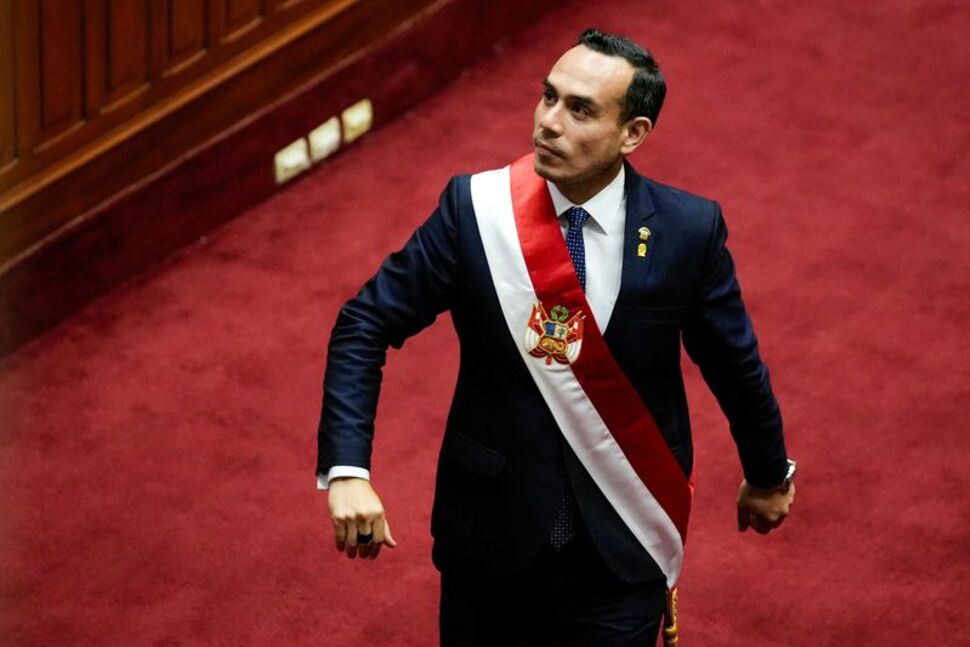
Peru’s Congress will convene a special session on the morning of February 17 to consider removing President Jose Jeri from office, legislative leader Fernando Rospigliosi announced. The session was confirmed in a statement posted to social media by the country’s legislature. The move comes as Jeri’s brief presidency, now four months old, has become engulfed by allegations of secret meetings and improper conduct.
Jeri assumed the presidency in October after Congress unanimously voted to impeach his predecessor, Dina Boluarte, citing “permanent moral incapacity.” At the time, Jeri served as congressional president, a position that placed him in line for the executive role under Peru’s succession rules.
Boluarte herself had taken office after Pedro Castillo was impeached for attempting what authorities described as a self-coup. The pattern of instability has persisted for years, with Peru cycling through eight presidents in the past decade. Several have been impeached or stepped down before completing their terms.
The controversy surrounding Jeri centers largely on what has become known as “chifagate,” a reference to chifa, the Peruvian-Chinese fusion cuisine. Local media obtained video footage showing Jeri arriving late at night at a restaurant to meet Zhihua Yang, a Chinese businessman who had previously secured government authorization to construct a hydroelectric facility.
The encounter did not appear on the official presidential schedule, a violation of Peruvian legal requirements mandating disclosure of such meetings. Jeri wore clothing that included a deep hood obscuring much of his face, prompting critics to suggest he intended to avoid recognition.
Read also: Peru Opens Investigation Into Iniesta’s $600K Fraud Claim
Additional footage emerged showing Jeri at another business owned by Yang several days afterward. Reports also indicated Jeri met with a second Chinese businessman, Jiwu Xiaodong, who was reportedly confined to house arrest for illegal activities at the time.
Jeri has offered explanations for the undisclosed encounters, describing some as planning sessions for a forthcoming Chinese-Peruvian friendship event. He characterized others as routine shopping excursions for sweets and other food items. While acknowledging the meetings constituted a “mistake,” he has rejected suggestions of criminal behavior.
“I have not lied to the country. I have not done anything illegal,” Jeri told the news outlet Canal N.
Read also: Peru’s Ousted ‘President Of Poor’ Gets 11-Yr Coup Sentence
Opposition figures and watchdog groups have accused Jeri of leveraging his office for influence-peddling through the unregistered meetings. The accusations gained momentum earlier this month when media outlets highlighted what they described as irregular hiring practices involving several women in Jeri’s administration and contracts he awarded, which critics characterized as potential evidence of bribery.
The impeachment debate arrives as Peru approaches a general election scheduled for April 12. The presidency is among the offices being contested. Jeri has indicated he will not seek to retain the position.
Under Peruvian constitutional provisions, Congress can remove a sitting president on grounds including “permanent moral incapacity,” a broadly interpreted standard that has been invoked repeatedly in recent years. The mechanism requires a two-thirds majority vote in the unicameral legislature.
Critics of the process argue the “moral incapacity” provision has been weaponized for political purposes, allowing Congress to unseat presidents without demonstrating specific criminal conduct. Supporters maintain it provides necessary accountability for executive overreach or ethical violations.
Jeri’s administration has faced additional scrutiny over policy decisions and governance challenges during his brief tenure. Economic pressures, including inflation and employment concerns, have contributed to public dissatisfaction with government performance.
The upcoming session will involve debate among legislators before any vote takes place. Congressional leadership has not disclosed how much time will be allocated for discussion or whether Jeri will be permitted to address lawmakers directly.
Peru’s political turbulence has created uncertainty for investors and complicated efforts to address long-term economic and social issues. Frequent leadership changes have disrupted policy continuity and undermined confidence in government institutions.
Regional observers have expressed concern about the pattern of instability, noting its effects on Peru’s standing within Latin America and its ability to negotiate effectively on trade and diplomatic matters.
The April election will determine whether Peru’s next president can establish greater stability or whether the cycle of short-lived administrations will continue. Multiple candidates are competing across the political spectrum, with polls showing a fragmented field and no clear frontrunner.
Rospigliosi, the congressional president who announced the special session, has not commented on his own position regarding Jeri’s removal. The outcome will depend on how individual legislators assess the evidence and arguments presented during the debate.