
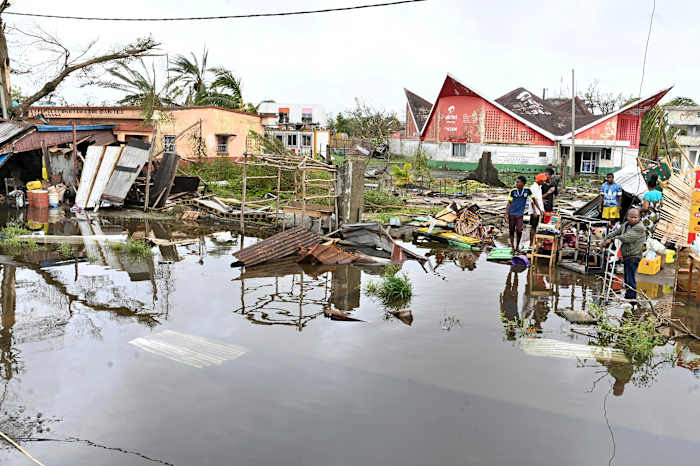
Cyclone Gezani has killed at least 59 people in Madagascar, injured more than 800, and left nearly half a million people affected across the Indian Ocean island nation, authorities confirmed Monday, as emergency teams pressed deeper into devastated communities and officials appealed for international assistance to address what the government described as an overwhelming humanitarian crisis.
Madagascar’s government declared a national emergency and said the storm caused an estimated $142 million in damage. Colonel Michael Randrianirina, Madagascar’s leader, said about 75 percent of Toamasina had been destroyed. The World Food Programme’s Madagascar director, Tania Goosens, put the figure even higher. “The scale of destruction is overwhelming in Toamasina. The authorities have reported that 80 percent of the city has been damaged,” she told reporters.
Cyclone Gezani made landfall near Toamasina on February 10 as an intense tropical cyclone, with winds of up to 250 kilometers per hour, causing severe damage across eastern and central Madagascar.
Toamasina, Madagascar’s main port city and economic hub, bore the full force of a system that meteorologists described as among the most intense ever recorded in the southwest Indian Ocean, rivaling Cyclone Geralda from February 1994, which killed at least 200 people and affected half a million more.
Drone video released by the disaster agency showed the extent of the damage in Toamasina, home to more than 300,000 people. Almost every building sustained major damage by having their roofs or other parts of the structures ripped off. Many buildings were flattened completely, while trees were stripped bare or uprooted and left lying in roads across the city. Residents waded through knee-deep floodwater as they began attempting to salvage belongings from what remained of their homes.
Authorities said 32 of the deaths occurred in the Toamasina area. The disaster agency said 17,980 houses were destroyed and more than 37,000 others were damaged. Around 600 classrooms were destroyed or severely damaged. The main road linking Toamasina to the capital, Antananarivo, was severed in multiple places, blocking humanitarian convoys from reaching affected communities in the days immediately following the storm. The scale of the catastrophe is compounding a humanitarian situation already strained by last month’s storm. Cyclone Gezani compounds existing humanitarian needs, coming just ten days after Tropical Cyclone Fytia, which caused 12 deaths, displaced over 31,000 people and affected more than 200,000 people across nine regions, damaging nearly 18,600 houses, 493 classrooms and 20 health facilities. Communities that had not yet recovered from Fytia were struck again by a far more powerful system.
Read Also: Madagascar Military-led Cabinet Appointed After Coup
The UN Central Emergency Response Fund pre-allocated $3 million to six UN agencies in Madagascar in anticipatory action financing to help partners support more than 93,000 vulnerable people among the most exposed to the cyclone. France announced the dispatch of food aid and rescue teams from its Réunion Island, about 1,000 kilometers away. Randrianirina called on Madagascar’s population to assist with recovery efforts and on international leaders to provide emergency support. “We can clearly see what Toamasina needs right now: above all, food, basic necessities, and building materials to quickly rebuild everything that has been destroyed,” he said.
Gezani did not confine its destruction to Madagascar. After crossing the island, the system moved westward into the Mozambique Channel, strengthening again before striking the southern coastal province of Inhambane. The storm lashed Inhambane with winds of up to 215 kilometers per hour, brought down trees and power lines, and left more than 13,000 people without power. Water supplies were also cut off in several districts of the city of Inhambane, home to approximately 100,000 people. At least four people were killed in Mozambique.
On Monday, meteorological authorities warned of a further threat. Forecasters at the Regional Specialized Meteorological Centre La Réunion projected that Gezani would loop back eastward and could make a second approach toward southwestern Madagascar by Monday evening. Authorities placed the Ampanihy district on red alert, though forecasters indicated the system would pass approximately 100 kilometers off the coast with significantly diminished intensity, bringing winds of around 65 kilometers per hour but no heavy rainfall.
Read Also: Deposed Madagascar Leader Stripped Of Citizenship
A red alert was issued for rivers at risk of flooding across Madagascar, with communities living along the Betsiboka, Mahavavy Sud, Onibe, Maningory, Ivondro, Rianila, and several other river systems urged to take immediate precautionary measures.
Madagascar’s exposure to cyclones is a structural feature of its geography and climate, not an aberration. The island lies in one of the world’s most active tropical cyclone basins, the southwestern Indian Ocean, and its largely poor population — more than 75 percent of Madagascar’s 31 million people live below the poverty line — has limited capacity to withstand repeated shocks. The island has been hit by more than a dozen cyclones or strong tropical storms since 2020.
Climate scientists have consistently warned that warming sea-surface temperatures in the Indian Ocean are intensifying tropical cyclones, increasing both their peak wind speeds and rainfall totals. Gezani’s rapid intensification from a tropical system on February 5 to an intense cyclone striking land just five days later is consistent with observed trends in cyclone behavior in the southwestern Indian Ocean region.
The full humanitarian picture will continue to develop for weeks as assessors reach communities cut off by infrastructure damage. With 15 people still listed as missing and assessments continuing across multiple regions, Monday’s figures of 59 dead, 804 injured, and 423,986 people affected are expected to be revised upward as data collection improves.