
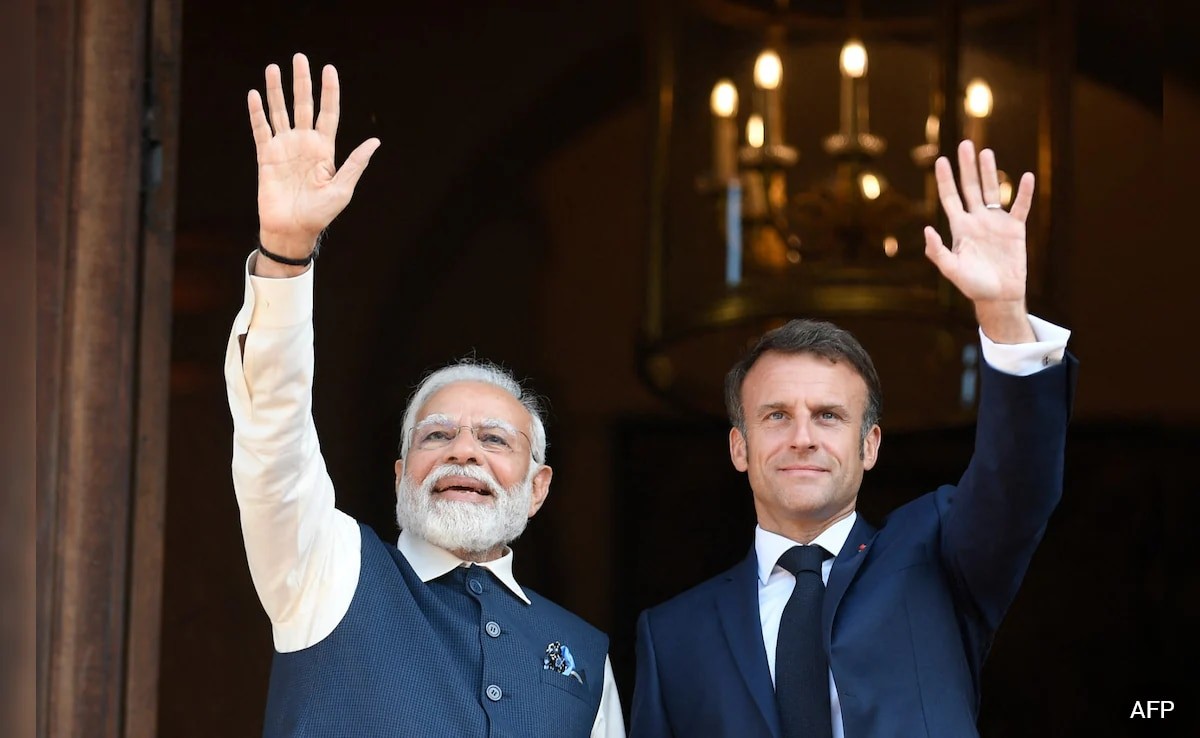
NEW DELHI — French President Emmanuel Macron is set to arrive in India on Tuesday for a three-day visit aimed at strengthening bilateral cooperation across defence, technology, and strategic sectors, officials said.
The visit comes amid efforts by New Delhi and Paris to advance their “Horizon 2047” roadmap, a long-term framework launched in 2023 to deepen collaboration on fighter jet production, nuclear energy, critical minerals, and high-tech manufacturing.
The initiative is part of broader ambitions to align France and India as strategic partners in the Indo-Pacific region.
Macron is expected to meet Prime Minister Narendra Modi to review the progress of the bilateral strategic partnership and to accelerate ongoing defence, energy, and digital initiatives under the Horizon 2047 agenda.
Officials have indicated that artificial intelligence, defence cooperation, and regional security will dominate discussions.
A focal point of the visit will be the AI Impact Summit in New Delhi, where leaders from government and industry will discuss emerging technology partnerships.
Both sides are anticipated to explore joint research projects, develop common standards for trustworthy AI, and enhance collaboration between French and Indian technology companies. India, which is positioning itself as a global technology hub, will host chief executives and policymakers from leading international firms alongside Macron.
In addition to technology, cooperation in critical minerals is expected to feature prominently.
Both countries have expressed interest in diversifying supply chains for rare earths and other essential materials, reducing dependency on China, which dominates global production.
Read Also: Macron Calls for Automatic Public Office Ban Over Racism
“Because of the nature of trust that we have and the kind of relationship that India and France enjoy, it is but natural that we will seek to cooperate in the area of critical minerals,” said Jawed Ashraf, a former Indian ambassador to France. “(We are also expected to seek cooperation) in advanced areas of green energy transition, semiconductors and AI, the building blocks of our new age.”
Defence ties between India and France are already significant. France has supplied Indian armed forces with Rafale fighter jets and Scorpene-class submarines and has agreed to transfer advanced technology for domestic production.
Last week, the Indian government approved the procurement of additional Rafale aircraft as part of a 3.6 trillion rupee (US$39.7 billion) defence package, covering multiple acquisitions across the army, navy, and air force.
The Indian Defence Ministry has not officially disclosed the number of jets to be acquired, though media reports suggest the Indian Air Force will receive 114 aircraft. Eighteen are expected to be delivered directly from French manufacturer Dassault Aviation, while the remaining 96 will be produced domestically under the government’s “Make in India” program.
Ashraf highlighted France’s openness to full technology transfers as a distinguishing feature of its defence relationship with India.
“France is willing to transfer technology and create a defence industrial base in India, which is perhaps unmatched by anyone else,” he said. “In some of the most advanced areas, like aircraft engines, they are willing to provide 100 per cent transfer of technology … and help us learn the ropes of design and development.”
Analysts say such agreements reflect the high degree of trust between the two governments.
France’s willingness to maintain a military presence in the Indian Ocean and support India’s vision of a multipolar Asia reinforces its role as a strategic European partner.
For Paris, India represents a key ally in efforts to reduce reliance on China for strategic and economic needs.
Beyond defence and technology, energy collaboration is likely to feature in Macron’s discussions. Horizon 2047 encompasses nuclear energy cooperation and renewable energy projects, including solar and green hydrogen initiatives.
Both countries have indicated that future joint projects will focus on sustainable development and high-value industrial cooperation.
Read Also: France Probes Diplomat Over Epstein Ties, UN Leaks
Macron’s visit is also seen as an opportunity to consolidate commercial and industrial links.
Officials expect agreements on joint research, technology partnerships, and critical mineral supply chains to translate into contracts, domestic manufacturing opportunities, and employment growth.
Observers note that the outcomes of Horizon 2047 will be evaluated not only in strategic terms but also in their capacity to generate tangible economic results.
The French delegation is scheduled to participate in a range of events across New Delhi over the three days, including ministerial meetings, business roundtables, and public forums linked to the AI Impact Summit.
The summit will convene technology leaders from India and abroad, underscoring the country’s ambitions to expand its global role in innovation and digital policy.
The visit underscores the broadening scope of India-France relations, which now encompass security, high technology, energy, and industrial development.
Both sides have expressed a commitment to translating the strategic vision of Horizon 2047 into concrete actions, with technology transfers, defence production, and critical minerals emerging as immediate priorities.
As Macron arrives in India, officials in both capitals will monitor the discussions closely for tangible outcomes, including agreements on defence acquisitions, technology partnerships, and joint industrial projects.