
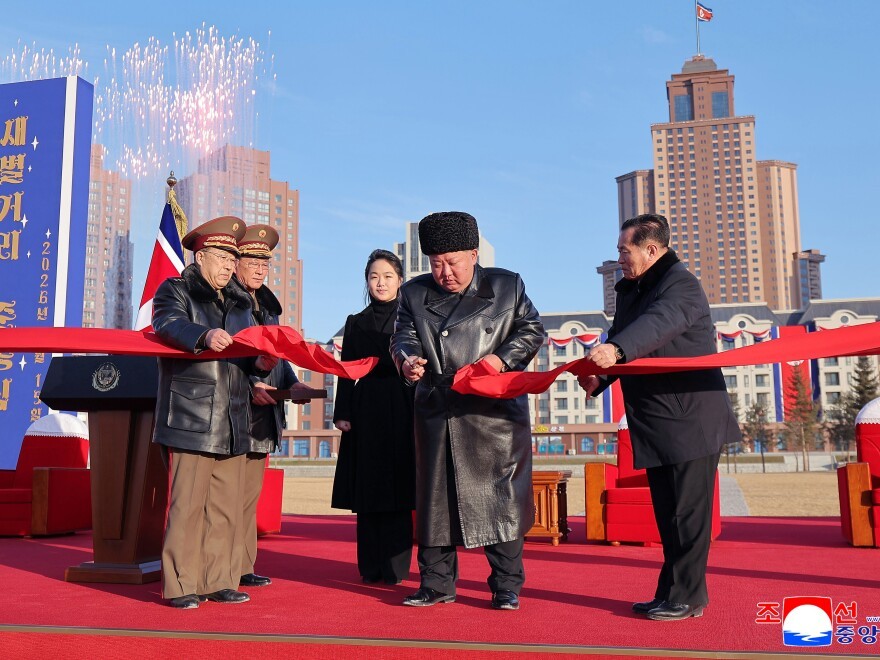
North Korea leader Kim Jong Un inaugurated a new residential district in Pyongyang on Sunday for the families of soldiers killed fighting alongside Russian forces in Ukraine, in a ceremony of state grief that the government used to cement the legitimacy of a foreign military deployment it has for months refused to officially acknowledge.
Kim pledged to repay the “young martyrs” who “sacrificed all to their motherland” as he walked through the newly completed Saeppyol Street, a name translated as “New Star Street,” accompanied by his daughter, Kim Ju Ae, who has appeared with increasing regularity at major public events as her father cultivates her public profile in what analysts interpret as a succession signal. Kim said Saeppyol Street was “a source of honour for our generation and a pride of Pyongyang and our state,” according to North Korean state newspaper Rodong Sinmun. In a speech, Kim said the new district symbolized the “spirit and sacrifice” of the dead troops, and that the homes were meant to allow bereaved families to “take pride in their sons and husbands and live happily.”
The ceremony provided state media with imagery of Kim and his daughter visiting families inside their new apartments. All reporting from the event was produced exclusively by the Korean Central News Agency. Independent journalists were not given access, and the content distributed by the North Korean government could not be independently verified.
Rodong Sinmun reported that Kim “prayed for the immortality of the martyrs along with its inauguration which will etch the martyrs’ names and images in history.” The language of martyrdom, borrowed from religious tradition and applied to fallen soldiers, is a deliberate rhetorical device that elevates the status of the dead and implicitly justifies the political decisions that sent them to a war thousands of kilometers from home.
The spy agency said it believed North Korean forces were gaining modern combat experience and Russian technical support that could improve the performance of their weapons systems, according to lawmakers who attended last week’s closed-door briefing. That assessment captures the two-sided nature of the arrangement from Pyongyang’s perspective: the deployment is not merely a commercial transaction, exchanging lives for cash and energy, but a strategic investment in military modernization that would otherwise be impossible under sanctions.
Read Also: Seoul Says Kim Jong Un Picks Teen Daughter As Heir
In addition to deploying troops, Pyongyang is thought to have shipped artillery shells, missiles and long-range rocket systems to Moscow, while receiving cash, military know-how, and food and energy shipments from Russia in return. Ukraine and its Western partners have repeatedly called on China and other third parties to pressure Pyongyang to withdraw its forces, without visible effect.
The Saeppyol Street inauguration is part of a broader campaign that has intensified in recent months as casualties mounted and the need to manage domestic perceptions of the deployment grew more acute.
North Korea has staged multiple public ceremonies in recent months to honour its war dead, including the unveiling of a new memorial complex in Pyongyang adorned with soldiers’ sculptures. A state museum commemorating the soldiers’ service has also been opened, combining the functions of heroic narrative and preventive grief management in a single institution.
Analysts tracking North Korean internal politics view the campaign as serving multiple simultaneous functions. It preemptively frames the deployment as noble sacrifice before the scale of losses can generate private questioning, provides political cover for families who might otherwise grieve without official recognition, and allows the regime to project an image of national unity and strength at a moment when its soldiers are dying in a foreign country for a foreign cause.
The Saeppyol Street ceremony comes as North Korea prepares to open a major ruling party congress later this month, at which Kim is expected to announce five-year domestic and foreign policy goals and consolidate his political authority through further institutional steps. The congress will provide an opportunity for Kim to formalize the Russia alliance and the Ukrainian deployment within the party’s ideological framework, potentially laying the groundwork for an eventual public acknowledgment of a military partnership that has been an open secret globally for many months.
Read Also: Kim Jong Un Sacks Vice Premier, Publicly Criticizes Officials
Kim Ju Ae’s prominent role in Sunday’s ceremony, visiting bereaved families in their new homes alongside her father, adds another dimension to an event already dense with political meaning. Her repeated appearances at major state ceremonies, military reviews, and now this inauguration have prompted sustained analysis of whether Kim is actively preparing his daughter for a leadership transition, though North Korean succession politics remain deeply opaque and any such process would unfold over years.
The families who received apartments on Saeppyol Street on Sunday are the public face of a grief that North Korea has transformed into an instrument of state cohesion.
Whether that transformation holds as more families join their ranks will depend on how the regime manages the continued flow of casualties from a war that shows no signs of ending.