
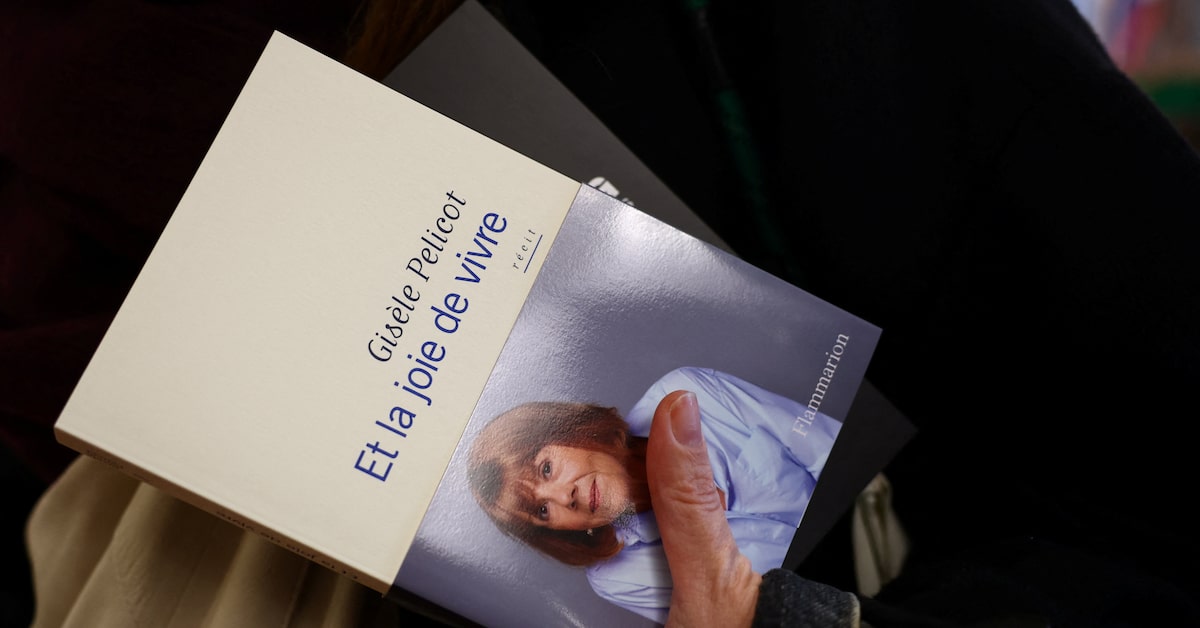
Gisèle Pelicot, who became a global symbol for sexual assault survivors after waiving anonymity during her ex-husband’s mass rape trial, released her memoir Monday recounting how she discovered Dominique Pelicot had drugged and raped her for nearly a decade while inviting strangers to abuse her unconscious body, and explaining why she chose public testimony over private anguish in a case that shocked France and prompted lawmakers to redefine rape as requiring explicit consent.
“A Hymn to Life,” published in 22 languages simultaneously, traces Pelicot’s journey from the November 2020 phone call summoning her to a police station through the devastating discovery of what her husband had done, the three-month trial that ended with convictions of all 51 defendants in December 2024, and her determination to rebuild despite unimaginable betrayal. Explaining her decision to waive anonymity, a choice that transformed what could have been a closed-door proceeding into an international reckoning with sexual violence, Pelicot wrote that keeping the trial private would have meant “no one would ever know what they had done to me.” She continued: “No one beyond those involved in the trial would see their faces, look them up and down and wonder how to pick out the rapists among their neighbours and colleagues.”
The 73-year-old recounts learning police had initially asked if she and Dominique were swingers when they called her in for questioning after a supermarket security guard caught him filming up women’s skirts. When she replied they weren’t, officers showed her images she struggled to comprehend, photographs of herself unconscious in bed with unknown men while her husband of nearly fifty years orchestrated assaults.
“The officer says a number,” Pelicot writes in the memoir co-authored with French journalist Judith Perrignon. “He tells me fifty-three men had come to my house to rape me.”
She then describes going home and hanging out her husband’s washing, a detail that captures the surreal disconnect between horror revealed and domestic routine that continued even as her world collapsed.
“I was like a dog waiting by the garden gate for its master,” she wrote, conveying how decades of trust and habit persisted even after learning the person she loved had systematically violated her body while she lay drugged and defenseless.
Read Also: Macron Calls for Automatic Public Office Ban Over Racism
Pelicot also describes the agonizing task of telling friends and especially her three children what their father had done, aware her daughter Caroline was about to “go through hell and back” as revelations emerged that Dominique had also photographed Caroline unconscious in positions suggesting possible abuse, images that fueled suspicions he assaulted his daughter though he denied it and insufficient evidence existed for prosecution.
During the trial held in Avignon from September through December 2024, Gisèle never directly addressed Dominique despite sitting meters from him in the courtroom for weeks while prosecutors presented videos he filmed showing men raping her while she lay motionless, sometimes snoring. But she wrote in the memoir that she plans to visit him in prison seeking answers to questions that haunt her. “Did you ever think, ‘I must stop’? Did you abuse our daughter? Did you commit the most abject crime of all? Do you have any idea of the hell we’re living in? … Did you kill? … I’ll ask him all these questions. I need answers; he owes me that much.”
Dominique Pelicot received the maximum 20-year sentence after admitting he drugged Gisèle with sleeping pills and anti-anxiety medication crushed into food and drinks, then recruited men through an online forum to come to their Mazan home and rape her between 2011 and 2020. The 50 other defendants, ranging from a nurse to a journalist to a firefighter, whose ages spanned 27 to 74, received sentences between three and 15 years after a trial that examined what one French newspaper called the “banality of evil” reflected in ordinary men who answered online invitations to rape an unconscious stranger.
Many defendants claimed they believed they were participating in a consensual sex game orchestrated by a libertine couple, arguments judges and prosecutors rejected given video evidence showing Gisèle clearly unconscious, the lack of any communication with her, and Dominique’s testimony that he never suggested his wife consented.
Read Also: Ex-Norwegian PM Charged With Corruption Over Epstein Ties
Pelicot says she drew strength from thousands of letters she received from women worldwide and from crowds who gathered daily outside the Avignon courthouse holding signs reading “Gisèle, we believe you” and “Shame changes sides,” the phrase she uttered at trial’s opening that became an international rallying cry. “Not long after the trial began, I started to be presented with a bundle of correspondence at the end of each day,” she wrote. “I preferred to read their letters rather than the newspapers; they gave me the chance to listen to women’s voices. How could I tell the women … that their presence outside the courtroom eased for me what was happening inside.”
The memoir also reveals Pelicot found love again with a man she met through mutual friends, a relationship she describes with cautious joy and determination not to let what Dominique did destroy her capacity for trust and intimacy. The evening she met him, she recalled, “I was light-headed with happiness.” She continues: “I needed to love again. I wasn’t afraid. … I still have faith in people. Once, that was my greatest weakness. Now it is my strength. My revenge.”
French lawmakers responded to the trial by passing legislation in December 2024 that for the first time explicitly defines rape as sex without consent, closing a loophole critics said allowed perpetrators to avoid convictions by claiming they believed victims agreed even when those victims were unconscious, intoxicated, or clearly unwilling. The new law shifts burden from requiring prosecutors to prove victims resisted or said no, to requiring evidence that affirmative consent was given, a standard sexual assault prevention advocates have demanded for years.
Pelicot was named the most noteworthy person of 2024 in a French opinion poll, eclipsing political leaders and celebrities, and Time magazine honored her as one of the year’s most influential figures. The Independent designated her the most influential woman of 2025 on International Women’s Day. France awarded her the Legion of Honor, the country’s highest civilian distinction, in recognition of her courage and the social transformation her testimony catalyzed.
The book positions her not as victim but as witness testifying to horrors that millions of women endure in silence, and as someone who refuses to allow trauma to define her future. “After what I have been through, I am an optimist,” Pelicot told interviewers promoting the memoir’s release. “My message is: you can get through anything. You can rebuild. There is life after.”