
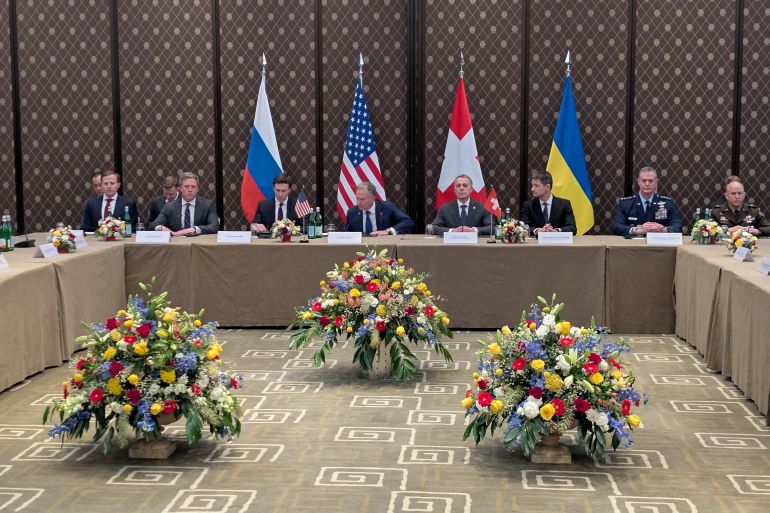
Diplomatic efforts to halt Europe’s most destructive conflict since the Second World War have again stalled, as talks between Russia, Ukraine and the United States concluded in Geneva without a substantive breakthrough. After two days of negotiations—extended late into Tuesday but lasting only two hours on Wednesday—the central fault lines remain intact: territory, sovereignty and the architecture of post-war security.
The Geneva meeting was convened amid mounting international pressure to test whether four years of full-scale war can be redirected toward negotiation. While US envoy Steve Witkoff had projected cautious optimism before the discussions, both Moscow and Kyiv signalled the difficulty of the exchange. Ukrainian President Volodymyr Zelensky described the talks as “not easy,” echoing remarks from Russia’s chief negotiator, Vladimir Medinsky, who called them “difficult” but “businesslike.”
According to a Ukrainian diplomatic source, limited progress was achieved on technical military matters, including clarification of front-line positions and potential mechanisms for monitoring a ceasefire. Yet such incremental movement does not resolve the central obstacle: the question of territory. Without consensus on borders and control, any ceasefire arrangement remains provisional at best.
Russia has maintained its demand for full control of the eastern Donbas region, comprising the Donetsk and Luhansk oblasts. For Ukraine, relinquishing those areas would amount to formalising the loss of sovereign territory seized during a war it did not initiate. The positions are not merely divergent; they are structurally incompatible.
Ukrainian negotiator Rustem Umerov characterised the Geneva sessions as “substantive and intensive,” while declining to disclose details. He acknowledged progress but cautioned that alignment among all parties would require time. His language reflected diplomatic restraint, though it underscored the absence of a tangible agreement.
Shortly before the conclusion of talks was announced, Zelensky accused Moscow of attempting to prolong discussions that, in his view, could already have reached a decisive stage. The comment signalled Kyiv’s concern that Russia may be using negotiations to consolidate military positions rather than to compromise.
The current diplomatic track follows US-brokered discussions in Abu Dhabi in January, which resulted in a prisoner exchange after several months of stagnation. Zelensky indicated that another swap may now be possible. While such humanitarian steps are significant, they do not address the strategic architecture of peace.
The Geneva initiative unfolds against the backdrop of sustained military pressure. Russian forces continue to hold territory in eastern and southern Ukraine, while Kyiv’s defensive lines remain entrenched across Donetsk. The war has produced tens of thousands of military and civilian casualties and displaced millions, reshaping Ukraine’s demographic and economic landscape.
US President Donald Trump, who has placed personal emphasis on brokering a settlement, has signalled impatience. On Monday, he urged Ukraine to “come to the table, fast.” Zelensky rejected the framing, arguing it was unfair to expect Kyiv to shoulder the burden of compromise when it is defending internationally recognised borders.
Read Also: Interim Peru President Ousted After Four-Month Tenure
The dispute over Donbas is not solely territorial; it is strategic. Ukrainian officials argue that ceding the region would leave the country exposed to renewed aggression. The fortified cities and defensive networks there function as buffers. Zelensky has drawn historical parallels to the 1938 Munich Agreement, when European powers permitted Nazi Germany to annex the Sudetenland in what was framed as a concession for peace. For Kyiv, any enforced territorial compromise carries existential risk.
In remarks to US outlet Axios, Zelensky suggested that if the question of surrendering Donbas were put to a referendum, Ukrainian voters would reject it. Public sentiment remains hardened by years of aerial bombardment and occupation. Daily missile and drone strikes continue across Ukrainian cities, reinforcing a climate of insecurity incompatible with premature concessions.
Another unresolved matter concerns the Zaporizhzhia Nuclear Power Plant, Europe’s largest. Located near the front line and under Russian control since March 2022, the facility presents both strategic leverage and international safety concerns. Kyiv insists the plant should be returned to Ukrainian control. Zelensky has previously floated the possibility of shared management with the United States, an arrangement Moscow is unlikely to accept. Control over energy infrastructure is inseparable from broader security calculations.
European governments are attempting to secure a more formal role in the negotiation process. Officials from Britain, France, Germany and Italy were present in Geneva and held separate consultations with Ukrainian representatives. European capitals have expressed frustration at being marginal to US-led diplomacy, despite bearing direct security consequences of the war. Zelensky has stated that European participation is indispensable to any final agreement, particularly in structuring long-term security guarantees.
Those guarantees are central to Kyiv’s calculus. Ukraine seeks binding commitments from Western allies to deter future Russian incursions. The form such assurances might take—whether NATO membership, bilateral defence pacts, or alternative mechanisms—remains contested. For Moscow, expansion of Western military influence near its borders has long been framed as a core grievance.
Four years after Russia’s full-scale invasion began, the structural distance between Moscow’s objectives and Kyiv’s definition of a “just peace” remains wide. Russia demands recognition of territorial gains and security buffers; Ukraine demands restoration of sovereignty and credible protection against renewed attack. Each side views concession as strategic vulnerability.
Read Also: Vatican Declines Trump’s ‘Board Of Peace’ Invitation
The Geneva talks reflect the limits of diplomacy in the absence of converging interests. Technical discussions on monitoring and front-line delineation suggest a shared recognition that military escalation carries risks. Yet peace requires more than de-escalation; it requires political settlement.
As the fourth anniversary of the invasion approaches next Tuesday, the war continues to define European security and global alignment. For Africa and the wider Global South, the conflict’s ripple effects—ranging from grain exports to energy prices—underscore the interconnectedness of regional wars and global stability.
In Geneva, negotiators described their exchanges as “businesslike.” That characterisation captures both the professionalism and the impasse. The process moves, but the destination remains obscured by irreconcilable claims.
Absent movement on territory and security guarantees, the prospect of a durable ceasefire remains uncertain. Diplomacy persists, but so does war.