
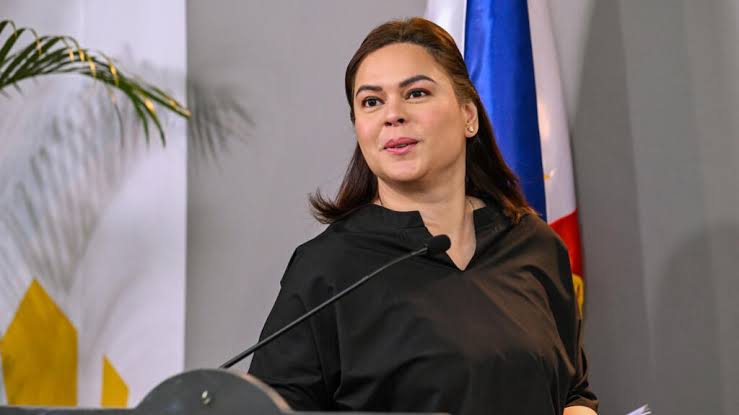
Philippine Vice-President Sara Duterte on Sunday formally announced her candidacy for the presidency in the 2028 national elections, setting the stage for an early confrontation in a contest dominated by personal political brands.
Duterte, 47, declared her bid in a statement to the public, saying: “I offer my life, my strength, and my future in the service of our nation.
I am Sara Duterte. I will run for president of the Philippines.”
The announcement comes amid a growing political rift between Duterte and current President Ferdinand “Bongbong” Marcos Jr., with whom she previously allied in the 2022 national election.
Marcos, who is constitutionally prohibited from running for a second term, has yet to nominate a candidate to run against Duterte, potentially giving her a leg up in what promises to be a highly competitive and personality-driven election.
It is not uncommon for presidential hopefuls in the Philippines to begin preparing for a campaign years in advance, despite elections being held every six years.
Duterte’s candidacy reflects the speed at which the alliance she forged with Marcos in 2022 has fallen apart.
The two ran together on a joint ticket and won a landslide victory, but their alliance has been on shaky ground as they have pursued different political agendas.
This came to a head in March 2025, when the Marcos administration allowed the International Criminal Court to detain Duterte’s father, former President Rodrigo Duterte, for crimes against humanity related to his controversial anti-drug campaign.
The elder Duterte is currently being held at The Hague, awaiting trial.
Read Also: Philippines Landfill Collapse: Cebu Death Toll Rises
The political repercussions of this decision were further exacerbated by the mid-term legislative elections held in May 2025, which were seen as a gauge of public support for the ruling administration.
Candidates supported by the Duterte family won a large number of seats, beating many Marcos-supported candidates, which indicated a change in the balance of power in the legislature in favor of the vice-president’s group.
Duterte’s term as vice-president has also been plagued by legal and political controversies. In early February 2026, several members of the Philippine Catholic clergy filed an impeachment complaint against her for corruption.
Duterte has denied these charges, claiming that they have political motivations.
Born in 1978, Sara Duterte is the eldest sibling of Rodrigo Duterte and is generally accepted as his political heir.
Rodrigo Duterte has publicly referred to her as the “alpha” of the family, indicating that she has a strong level of loyalty from both her family members and political supporters.
Sara Duterte started her political career in Davao City, where she was the vice-mayor under her father’s administration and later became the mayor.
The city has long been recognized for its tough crime-fighting policies, which the Dutertes have defended as necessary for the safety of the city’s residents and for promoting economic development.
Duterte first made headlines nationally for physically confronting a local sheriff in Davao while defending the residents of a shantytown in a televised incident.
She retained her prominent position in local politics throughout her father’s presidency from 2016 to 2022.
Her partnership with Marcos in the 2022 election was considered crucial for both politicians, who combined the power of two strong political dynasties to secure a landslide victory.
The vice-president has also created a public image that is tough and accessible.
Read Also: Philippines Jails Ex-Mayor Over Spying, Human Trafficking
She is famous for riding powerful motorcycles, giving her children unique nicknames like Sharky, Stonefish, and Stingray, as well as having tattoos similar to those of her brothers.
It is argued that this image of toughness and accessibility has helped to consolidate her position among her supporters, who see her as carrying on the political legacy of her father.
The politics of the Philippines is often marked by personality politics, and Duterte’s declaration is an indication of the early mobilization of resources and alliances that will define the 2028 election.
Marcos’ allies have not yet announced a candidate of their own, and the political landscape is still fluid.
It has been observed that declarations like Duterte’s can be a move to consolidate support among regional leaders, business groups, and national supporters before the actual filing of candidacy.
Duterte’s action also points to the continued fragmentation of the ruling coalition that won the majority of the seats in the 2022 elections.
Observers have noted that the current split is part of a larger trend in Philippine politics, where temporary coalitions tend to fall apart once elected officials begin to follow their own agendas or are confronted with competing policy choices.
As the election draws near, the vice-president is expected to use her family’s political connections and her track record in local politics to build a campaign apparatus that has a chance of competing at the national level.