
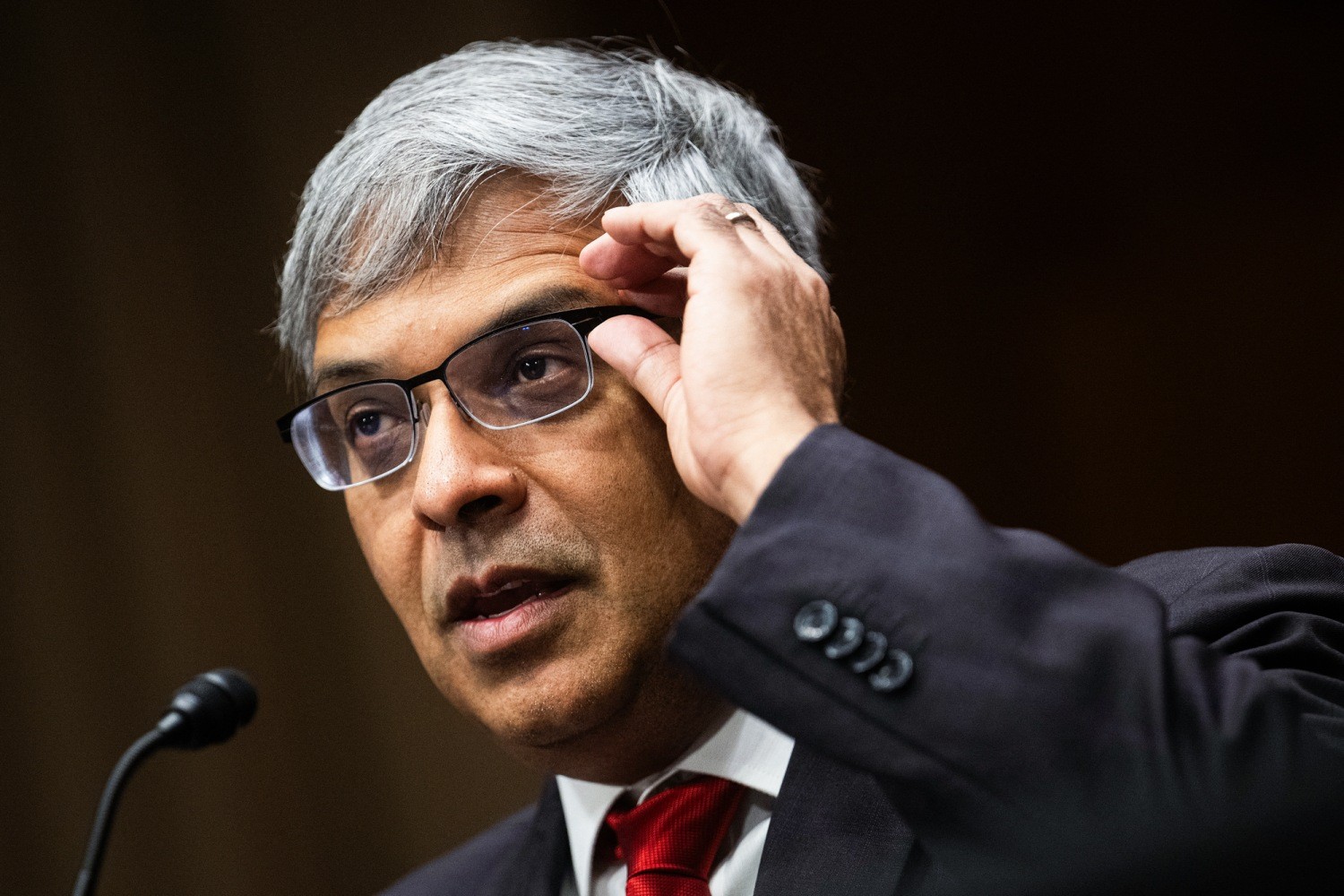
The Trump administration has appointed National Institutes of Health Director Jay Bhattacharya to simultaneously lead the Centers for Disease Control and Prevention on an acting basis, administration officials confirmed Wednesday, a dual assignment that makes him responsible for two of the federal government’s largest and most consequential public health agencies at the same time.
Bhattacharya, a former Stanford Medicine professor who gained prominence during the Covid-19 pandemic for his opposition to lockdowns, has led the NIH since April. He now takes on stewardship of the Atlanta-based CDC as well, an agency that tracks domestic and global disease threats and channels roughly two-thirds of its budget to state and local public health departments. The NIH, headquartered in Bethesda, Maryland, manages a research portfolio approaching $50 billion annually. He replaces Jim O’Neill, who had served as acting CDC director since August while simultaneously holding the post of deputy secretary of the Department of Health and Human Services, and who is now departing both roles. O’Neill is expected to be offered the directorship of the National Science Foundation. The New York Times first reported Bhattacharya’s appointment Wednesday; Politico had reported O’Neill’s departure the previous Friday.
The move lands as the CDC enters what former officials describe as its most unstable period in decades. Former CDC director Susan Monarez was fired in August after 29 days on the job. She testified before the Senate Committee on Health, Education, Labor and Pensions that HHS Secretary Robert F. Kennedy Jr. had removed her because she refused to approve vaccine guidance changes without scientific backing. Kennedy has disputed her account. Her dismissal prompted the resignations of four senior agency officials, including former chief medical officer Deb Houry and Dan Jernigan, who had led the CDC’s National Center for Emerging and Zoonotic Infectious Diseases.
The CDC’s official leadership page currently lists the director position as vacant, a designation that has effectively described the agency’s situation, in practical terms, since last summer.
The criticism of Bhattacharya’s dual mandate was immediately noted. Jernigan said the notion that the NIH director could assume responsibility for another federal agency “in his spare time is hard to understand.” Houry, who resigned in protest after Monarez’s firing, put the stakes plainly. “This puts our nation at greater risk for not being able to respond to health threats and outbreaks,” she said.
Read Also: Moderna Shares Fall As FDA Refuses Flu Vaccine Review
At NIH, a combination of terminations, resignations, and retirements has already left more than half of the agency’s 27 institutes without permanent leadership. The CDC, meanwhile, has undergone its own wave of departures under policies directed by Kennedy, who has long expressed skepticism of established vaccine science and whose appointment as HHS secretary drew sustained opposition from public health institutions.
Under O’Neill’s tenure, the CDC signed off on a major overhaul of the childhood vaccine schedule last month, reducing the number of vaccines universally recommended for all children, a change that alarmed paediatricians and public health researchers nationwide. The agency’s vaccine advisory committee had been reconstituted under Kennedy with members openly critical of vaccine policy.
Bhattacharya has sought to occupy a more moderate lane on some of these issues. He told a Senate panel earlier this month that people should get vaccinated against measles, amid the largest outbreak in the United States in decades, and said he had seen no evidence linking vaccines to autism, even as Trump and Kennedy have continued to amplify that claim.
CDC staff were not officially notified of Bhattacharya’s appointment. According to an internal statement, employees learned of their new leadership through news reporting, the same way they had learned of O’Neill’s departure.
Union representatives described morale as being at an all-time low. “The fact of the matter is, Jay Bhattacharya is Acting CDC Director in name only,” the statement read. “We know that Sec. Kennedy is pulling the strings.”
The wider HHS restructuring announced Thursday included the elevation of Chris Klomp, currently Deputy Administrator of the Centers for Medicare and Medicaid Services, to the newly created role of chief counselor at HHS, with oversight of department-wide operations. Kennedy announced additional senior counselor appointments for the Food and Drug Administration and CMS. Administration officials described the reorganisation as intended to tighten coordination between the department and the White House ahead of the 2026 midterm elections, with Republicans planning to centre their health messaging on insurance costs, prescription drug prices, and food policy.
Read Also: FDA Agrees To Review Moderna Flu Vaccine After Rejection
Federal law constrains how long Bhattacharya can serve in the acting role. He will remain in the position until a permanent CDC director is nominated and confirmed, but the 210-day statutory window triggered by Monarez’s August firing closes in late March unless Trump submits a formal nomination to the Senate. The clock does not reset with a change in acting director, though it is paused while a nomination is pending in the Senate. No nomination has been announced.