
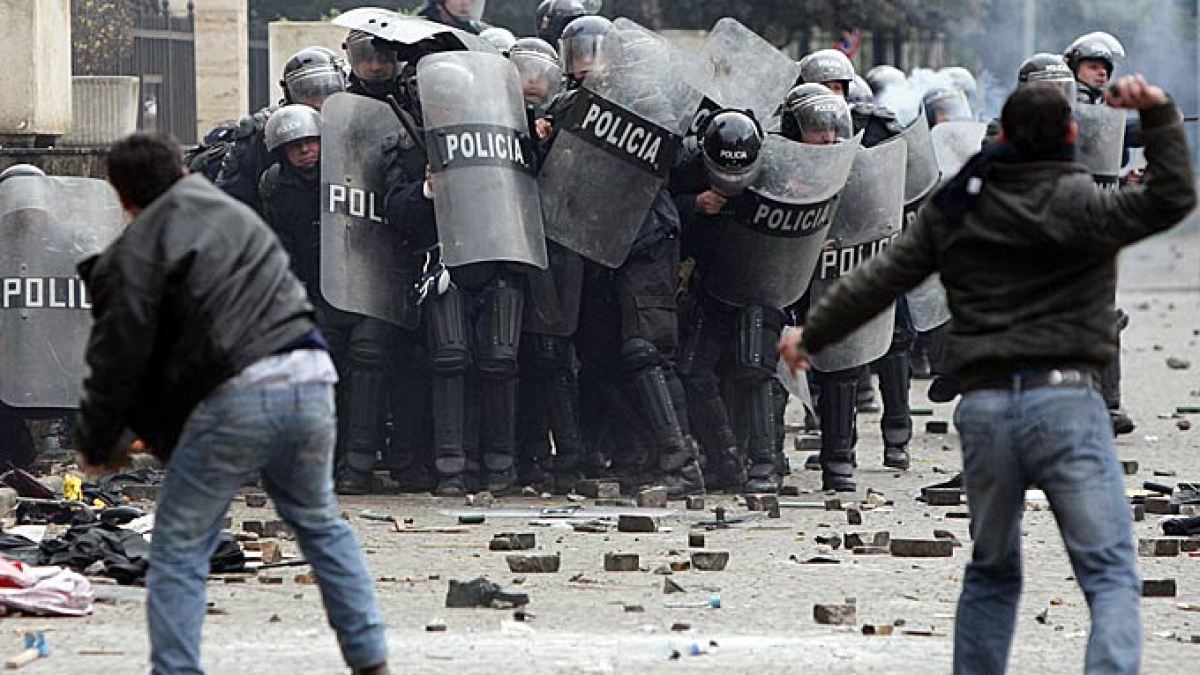
Riot police in Tirana deployed tear gas and water cannon Friday as thousands of demonstrators demanding the resignation of Prime Minister Edi Rama clashed with security forces outside the prime minister’s office and parliament.
Africa Today News, New York, gathered that protesters threw Molotov cocktails and fireworks at the office building before moving toward the legislature, where anti-riot units blocked their advance.
Street fighting in the area surrounding parliament continued for roughly two hours, according to an AFP journalist who witnessed the confrontations.
Police said approximately 30 people were arrested. The opposition Democratic Party put the number of detained supporters closer to 40.
The protests mark the latest in a series of street demonstrations that have erupted since December, when Deputy Prime Minister Belinda Balluku was indicted by a special prosecution unit. Balluku, a close ally of Rama, was suspended pending an investigation into corruption allegations. Several former ministers who served under Rama have also become subjects of corruption inquiries.
Thousands gathered Friday waving Albanian and opposition party flags, chanting “Rama, go away” and “Rama in jail.”
Sali Berisha, leader of the Democratic Party, addressed the crowd with a direct challenge to the government. “We will save Albania from Edi Rama, who has plunged the country into poverty and corruption,” he said. “Let them know that even if they go behind the sun, we will find them and punish them with the full force of the law.”
Interior Minister Albana Kociu condemned the unrest, describing the actions of protesters as “vandalism” and saying attacks on police constituted a “crime.”
Rama’s Socialist Party holds a commanding majority in Albania’s parliament after securing a fourth consecutive term in elections last year. The party has governed since 2013, weathering repeated accusations of corruption and links to organized crime — charges it has leveled back at the opposition with equal vigor.
Read also: Senegal Condemns Jail Terms For Fans Over AFCON Final
Albanian politics has been defined for years by sharp antagonism between left and right-wing factions. Both sides routinely accuse the other of malfeasance and criminal ties, a pattern that has persisted across multiple election cycles and government transitions.
Albania is pursuing European Union membership with a stated goal of accession by 2030. The corruption investigations now targeting senior officials in Rama’s administration have drawn attention from European institutions, which have repeatedly pressed Tirana to demonstrate tangible progress on judicial reform and anti-corruption measures as preconditions for advancing in the accession process.
The December indictment of Balluku followed months of scrutiny over procurement practices and contract awards within the government. Details of the specific allegations against her have not been made public, but prosecutors have indicated the probe involves irregularities in public spending and potential abuse of office.
Rama has not publicly addressed the street protests or responded to calls for his resignation. His government has maintained that the judicial process is independent and that investigations into former officials demonstrate the strength of Albania’s anti-corruption institutions.
The Democratic Party has organized multiple protests since the indictment was announced, each drawing thousands to central Tirana. Friday’s demonstration was the largest and most violent so far, with confrontations escalating after police blocked access routes to parliament.
Authorities have not disclosed whether additional security measures will be implemented ahead of future demonstrations or whether the government plans to open dialogue with opposition leaders.
Read more: Israel Caps Al-Aqsa Access To 10,000 for Ramadan Prayers
Albania has a history of political unrest tied to corruption allegations. In 2019, protests organized by the Democratic Party led to clashes with police and the resignation of several ministers.
The current wave of demonstrations follows a similar trajectory, with opposition leaders framing the movement as a fight to restore integrity to governance.
European observers have noted that sustained instability could complicate Albania’s EU accession timeline, particularly if violence continues or if the government is perceived as unable to manage internal dissent while pursuing reform commitments.