
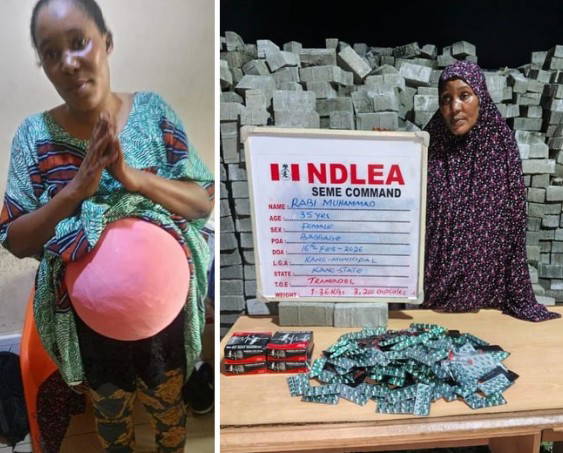
Nigeria’s anti-narcotics authorities have intercepted two high-risk drug trafficking operations in separate incidents that underscore the evolving tactics of transnational narcotics networks operating through West Africa. The National Drug Law Enforcement Agency (NDLEA) confirmed the arrest of a woman who allegedly concealed illicit substances under the guise of pregnancy, as well as the apprehension of an Ivorian national who expelled 82 wraps of cocaine after arriving at Kano’s international airport.
The incidents, which occurred at different locations, reflect the continuing pressure on Nigerian enforcement agencies as traffickers adopt increasingly deceptive methods to evade detection.
In the first case, NDLEA officers arrested a woman who had allegedly strapped packages of illegal drugs to her abdomen to simulate pregnancy. According to the agency, the concealment method was designed to exploit social assumptions and reduce scrutiny during routine checks. Officers reportedly uncovered the deception during inspection procedures, leading to her arrest.
While authorities did not immediately release detailed information about the quantity or specific type of narcotics recovered in that operation, the agency described the method as part of a broader pattern in which traffickers use elaborate disguises to bypass security controls.
In a separate operation at Mallam Aminu Kano International Airport, NDLEA operatives arrested a 66-year-old Ivorian national suspected of acting as a drug courier. The agency stated that the suspect was taken into custody after intelligence profiling and initial screening raised concerns.
Subsequent medical monitoring confirmed that the individual had ingested multiple pellets of cocaine prior to travel. Over a period of observation, the suspect reportedly excreted 82 wraps of the narcotic substance. Authorities confirmed that the recovered material tested positive for cocaine.
The use of internal concealment—often referred to as “body packing”—remains a common method among international trafficking syndicates. Couriers ingest or insert tightly wrapped narcotics to transport them across borders, a practice that carries significant health risks and often relies on vulnerable individuals recruited for financial incentives.
Read Also: Explosions In Western Ukraine Leaves Multiple Casualties
Nigeria’s geographic position and extensive aviation connections make it both a transit hub and a destination market in global narcotics routes linking Latin America, West Africa, and Europe. Kano, in particular, has emerged as a strategic entry point in northern Nigeria, given its commercial connectivity and regional trade flows.
The NDLEA has intensified airport surveillance in recent years, deploying advanced scanning technologies and intelligence-driven profiling to identify high-risk travelers. Officials have repeatedly stated that traffickers are increasingly targeting secondary airports and experimenting with unconventional concealment strategies as enforcement improves at major gateways.
The agency has not disclosed the flight origin of the Ivorian suspect or whether the cocaine was destined for domestic distribution or onward transit. Investigations are ongoing to determine potential links to broader trafficking networks.
NDLEA Chairman Brigadier General Mohamed Buba Marwa (Rtd.) has consistently emphasized a dual strategy combining interdiction with prevention and rehabilitation. The agency has recorded a series of high-profile seizures in recent months, reflecting what officials describe as an expanded operational footprint.
Drug trafficking remains a major security and public health concern in Nigeria. Cocaine flows through West Africa have increased over the past decade, according to international monitoring agencies, as traffickers exploit porous borders and uneven enforcement capacity across the region.
The arrest of a foreign national also highlights the transnational character of the narcotics trade. West African states, including Côte d’Ivoire and Nigeria, have faced growing pressure to coordinate intelligence-sharing and joint enforcement operations. Regional cooperation frameworks under ECOWAS have sought to strengthen border security and disrupt organized crime networks operating across national boundaries.
Authorities did not indicate whether additional suspects are being pursued in connection with either case. However, law enforcement analysts note that individual couriers typically operate within structured supply chains involving recruiters, financiers, and distribution contacts.
In the case involving the woman who simulated pregnancy, investigators are expected to examine whether she acted independently or as part of a coordinated operation. Similar concealment tactics have been recorded in other jurisdictions, reflecting a broader pattern of traffickers adapting to social and cultural contexts to reduce suspicion.
Medical supervision remains critical in cases involving ingested narcotics. The rupture of internally concealed drug pellets can lead to fatal overdoses. NDLEA officials have stated in previous briefings that suspects are placed under strict medical observation until all substances are safely recovered.
The agency has reiterated its call for public vigilance and community cooperation in reporting suspicious activities. It also continues to advocate preventive education campaigns aimed at discouraging participation in drug trafficking, particularly among economically vulnerable populations who may be targeted by recruiters.
Both suspects are expected to face prosecution under Nigeria’s drug control laws once investigations are completed. Convictions for trafficking offenses carry severe penalties, including lengthy prison terms.
Read Also: USA Wins First Men’s Olympic Ice Hockey Gold In 46 Years
The latest arrests reinforce the complexity of Nigeria’s anti-narcotics challenge. As traffickers refine concealment methods, enforcement agencies are compelled to match that evolution with intelligence, technology, and cross-border collaboration.
For West Africa more broadly, the incidents serve as a reminder that the region remains a contested corridor in the global narcotics economy. Sustained institutional capacity, legal reform, and regional coordination will be central to addressing the structural drivers that enable such networks to persist.
Nigeria’s enforcement authorities have signaled that they will maintain heightened surveillance at airports and land borders. Whether these measures significantly disrupt trafficking patterns will depend on continued operational consistency and cooperation beyond national frontiers.