
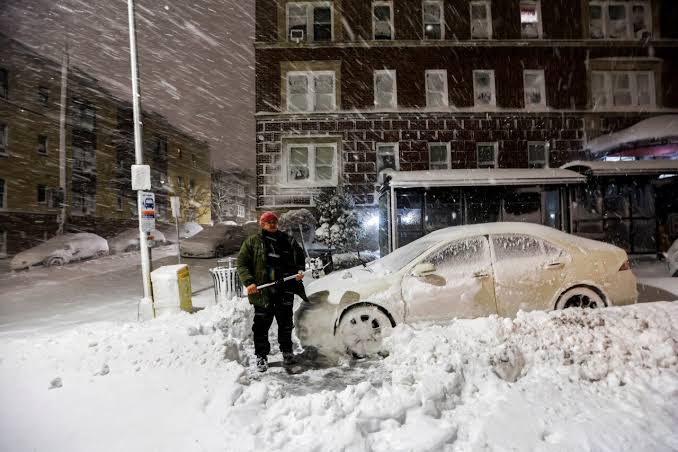
A powerful winter storm swept across the northeastern United States on Monday, burying cities under heavy snowfall, cutting electricity to hundreds of thousands of homes and grounding thousands of flights across the country’s busiest air corridors.
Meteorologists reported extraordinary snowfall totals across coastal New England and the Mid Atlantic.
Africa Today News, New York, learned that parts of Rhode Island and Massachusetts received close to 37 inches, while New York City’s Central Park recorded more than 19 inches, according to the National Weather Service. The storm system stretched from North Carolina to northern Maine and extended into portions of eastern Canada.
Authorities warned that travel conditions deteriorated rapidly as winds intensified and visibility dropped. New York officials described road travel as nearly impossible during peak snowfall.
A temporary shutdown of roads, bridges and highways brought the city of more than eight million residents close to a standstill before restrictions were eased later in the day.
Read also: Climber Goes On Trial For Death On Austria’s Highest Peak
Power outages spread throughout the region as heavy snow and strong winds toppled trees and power lines. More than 600,000 homes and businesses lost electricity along the east coast, with New Jersey and Massachusetts reporting the highest numbers. In Massachusetts alone, roughly 300,000 customers were without power, including most residents of Cape Cod’s Barnstable County.
Rhode Island appeared to bear the brunt of the storm. Providence, the state capital, recorded about 36 inches of snow, surpassing the previous record set during the winter of 1978. A meteorologist with the National Weather Service said the accumulation exceeded expectations and set a new benchmark for the state.
Officials in Rhode Island and neighbouring Connecticut imposed bans on non essential travel as plough crews struggled to clear roads. Massachusetts later introduced similar restrictions, reducing speed limits on major highways and warning motorists to stay home. State leaders cautioned that emergency responders might not be able to reach stranded drivers quickly because of white out conditions.
Air travel was severely disrupted. Flight tracking data showed more than 5,700 flights within, into or out of the United States were cancelled on Monday.
Nearly all departures from New York’s LaGuardia Airport were scrapped, and the vast majority of flights from John F. Kennedy International Airport were also called off. Boston’s Logan International Airport and Newark Liberty Airport each cancelled more than 90 percent of scheduled departures, while Philadelphia International Airport halted most operations.
Read more: Avalanches Leaves 13 Dead Across Northern Italian Mountains
Airlines warned that cancellations would continue into Tuesday, with more than 2,000 additional flights expected to be affected as crews reposition aircraft and airports clear runways and terminals.
The National Weather Service said snowfall would continue in some coastal areas through Monday night, with certain communities forecast to receive one to two feet in total accumulation before the system moves offshore. Forecasters also warned that fallen branches and weakened trees could prolong outages and complicate cleanup efforts.
Utility companies and emergency services remained on high alert as crews worked to restore power and reopen transportation routes.
Residents across the region were advised to avoid unnecessary travel while recovery operations continue and temperatures remain low, increasing the risk of ice formation on untreated surfaces.