
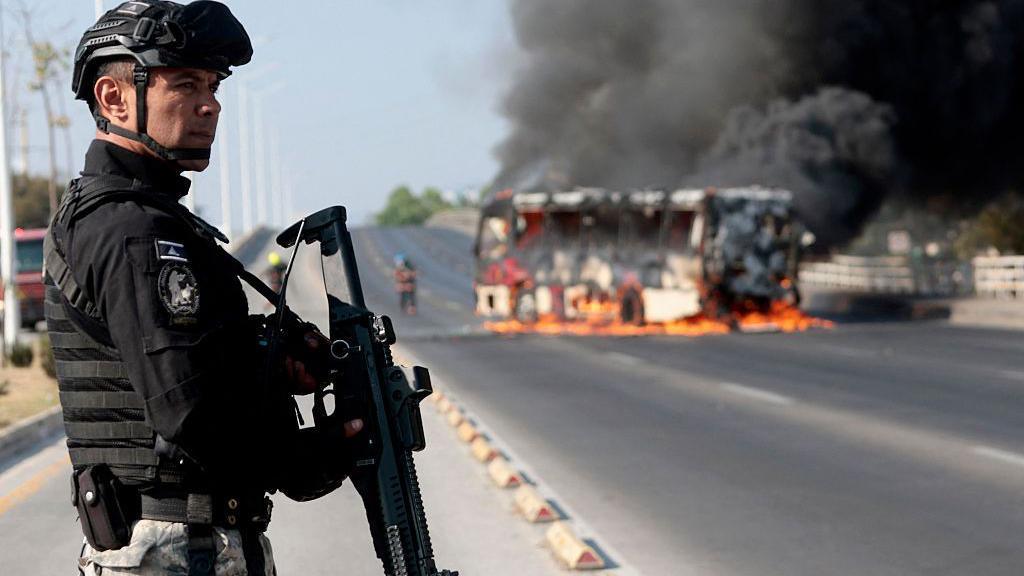
Mexico’s president told the country on Tuesday that there was “no risk” to fans travelling to the 2026 FIFA World Cup, as the government deployed 2,500 additional troops to Jalisco state, attempted to restore suspended airline services, and worked to project stability in a host city whose streets had been blocked by burning vehicles and whose local football matches had been postponed just three days before the tournament’s governing body held its most intensive security review of any Mexican venue since the hosting agreement was signed.
President Claudia Sheinbaum was asked at her daily press briefing what guarantees could be given that World Cup matches would be held in Jalisco. “Every guarantee,” she said, adding that there was “no risk” for fans attending the tournament. Jalisco Governor Pablo Lemus said he had spoken with FIFA officials locally. “There is absolutely no intention on FIFA’s part to remove any venues from Mexico. The three venues remain completely unchanged,” he said. FIFA president Gianni Infantino, speaking in Colombia, said he was “very calm” and that “everything is going to be spectacular.”
Four professional football matches in Mexico were postponed after violence flared near Guadalajara in the wake of the military operation.
FIFA Mexico said it was “closely monitoring the situation in Jalisco and remain in constant communication with the authorities,” and that it would “continue to follow the actions and directions from the different government agencies, aimed at maintaining public safety and restoring normalcy.”
Portugal’s football federation said it was “closely monitoring the delicate situation” in Mexico. Its national team was scheduled to play Mexico in a friendly on March 28 at the Azteca Stadium in Mexico City, which is also the venue for the World Cup’s opening match.
More than 70 people died in the operation to capture El Mencho and the violence that followed. Violence raged across Jalisco and several other states, with cartel members blocking highways with burning cars and torching businesses. In Puerto Vallarta, frightened tourists described plumes of dark smoke rising into the sky. Air Canada, United Airlines, Aeromexico and American Airlines suspended flights to Puerto Vallarta and Guadalajara.
Read Also: FIFA Confirms Full Draw Format For 2026 World Cup
Authorities subsequently deployed an additional 2,500 troops to stabilise key areas, dismantle roadblocks, and secure transport corridors, while expanding AI-powered surveillance systems and drone detection technology around stadiums and fan festival zones.
The violence placed Guadalajara at the centre of the global conversation about Mexico’s hosting role in a way that neither the government nor FIFA had anticipated at this stage of preparation.
Hugo Alejandro Pérez, a 53-year-old restaurant owner who lives a few miles from Estadio Akron, said he was already sceptical before the violence erupted and that the week’s events had confirmed his doubts. “I don’t think they should host the World Cup here,” he said. His view reflected a wider constituency among Guadalajara residents who noted that basic municipal services, water connections, road maintenance, remained unreliable in significant parts of the city even as the stadium infrastructure was being prepared for an international audience of hundreds of millions.
Guadalajara is not a spare venue filling gaps. It is carrying four matches at Estadio Akron, including Mexico versus Korea Republic, and several fixtures in the tournament’s first phase, when fans are arriving, calibrating, and spending. The city’s value to the tournament is clear, but the security question is the thing that decides whether the event can even take place.
Under 2026 World Cup regulations, FIFA holds the right to cancel, reschedule or relocate matches for any reason at its sole discretion, including as a result of force majeure or health, safety or security concerns. Sports law professor Jack Anderson at the University of Melbourne said: “Under the contracts in place, FIFA has broad powers to unilaterally terminate the arrangement with the host country and city,” though only if it could justify an extraordinary ground of termination.
Read Also: ‘El Mencho’ Death Triggers Wave Of Violence Across Mexico
The operation that killed El Mencho was conducted with United States intelligence support. The White House confirmed that US agencies had provided assistance and applauded Mexico’s army for taking down one of the most wanted criminals in both countries. The cooperation reflected an agreement reached between the Sheinbaum administration and the Trump administration, under which Mexico intensified its counter-cartel operations in exchange for relief from threatened additional tariffs and the withdrawal of earlier US threats of unilateral military action on Mexican territory. Trump had repeatedly characterised Mexico as controlled by cartels and had invoked the designation of CJNG and other organisations as foreign terrorist organisations to argue for direct US military intervention, a position the Mexican government rejected.
For Mexico and the broader Mexican-American diaspora in the United States, the 2026 World Cup is more than sport. It represents economic opportunity, cultural visibility, and a claim to global credibility.
Guadalajara alone expects hundreds of thousands of visitors, generating significant revenue across hospitality and tourism. If Jalisco stabilises, the matches proceed and the city receives a month of global attention. If the disruption continues at scale, matches will likely be rerouted. No decision to that effect had been made or publicly considered by FIFA as of Wednesday.