
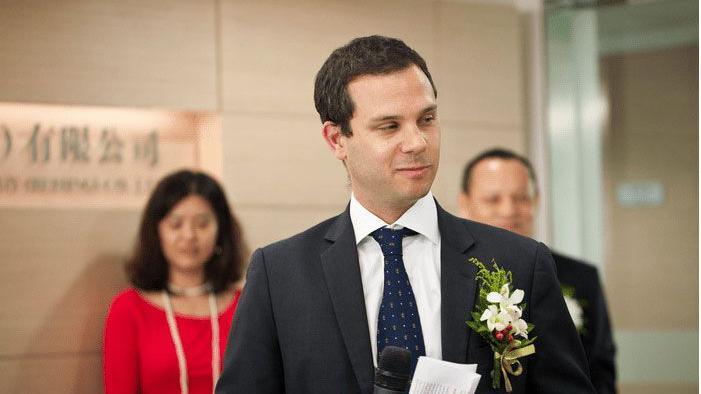
In the spring of 2019, beneath the neon skyline of Shenzhen, investors and technology founders gathered for a gala evening linked to one of Britain’s most high-profile royal initiatives abroad. Prince Andrew, then still a working member of the Royal Family, observed as performers filled the stage at an event for the Chinese arm of his entrepreneurship platform, Pitch@Palace. The occasion would soon acquire retrospective significance. Within a year, Andrew would withdraw from public duties following a widely criticised interview about his association with the convicted American sex offender Jeffrey Epstein.
Among those present that evening in southern China was a figure largely unknown outside select financial and diplomatic circles: David Stern. Captured only fleetingly in official footage, the German businessman had, for nearly a decade, operated as an intermediary linking Andrew and Epstein. Newly released documents from the United States Department of Justice (DOJ) now illuminate the depth of Stern’s involvement with both men and with Sarah Ferguson, Duchess of York.
The DOJ’s disclosure of millions of pages connected to Epstein has placed Stern’s name in more than 7,000 documents spanning 2008 to 2018. The records suggest that Epstein first introduced Stern into the orbit of Andrew Mountbatten-Windsor and Ferguson. They also indicate that Stern functioned as a facilitator—arranging meetings, transmitting documents, proposing commercial ventures, and, at times, assisting with Ferguson’s financial difficulties.
In one 2011 message to Epstein, Stern appeared to define his own role succinctly: “I stay in the background/hidden, just make the arrangements.” The phrasing captures a pattern reflected throughout the correspondence. Stern has been approached for comment but has not responded.
Read Also: Africa Market Intelligence—Part 2
For much of the relevant period, Stern was based in London, where he ran his own business interests while maintaining close contact with Epstein, whom he frequently addressed as “boss.” The communications portray a hierarchical dynamic: Epstein, 15 years older, wealthy and entrenched in elite American networks, appears as the senior figure; Stern as the ambitious junior, eager for guidance.
According to a biography Stern reportedly shared with Epstein, he studied Law and Chinese Law at the School of Oriental and African Studies in London. A person familiar with the matter said Stern completed a three-year Law BA in 2000 but withdrew from postgraduate research in 2003. The same biography describes him as fluent in Mandarin and notes periods of study in Taiwan and mainland China during the 1990s.
Professionally, Stern worked at the investment banking boutique Ermgassen & Co between 2000 and 2002 before founding Asia Gateway, an IT healthcare venture in Beijing. He later claimed to have sold a majority stake in that company to the UK-based publishing and events group Informa in 2010. Informa confirmed that it acquired the stake but stated that no product emerged from the arrangement and that the agreement expired in 2014.
The earliest known contact between Stern and Epstein appears in May 2008, when Stern invited Epstein to consider investing in a China-focused private equity fund. The timing is notable: Epstein pleaded guilty the following month to soliciting prostitution from a minor. The correspondence nonetheless continued and, over subsequent years, expanded to include a mix of business proposals and explicit commentary about women.
The emails contain numerous crude references, including Stern’s repeated use of the abbreviation “P,” understood to refer to women in derogatory terms. In a 2009 message, Stern described a Beijing dinner hosted by a steel magnate, writing that “entertainment during dinner were 5 girls on the dining table… while we ate.” Another email in 2010 appeared to propose a visit to Little Saint James, Epstein’s private Caribbean island, where many of his crimes were later documented. It remains unclear whether such a visit occurred.
Through Epstein, Stern appears to have been introduced to the Duke and Duchess of York in early 2010. An email attributed to “Sarah” and referencing Royal Lodge—the Windsor residence of Prince Andrew—states: “I was introduced to David Stern by Jeffrey. He came to Royal Lodge for dinner. He has been helping me a great deal with an ear and advice to my way ahead. He has a great roladex [sic] for China.” The context strongly suggests the author was Sarah Ferguson.
By that point, Ferguson was grappling with substantial financial obligations, reportedly estimating her debts at approximately £6 million. Correspondence indicates that Stern undertook efforts to assist in clarifying the extent of those liabilities. Privately, however, emails between Stern and Epstein depict a dismissive tone toward the Duchess. Stern complained about the difficulty of obtaining basic financial information; Epstein suggested treating her like a “girlfriend who has cheated,” an approach Stern later described as “working.”
Andrew himself appears in related communications. In 2010, he reportedly wrote to a friend indicating that he had gained a “handle on the debt situation.” At the same time, Stern proposed new commercial ventures. One suggestion involved establishing a London-based enterprise targeting high-net-worth individuals, particularly from China. In a message to Epstein, Stern proposed discreetly incorporating “PA”—apparently shorthand for Prince Andrew—into the structure, leveraging his “aura and access.” There is no evidence the plan materialised.
Despite Andrew’s public distancing from Epstein following the latter’s 2008 conviction, Stern appears to have maintained a conduit between them. The emails show him forwarding information and facilitating communication. Stern also claimed involvement in organising aspects of Andrew’s official visits to China during his tenure as a UK trade envoy. One message from October 2011 asserts that “most meetings by now are organised by me except mayors and governors.” The Court Circular confirms that Andrew was in China that month in his official capacity.
Stern’s formal association with Andrew deepened in 2016 when he joined the board of Pitch@Palace, the initiative designed to connect entrepreneurs with investors and mentors. He was photographed at one event seated near Queen Elizabeth II. The platform’s China branch later became embroiled in controversy after its co-founder, Yang Tengbo, was barred from the United Kingdom over suspicions of espionage—allegations he denies.
Read Also: US And Israel Strike Iran In Operation Shield Of Judah
Taken together, the DOJ files sketch a portrait of a businessman who positioned himself at the intersection of royal networks, transnational finance, and Epstein’s inner circle. Stern’s expertise in China, his access to elite British circles, and his sustained correspondence with Epstein suggest a relationship built on mutual utility.
For Britain’s institutions, the documents revive enduring questions about judgment, oversight, and the informal networks that shape influence behind closed doors. For global observers—including those in Africa, where governance transparency and elite accountability remain central public concerns—the case underscores how personal relationships can intersect with state representation, commercial diplomacy, and reputational risk.
The Shenzhen gala of 2019 now reads less as a celebration of entrepreneurial ambition than as a closing chapter in a network whose contours are only fully emerging years later.