
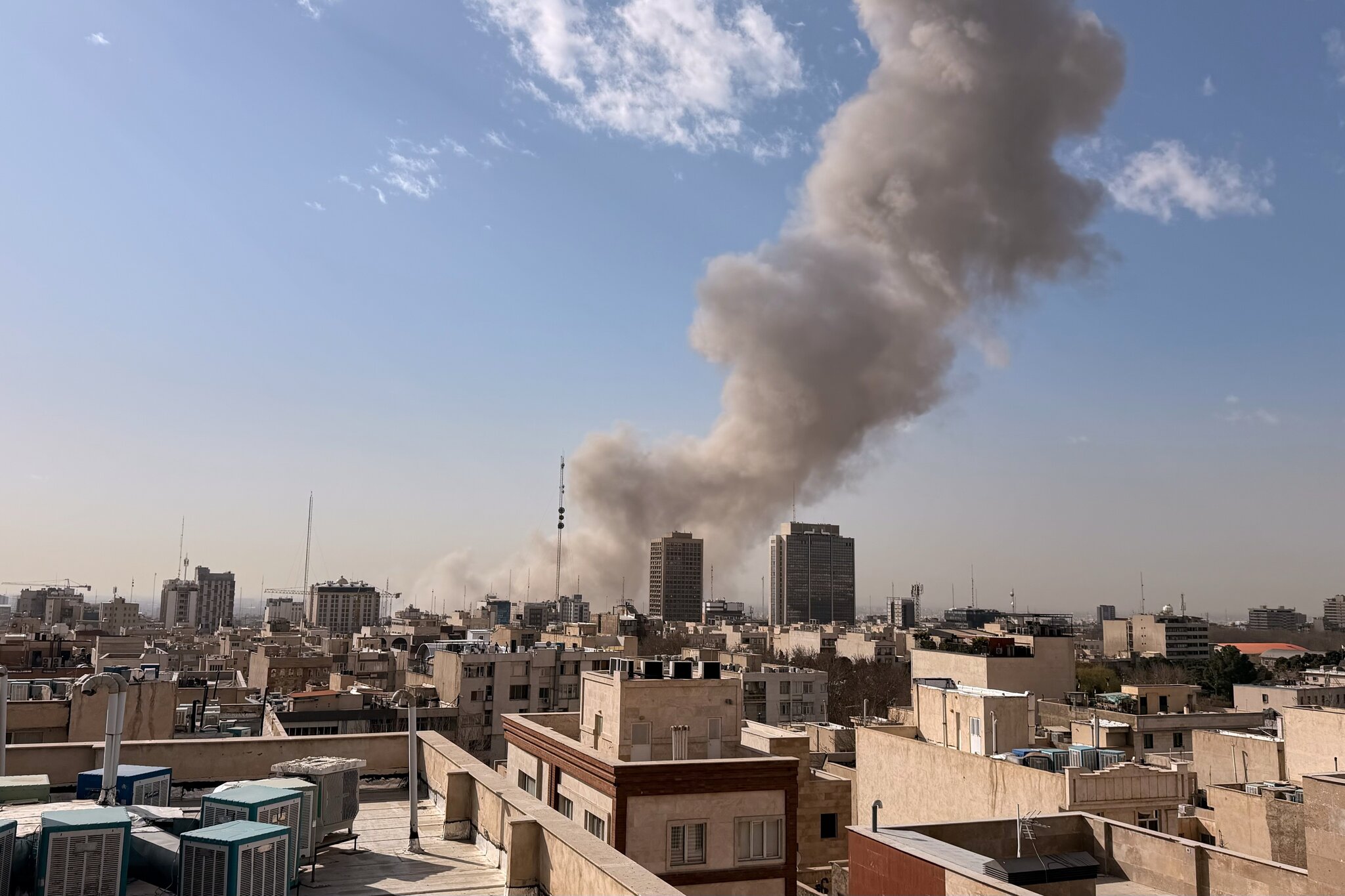
The United States and Israel launched a coordinated military assault on Iran on Saturday morning in an operation codenamed Shield of Judah, striking multiple cities including Tehran, Isfahan, Qom, Karaj, and Kermanshah in what President Donald Trump described as “major combat operations” designed to permanently eliminate Iran’s capacity to develop nuclear weapons, ending months of diplomatic engagement only 24 hours after the two sides had held their latest round of talks in Geneva and plunging the Middle East into its most acute military confrontation since the Second World War.
President Trump confirmed the strikes in a video posted to his Truth Social account, saying: “A short time ago, the United States military began major combat operations in Iran. Our objective is to defend the American people by eliminating imminent threats from the Iranian regime.” He said the operation was “massive and ongoing” and warned the American public explicitly that US military casualties were possible.
“The lives of courageous American heroes may be lost, and we may have casualties. That often happens in war,” he said. He vowed to destroy Iran’s ballistic missile programme and raze its nuclear infrastructure, and told Iranians directly: “The hour of your freedom is at hand.”
Israeli Defence Minister Israel Katz confirmed that Israel had launched what he described as a pre-emptive strike, stating that it was intended “to remove threats to the State of Israel.”
He declared a nationwide state of emergency under Section 9C of Israel’s Civil Defence Law, describing a high probability of an imminent Iranian missile and drone strike against Israeli civilian populations. Air raid sirens sounded across Israel at approximately 8:15 a.m. local time as the Israeli military issued a proactive public alert to prepare citizens for incoming fire. Schools, workplaces, and public gatherings were suspended across the country, with exemptions for critical services. Israel closed its airspace to all civilian traffic.
The scale of the assault was significant and still being assessed as this report was prepared. Iranian news outlets reported strikes across the country, including in Isfahan, home to a major Iranian nuclear facility, as well as Qom, Karaj, Kermanshah, Lorestan, and Tabriz. In Tehran, seven missiles were confirmed to have struck the district where Supreme Leader Ayatollah Ali Khamenei normally resides, an area that also contains the presidential palace and the National Security Council. Local sources reported targets that included the building of the Iranian Ministry of Intelligence, the alleged office of Khamenei, and facilities of the Iranian Atomic Energy Organization.
Iranian state media reported strikes targeting the Islamic Revolutionary Guard Corps’ intelligence headquarters. Mobile phone services were disrupted across parts of Tehran and Iran closed its airspace following the attack.
Ayatollah Khamenei was not in Tehran at the time of the strikes and had been transferred to a secure location, an Iranian official confirmed to Reuters. Iranian President Masoud Pezeshkian was reported to be safe. Some Iranian citizens were filmed laughing and celebrating as strikes hit what they called the “leader’s house,” a reflection of the country’s internal divisions after months of mass anti-government protests. The Mossad, Israel’s foreign intelligence service, launched a Farsi-language Telegram channel during the operation, addressed to “our Iranian brothers and sisters,” urging Iranians to help “return Iran to its glory days.”
Iran’s response was already underway. The Israeli military said it had identified ballistic missiles launched from Iran toward Israel as this report was being prepared, with sirens sounding in northern Israel. An Iranian official told Reuters that Tehran was preparing a “crushing retaliation” and warned that countries in the region hosting US military forces would be considered legitimate targets for counterstrikes, a threat that echoed Iran’s June 2025 retaliatory strike on the Al Udeid Air Base in Qatar following the first round of US-Israeli strikes on Iranian nuclear sites. US embassies across the region issued shelter-in-place orders for all staff, with the US Embassy in Qatar urging all American citizens to find secure buildings and remain there until further notice.
Read Also: Modi Arrives In Israel For Talks On Defence And Iran Crisis
An Israeli defence official told Reuters that Operation Shield of Judah had been planned for months in coordination with Washington, and that the launch date had been fixed several weeks in advance. According to US officials, dozens of strikes were being carried out simultaneously by attack aircraft operating from bases across the Middle East and from at least one aircraft carrier. The operation was described by US officials as “not a small strike.”
The timing of the assault was laden with political and symbolic weight on multiple fronts. The strikes fell during the Muslim holy month of Ramadan, a period of fasting and prayer observed across the Islamic world, and came two days before the Jewish holiday of Purim, which in Jewish tradition commemorates the deliverance of ancient Persian Jews from annihilation. The strikes also came hours after the most recent round of nuclear negotiations between US and Iranian officials had concluded in Geneva on Friday, February 27, a session that Secretary of State Marco Rubio had described as stalled on the question of Iran’s ballistic missiles.
The diplomatic and military backdrop to Saturday’s assault had been building in plain sight for months. Iran and the US opened indirect nuclear talks in Muscat on February 6, 2026, while the US simultaneously deployed a second aircraft carrier, the USS Gerald R. Ford, to the Middle East alongside the USS Abraham Lincoln, which had arrived in January. US and European officials had presented Iran with three non-negotiable conditions: a permanent end to all uranium enrichment, strict curbs on its ballistic missile programme, and a complete halt to support for proxy forces including Hamas, Hezbollah, and the Houthis.
Tehran agreed only to discuss the nuclear question and refused to negotiate on missiles, a position Secretary of State Rubio called a “big, big problem” ahead of the Geneva talks. As recently as February 25, Rubio confirmed that Iran was not currently enriching uranium but alleged that it was positioning itself to do so.
As of mid-June 2025, before the first round of US strikes, Iran had accumulated approximately 972 pounds of uranium enriched to 60 percent purity, a stockpile just one technical step from the 90 percent threshold required for weapons-grade material. One US intelligence assessment from that period found that Iran could potentially produce a nuclear weapon within three to eight months.
Read Also: Pakistan Declares ‘Open War’ As Jets Strike Kabul Targets
The IAEA’s Director-General Rafael Grossi said as recently as mid-February 2026 that Iran’s nuclear material remained “still there, in large quantities” despite the June 2025 strikes, though he noted that “some of it may be less accessible.”
Nationwide anti-government protests had erupted across Iran beginning in December 2025, triggered by economic crisis, the collapse of the rial, and surging prices. The unrest spread to more than 100 cities and became the largest domestic challenge to the Islamic Republic since the 1979 revolution. The government responded with a violent crackdown, with the deadliest incidents occurring between January 8 and 10, 2026. During his State of the Union address on February 24, President Trump alleged the Iranian government had killed approximately 32,000 protesters, a figure he described as approximate, and called the Islamic Republic “the world’s number one sponsor of terror.”
No casualty figures had been released by any government as of the time of publication. The operation was described by US officials as expected to last multiple days. The full scope of targets struck, the extent of damage to Iranian nuclear and military infrastructure, and the scale of Iran’s retaliatory response remained unclear as events continued to develop.