
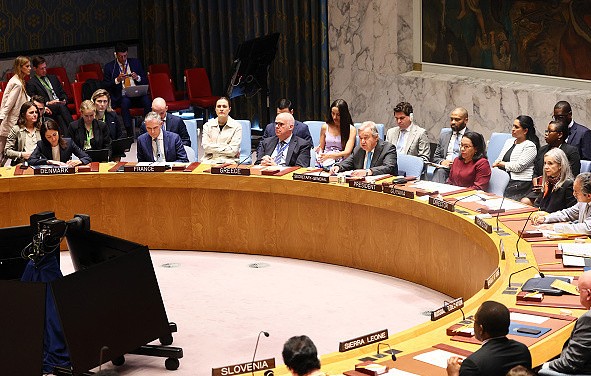
The United Nations Security Council convened an emergency session on Saturday afternoon as Iran struck the United States Fifth Fleet naval base in Bahrain, launched ballistic missiles that Jordan’s military shot down over its territory, and threatened to close the Strait of Hormuz, the world’s most critical oil export route, in a rapidly escalating military confrontation that has drawn in governments from Washington to Beijing and produced the most acute challenge to the international rules-based order in years.
The 15-member Security Council met at 4 p.m. New York time under the chairmanship of Britain, which holds the monthly council presidency. The session was called jointly by Russia, China, France, Bahrain, and Colombia. Russia and China framed the meeting explicitly as a response to what they described as an act of aggression, with Russia’s UN mission demanding that the United States and Israel “immediately cease their illegal and escalatory actions and embark on a path toward a political and diplomatic settlement.” Iran’s UN Ambassador told the Council that the United States had “decided to destroy diplomacy,” and said Iran’s armed forces would determine the “timing, nature and scale” of the country’s proportionate response.
UN Secretary-General António Guterres, who addressed the Council in person, had earlier issued a formal condemnation of both the US-Israeli assault and Iran’s retaliatory strikes.
“The use of force by the United States and Israel against Iran, and the subsequent retaliation by Iran across the region, undermine international peace and security,” Guterres said. “I call for an immediate cessation of hostilities and de-escalation. Failing to do so risks a wider regional conflict with grave consequences for civilians and regional stability.” He urged all parties to return immediately to the negotiating table.
The diplomatic urgency was sharpened by the military picture developing across the Gulf. The Bahraini government confirmed that an Iranian strike had hit the US naval base on the island, home to the US Navy’s Fifth Fleet, the primary American naval command for the Middle East.
Read Also: UN Rights Council Mulls Pause In Arms Sales To Israel
The United Arab Emirates said it had intercepted Iranian missiles, though shrapnel from one interception killed a national of an unspecified Asian country in Abu Dhabi. Loud explosions were reported over Dubai, with AFP correspondents witnessing a plume of smoke rising over the city. Jordan’s military said it had shot down two Iranian ballistic missiles over its territory. Iran’s Revolutionary Guard Corps transmitted warnings on VHF frequencies to vessels operating near the Strait of Hormuz stating that “no ship is allowed to pass,” according to an EU naval official speaking to Reuters on condition of anonymity. Iran had not formally confirmed any such order, but the transmission raised immediate alarm among energy markets and maritime operators dependent on the strait, through which approximately 20 percent of the world’s oil supply transits daily.
The diplomatic wreckage was as significant as the physical destruction. Oman’s Foreign Minister, who had personally mediated indirect nuclear talks between Washington and Tehran as recently as Thursday and told both sides he believed meaningful progress had been made, flew to Washington on Friday to brief US officials, only for the strikes to begin hours later. Iran’s Foreign Ministry said Tehran had been in the middle of active negotiations when it was struck, a characterisation that hardened international criticism of the operation’s timing. Iran’s Supreme National Security Council condemned the assault as a “brutal air operation carried out while negotiations were still underway.”
Read Also: Emergency UN Session Called After Iran Protest Fatalities
European governments responded with a mixture of condemnation of the Iranian regime and discomfort with the American action. French President Emmanuel Macron said the outbreak of war carried “grave consequences for international peace and security,” called on Iran to engage “in good faith in negotiations,” and was instrumental in calling the Security Council to convene. British Prime Minister Keir Starmer said the United Kingdom had “no role” in the strikes, described the Iranian regime as “utterly abhorrent,” and said Britain did not want to see further escalation. German Chancellor Friedrich Merz was notified of the strikes only on Saturday morning, his government confirmed, a disclosure that indicated close US allies had been given minimal or no advance warning. The EU began evacuating some staff from the region, and European governments coordinated emergency security meetings throughout the day.
Russia’s Foreign Ministry described the strikes as “a pre-planned and unprovoked act of armed aggression against a sovereign and independent UN member state,” accusing Washington and Tel Aviv of “hiding behind” nuclear concerns while pursuing regime change.
China said it was deeply concerned and prepared to assist in mediation. Malaysia’s Prime Minister Anwar Ibrahim said the Middle East had been pushed to the “edge of catastrophe.” Egypt warned of “grave repercussions” for regional stability. Pakistan’s Foreign Minister Ishaq Dar condemned what he called “unwarranted attacks” on Iran in a phone call with Iranian Foreign Minister Abbas Araghchi.
The United States found limited public support among its traditional allies for the operation. While European leaders broadly shared Washington’s position that Iran must never obtain a nuclear weapon, the method of unilateral military action without UN authorisation or allied consultation created a diplomatic rupture that several European officials privately described as the most serious since the 2003 invasion of Iraq. President Trump, for his part, had used his pre-dawn announcement to call on the Iranian people to “take over your government,” language that went beyond military objectives and suggested a broader political aim of ending the Islamic Republic’s theocratic government. “When we are finished, take over your government. It will be yours to take. This will be probably your only chance for generations,” he said.
No binding Security Council resolution was expected from Saturday’s session, given the United States’ veto power over any draft that condemned the strikes. The outcome of the meeting, the trajectory of Iran’s military response, and the status of the Strait of Hormuz remained active and rapidly developing as this report was filed.