
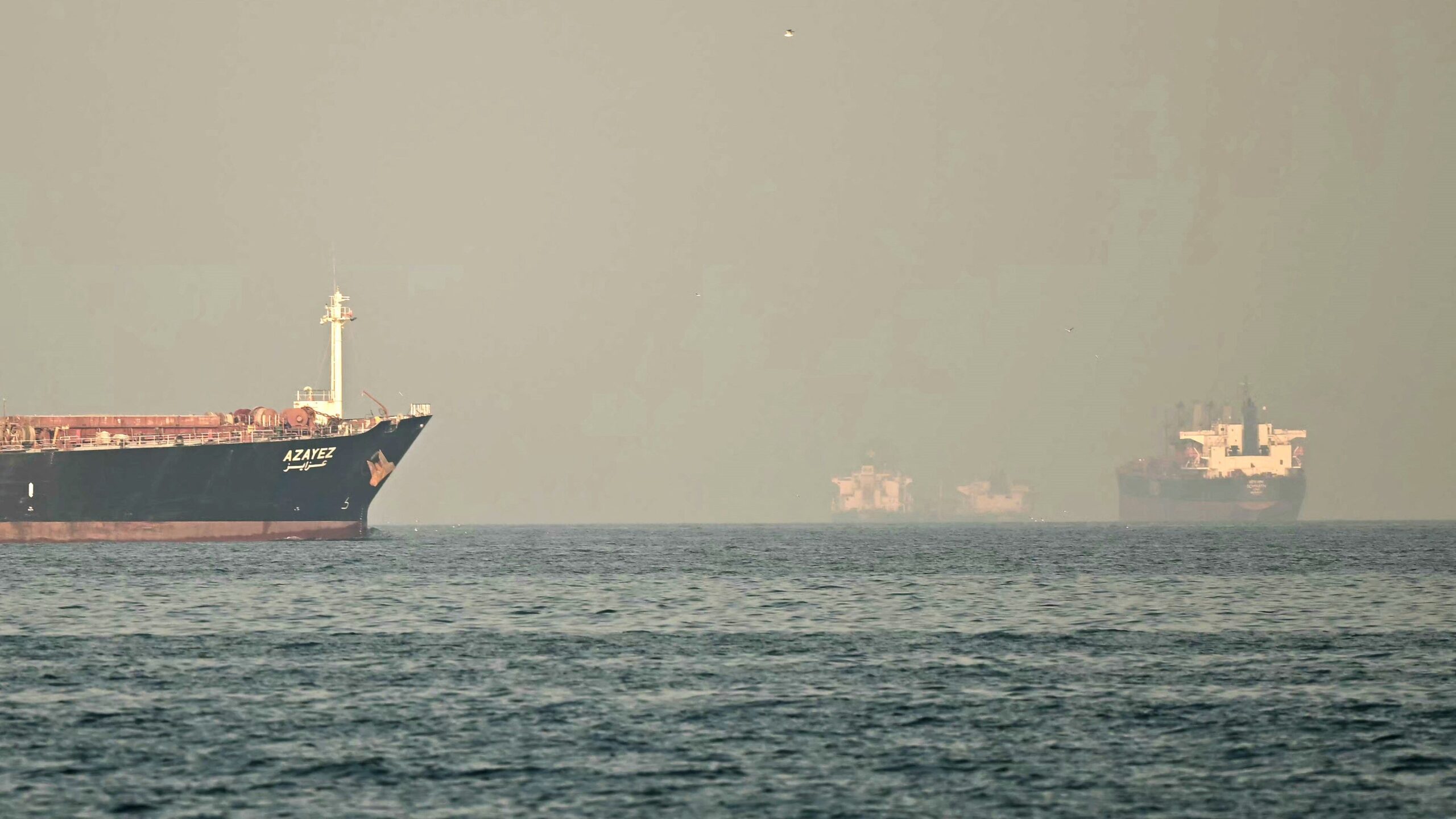
At least three ships came under attack near the Strait of Hormuz on Sunday as tensions rise in the region following the US and Israeli attack on Iran, maritime authorities said.
According to the UK Maritime Trade Operations Centre (UKMTO), two ships came under attack by unknown projectiles, while the third vessel was damaged by an explosion that took place nearby. All the crew members on the ships were safe, authorities said.
Another attack was reported, in which the crew members were evacuated, although the reason for the attack was not known.
The attack prompted the UKMTO authorities to advise all ships transiting the Arabian Gulf and the Gulf of Oman to “transit with caution.”
The Islamic Revolutionary Guards Corps (IRGC), an Iranian military force, said that three tankers flying the US and UK flags had come under attack by missiles and were on fire, although neither the US nor the UK had issued any comments on the attack by Sunday night.
Read Also: Flight Chaos After Iran Strikes Disrupts Global Air Travel
The Strait of Hormuz, which accounts for the passage of one-fifth of the world’s oil and gas, has witnessed a halt in the passage of all oil and gas ships at its entrance.
Ship tracking data by Kpler revealed that at least 150 oil tankers had anchored in the waters beyond the strait in the Gulf.
Only a handful of ships, including Iranian and Chinese-flagged vessels, passed through the strait on Sunday.
“Due to Iran’s threats, the strait has de facto closed,” said Homayoun Falakshahi, a maritime analyst at Kpler, a ship tracking service.
“The vessels have taken a precautionary measure not to enter as the risks are too high, and their insurance costs have skyrocketed.”
Falakshahi said the efforts of the U.S. to secure the shipping lanes would prevent a rise in oil prices, but if the strait remains closed, oil prices would “go much, much higher.”
A private security firm, Vanguard Tech, confirmed the reports of the UKMTO of the presence of oil ships from Gibraltar, Palau, the Marshall Islands, and Liberia, but the extent of the damage to the vessels was not confirmed.
Global shipping groups have already started to change their routes as a result of the conflict.
Maersk, a Danish container shipping line, announced in a statement that it would suspend its shipping route through the Bab el-Mandeb Strait and the Suez Canal, choosing to go around the Cape of Good Hope to avoid conflict areas.
The attacks on the shipping vessels occurred as a result of the renewed aerial strikes in the region after the death of Iran’s Supreme Leader, Ayatollah Ali Khamenei, in U.S.-Israeli operations on Saturday. The retaliatory strikes have reportedly targeted areas in Dubai, Doha, Bahrain, and Kuwait.
Oil prices have risen as a result of the conflict, with a 10% increase in oil prices reported in over-the-counter oil trades, which have risen to $80 a barrel, although the official Brent crude oil prices did not open until 23:00 GMT on Sunday.
Analysts have stated that the conflict could cause oil prices to rise to over $100 a barrel.
OPEC+, which is the group of oil-producing countries including Saudi Arabia and Russia, has announced on Sunday its plans to increase its output by 206,000 barrels per day in order to help stabilize the global energy market.
Read Also: American Strikes On Iran Revive War Authority Legislation Push
However, analysts have questioned the effectiveness of the move in countering the supply disruptions from the Gulf region.
Edmund King, the president of the AA motoring group, has said that the maritime disruptions would have a downstream impact on fuel prices.
“The turmoil and bombing across the Middle East will surely be a catalyst to disrupt oil distribution globally, which will inevitably lead to price hikes.
However, the extent and scale of the price hikes on fuel pumps will depend on the length of the conflict.”
The maritime incidents have pointed to the vulnerability of the Strait of Hormuz, which is the narrow waterway that connects the Persian Gulf to the Gulf of Oman and the Arabian Sea.
It is normally used by ships carrying oil from major Gulf producers such as Saudi Arabia, the UAE, Kuwait, and Iraq.
International shipping firms normally remain on high alert in the area due to periodic tensions in the region.
UKMTO’s guidelines emphasized the importance of all vessels in the area maintaining a high level of alertness and adhering to safety guidelines.
The cost of insurance for tankers in the vicinity of the strait is reportedly higher than before, leading many tankers to delay their journey.
This attack also brings into focus the widening extent of the conflict in the region.
Iran has repeatedly cautioned all merchant vessels in the region to avoid the strait following the US-Israeli strikes.
This brings into question a potential strategic move by Iran to target global energy supplies.
US military and diplomatic personnel have hinted at this being a potential concern for them but have not outlined their response plan.
The situation is fluid at the moment, with security issues still being reported in the Arabian Gulf as well as the Gulf of Oman.