
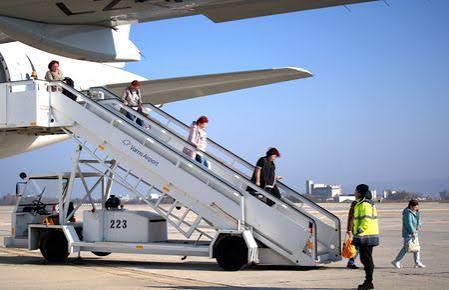
Airlines’ stocks made a comeback on Thursday as flights across the Middle East began to resume, helping alleviate the impact of strikes by the U.S. and Israel on Iran, which had wiped off billions of dollars in market value for the carriers earlier this week.
As the conflict escalated, governments across the Middle East and other affected countries worked on coordinating the evacuation of tens of thousands of their citizens stranded by the conflict, which led to the closure of airspaces due to the threat of missiles.
The usually busiest international airport, Dubai, saw air operations significantly curtail, leading to record-high air ticket prices on key international routes such as Australia to Europe.
Meanwhile, Emirates and Etihad Airways have restarted a limited schedule of flights via safe air corridors out of Dubai and Abu Dhabi, while Qatar Airways announced limited relief flights would start on Thursday.
Flights will be operated out of Muscat in Oman to six destinations across Europe, including London, Berlin, and Rome, as well as out of Riyadh to Frankfurt.
Read Also: Middle East Violence Batters Yen, Euro Over Fuel Concerns
These are the airline’s first flights since Saturday, when its hub in Doha was closed because of strikes against Iran, data from flight tracking website Flightradar24 showed.
As of Thursday morning, Emirates flights were departing to destinations including Sydney, Paris, Amsterdam, Toronto, and Mumbai, though most flights were still grounded.
The State Department said a government-chartered flight has brought Americans home and additional repatriation flights are being arranged.
Since February 28, over 17,500 American citizens have been repatriated from Middle Eastern locations.
Canada said it was helping stranded citizens by using a combination of commercial and charter flights.
This disruption is not limited to passenger movement, and analysts have already estimated that the conflict has resulted in a decline in global air cargo capacity by more than 20%.
At the same time, there has been a sharp rise in freight rates, and the prices of jet fuel worldwide touched a record high in Singapore, driven by a rise in supply concerns, S&P Global Platts reported Thursday.
Despite the pressure, the stocks of Asian airlines are showing a positive movement, and many carriers are witnessing a rise in their stocks, reversing double-digit percentage declines in earlier sessions this week.
Cathay Pacific Airways in Hong Kong, Japan Airlines, Qantas Airways in Australia, and Korean Air Lines in South Korea rose by over 4%, 0.25%, 1%, and over 6%, respectively, while Air China, China Eastern Airlines, and China Southern Airlines in China fell between 1% and 3% in Hong Kong and Shanghai, reversing double-digit percentage drops in earlier sessions this week.
“Asian airlines are highly sensitive to Iran’s situation because of their routes and energy costs,” said Gary Ng, a senior economist at Natixis.
“Any news on shortening the duration of the war can easily turn sentiment,” he added.
Kenny Ng, a securities strategist at China Everbright Securities International, said that “the rebound observed has been primarily short-term in nature and depends on how the situation develops.”
According to reports by the New York Times, citing officials briefed on the situation, “operatives of Iran’s Ministry of Intelligence have signaled a willingness to talk to the Central Intelligence Agency of the United States as part of efforts to bring an end to the war.”
Operationally, there have been complex logistical challenges facing these airlines.
The restricted airspaces have prompted many to reroute their flights or carry additional fuel or make unscheduled stops to refuel.
There have also been reports of passengers, including tourists and expatriates, seeking alternative routes via Saudi Arabia and Oman, whose airspaces are still operational.
Read Also: Britons Trapped In Middle East Amid Air Travel Disruptions
The strikes that were carried out earlier in the week were directed at facilities in Iran and have caused tensions in the region.
As a result, numerous flights have been canceled in the region due to the threat that has been posed by missiles.
This has seen numerous countries adhering to the temporary bans that have been put in place.
The conflict has also caused concerns for investors in the aviation sector.
The Asian countries have been affected due to the numerous routes that connect Asia to the Middle East.
The prices of fuel have also affected the sector.
It has been noted that investors’ reactions to the situation depend on the level and extent to which the conflicts in the region are expected to last.
The repatriation operations carried out by the US and Canadian governments have highlighted the level of displacement that has been caused by the war.
The Canadian government has noted that it has been working with numerous airlines to ensure that citizens are able to safely exit the region through the use of charter planes.
The US government has been using charter planes to carry out evacuations in collaboration with other airlines.
The cessation of flights, coupled with the rising cost of fuel and the challenge of flight routes, has put pressure on the schedules of flights around the world.
The flights from Asia to Europe and America have been affected, causing the cost of tickets to skyrocket in some routes.