
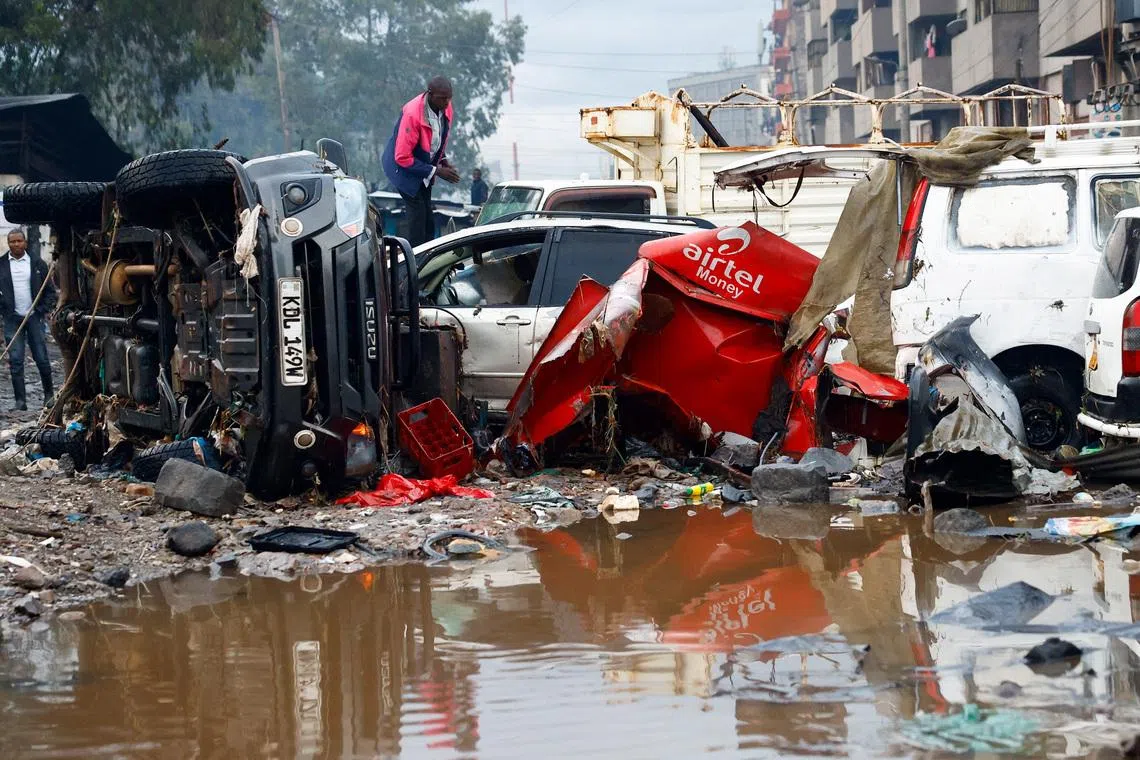
Flash floods triggered by overnight downpours killed at least ten people, swept away 71 vehicles, disrupted flights at Jomo Kenyatta International Airport, and prompted the deployment of military personnel across Nairobi on Friday night and Saturday morning, the city’s deadliest single flood event since the catastrophic April 2024 rains that killed more than 200 people nationally, and one that exposed once again the structural inadequacy of drainage infrastructure in East Africa’s largest city.
Nairobi Police Commander George Seda confirmed ten deaths and said rescue operations remained active, warning the toll could rise. Eight of the victims were swept away by fast-rising floodwaters, with some dying while trapped inside vehicles carried away by the currents.
Two others died in separate electrocution incidents in different parts of the county during the floods. Kenya Red Cross Secretary General Ahmed Idris said multiple residential estates and informal settlements were severely affected as floodwaters surged through low-lying areas and along river corridors, with Pipeline and Embakasi among the hardest-hit, particularly along sections of Kware Road that were completely cut off.
In the industrial Grogan neighbourhood of central Nairobi, security guard John Lomayan stood beside the body of an elderly man he recognised — a roadside egg seller — trapped beneath a car that had been washed away when the Nairobi River burst its banks.
“I saw him being carried by the water from up there,” he told Reuters, gesturing up the road. “We didn’t know where he had gone. It is only now that we see him under the car.” A Reuters reporter observed three bodies pulled from beneath submerged vehicles at the scene. Grogan, known as a hub for automotive workshops and secondhand spare parts, was among the areas most visibly devastated, with stacked cars crumpled against each other and machinery buried under a layer of mud and debris.
The Kenya Meteorological Department had issued a warning covering the 24-hour period ending 9 a.m. Saturday, forecasting between 30 and 70 millimetres of rainfall for Nairobi’s Westlands, Dagoretti, Roysambu, and Embakasi areas, as well as significant precipitation in neighbouring Kiambu, Machakos, and Kajiado counties. Forecasters said heavy rainfall exceeding 20 millimetres within 24 hours was expected to continue across several parts of the country between March 3 and March 9, with the rainfall expected to peak between March 4 and March 7 across the Lake Victoria Basin, Western Kenya, Central Highlands, coastal region and southeastern lowlands. Residents in South B, South C, Nairobi West, and Lang’ata reported rising water levels entering their homes, while eastern neighbourhoods including Umoja 3, Chokaa, Njiru, Ruai, and Utawala were also affected.
Read Also: Kenya: Paul Mackenzie Hit With 52 New Manslaughter Counts
Key transport routes were severely disrupted, particularly in the central business district and on feeder roads including Museum Hill, Uhuru Park, and Uhuru Highway. Mombasa Road near South C, the JKIA exit, and Thika Superhighway near Githurai and Kahawa Sukari were all affected. Flooding was also reported on Lunga Lunga Road near the Kenya Power depot, Limuru Road near the Belgian Embassy, Jogoo Road, Enterprise Road, Lang’ata Road near T-Mall, and Riverside Drive.
The Kenya Red Cross rescued at least 20 people along Kirinyaga Road, while Rapid Response Unit teams towed stalled vehicles at Kariokor–Ring Road and managed traffic at affected junctions. Amid heavy flooding along Mombasa Road, MOJA Express temporarily opened the Nairobi Expressway for free use to ease congestion and assist stranded motorists.
Kenya Airways confirmed that flights to Jomo Kenyatta International Airport had been disrupted overnight and several aircraft diverted to Mombasa’s Moi International Airport. The airline said it expected normalcy to return by Saturday evening. The JKIA diversion was the second consecutive year in which Nairobi’s primary international gateway had been affected by flooding, following disruptions in April 2024.
Read Also: Children Among 4 Missing In Nairobi Apartment Block Collapse
Public Service Cabinet Secretary Geoffrey Ruku summoned a high-level emergency coordination meeting at 8 a.m. on Saturday, bringing together the National Police Service, Kenya Red Cross, Meteorological Department, National Youth Service, St. John Ambulance Kenya, National Disaster Management Unit, National Disaster Operations Centre, and National Drought Management Authority. Ruku directed every sub-county in Kenya to immediately establish public information desks, emergency response and assistance centres, and rapid response stations to decentralise the relief effort.
The military was deployed to assist stranded residents across the worst-affected districts, a step that underscored the scale of the emergency response required. Resident Cedric Mwanza, surveying the wreckage on his street, described watching the Nairobi River overwhelm everything in its path.
“So many cars, so much stuff, I don’t know. Everything was just washed away. All of the water came from that river,” he said.
Scientists say global warming is intensifying flood and drought cycles across East Africa by concentrating annual rainfall into shorter, more extreme events. A 2024 World Weather Attribution study found that climate change had made devastating rainfall episodes in the region at least twice as likely as in the pre-industrial baseline.
Nairobi’s drainage infrastructure — much of it constructed when the city’s population was a fraction of its current four million — was designed for precipitation volumes the current climate routinely exceeds. Urban expansion across flood-prone areas including the Nairobi River basin has further reduced the land’s capacity to absorb rainfall, directing runoff into streets, homes, and commercial districts with increasing speed and volume.
Rescue operations were still active in multiple areas of the city as of Saturday morning, with authorities warning that additional bodies might be found.