
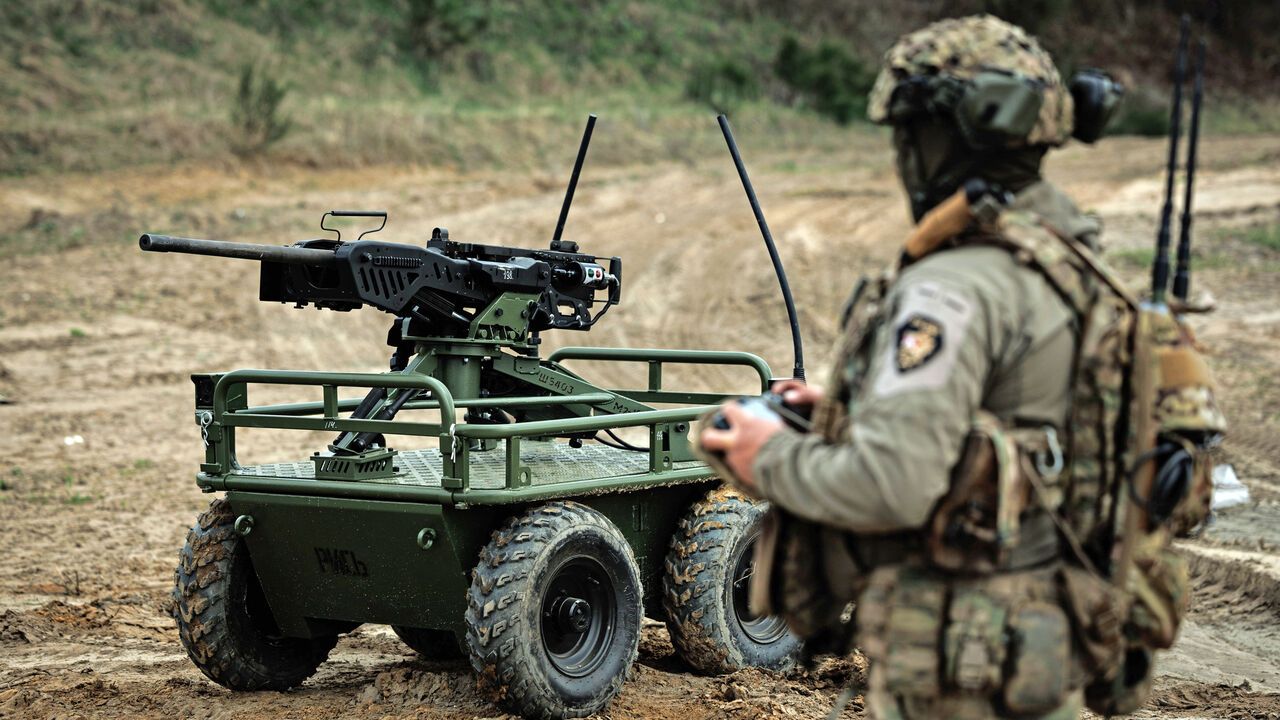
The war in Ukraine, already defined by its heavy reliance on advanced military technology, is entering a new phase in which armed robotic systems are beginning to operate directly on the ground battlefield. As drones have transformed the aerial dimension of the conflict and uncrewed maritime systems have disrupted naval operations in the Black Sea, both Ukraine and Russia are now investing heavily in ground-based robotic platforms designed to support, and in some cases replace, human soldiers in high-risk combat zones.
Since Russia launched its full-scale invasion in February 2022, Ukraine’s battlefield has become a testing ground for rapidly evolving forms of automated and semi-automated warfare. Surveillance drones, loitering munitions, and remotely piloted strike aircraft have already altered the dynamics of frontline engagements. Now, attention is shifting toward Uncrewed Ground Vehicles (UGVs), robotic systems capable of carrying weapons, transporting supplies, or conducting reconnaissance without placing soldiers directly in harm’s way.
Within the Ukrainian armed forces, these machines are increasingly integrated into combat operations. Ukrainian military units refer to them as “ground robot systems,” and some formations have begun building specialized units dedicated exclusively to their deployment.
One such formation operates within the Ukrainian army’s K2 Brigade, where a dedicated battalion has been created to manage and deploy robotic ground platforms. According to Oleksandr Afanasiev, an officer commanding the unit, the battalion represents a pioneering effort in modern warfare. He describes it as the first military formation specifically organized around UGV operations.
These systems are being adapted for several roles on the battlefield. In some cases, Ukrainian forces mount Kalashnikov machine guns on the robotic platforms, effectively turning them into remote-operated firing systems capable of engaging enemy positions in areas too exposed for infantry.
The operational logic is straightforward: machines can be risked where human soldiers cannot. According to Afanasiev, the robots are frequently deployed in situations where direct human presence would be considered tactically untenable. Their expendability allows commanders to probe enemy defenses or apply pressure without risking trained personnel.
Other variants are designed for direct strike missions. Ukrainian forces have reportedly deployed battery-powered ground robots packed with explosives, which are driven toward enemy positions in a manner similar to aerial kamikaze drones. Unlike aerial systems that produce a distinct buzzing sound before impact, these ground platforms approach their targets almost silently, reducing the likelihood of early detection.
Ukrainian officers also claim that the systems have already been used in defensive roles. A deputy commander in the 33rd Detached Mechanised Brigade’s tank battalion, known by the callsign “Afghan,” has described instances where armed robotic vehicles were used to ambush Russian armored units and defend static positions for extended periods.
Despite these developments, current UGV systems remain only partially autonomous. Human operators still play a decisive role in their use, particularly when lethal force is involved. Afghan emphasizes that Ukrainian forces maintain human oversight when deciding whether to open fire.
The restriction is partly technological but also reflects ethical and legal concerns. Military planners remain wary of allowing machines to independently determine targets. Misidentification of civilians or friendly forces remains a serious risk, and international humanitarian law still requires clear human responsibility for lethal decisions in combat operations.
As a result, most armed ground robots currently deployed by Ukraine are remotely controlled. Operators typically manage them from a distance using secure communications links, often through internet-based control systems that allow the vehicle to be guided in real time.
Beyond combat functions, many UGVs serve more logistical purposes. A large proportion of Ukraine’s robotic vehicles are used to deliver ammunition, food, and medical supplies to frontline troops or to evacuate wounded soldiers from areas that are heavily exposed to enemy fire.
Even in these support roles, the systems provide a crucial advantage. The front lines of the conflict have become increasingly dangerous due to the proliferation of aerial drones capable of identifying and striking targets across wide areas. Ukrainian commanders say this has expanded the effective “kill zone” of the battlefield to roughly 20 to 25 kilometers beyond the immediate contact line, making routine movements extremely hazardous.
In that environment, unmanned vehicles allow militaries to sustain frontline units while reducing the exposure of human personnel.
Ukraine’s leadership believes that robotic systems will become even more prominent in the near future. Valerii Zaluzhnyi, the country’s former commander-in-chief who now serves as Ukraine’s ambassador to the United Kingdom, recently described the likely evolution of battlefield robotics during a discussion at the London-based policy institute Chatham House.
Read Also: U.S. Economy Loses 92,000 Jobs As Unemployment Ticks Up
Zaluzhnyi suggested that the next stage of warfare may involve coordinated swarms of autonomous or semi-autonomous systems operating across multiple domains simultaneously. In such scenarios, aerial drones, ground robots, and maritime systems could conduct synchronized attacks from different directions, overwhelming defenses through sheer scale and coordination.
The development is also shaped by a pressing practical challenge facing Ukraine’s armed forces: manpower shortages. After more than three years of war, recruiting and replacing soldiers has become increasingly difficult. While robots cannot fully replace infantry, Ukrainian commanders view them as an essential force multiplier that can absorb risk while preserving trained personnel.
Russia, meanwhile, is pursuing its own robotic ground systems. Russian media reports have described combat platforms such as the Kuryer, a UGV capable of operating for several hours autonomously and equipped with heavy weaponry including machine guns and flamethrowers.
Russian forces have also deployed smaller suicide vehicles known as Lyagushka—meaning “Frog”—which function as ground-based explosive delivery systems similar to aerial kamikaze drones.
As both sides expand their robotic capabilities, direct engagements between opposing autonomous systems may become increasingly likely. Yuriy Poritsky, chief executive of the Ukrainian robotics manufacturer Devdroid, believes such encounters are inevitable as the number of robotic combat platforms increases.
His company produced hundreds of so-called “strike droids” for Ukrainian forces over the past year. Poritsky says future iterations are being designed with improved resilience, including systems that allow the machines to automatically return to base if communication with their operator is lost.
Engineers are also exploring greater degrees of autonomy. Future platforms could potentially navigate independently to a designated location, monitor enemy activity, and carry out specific tasks before returning to base.
Production is expanding rapidly across Ukraine’s growing defense technology sector. Another manufacturer, Tencore, produced more than 2,000 robotic ground vehicles for the Ukrainian military in 2025 alone. Its director, Maksym Vasylchenko, expects demand to rise dramatically in the coming years.
According to Vasylchenko, Ukraine may require as many as 40,000 ground robots by 2026, with a portion of those equipped with weapon systems.
Read Also: Russia Threatens Response As Finland Lifts Nuclear Weapons Ban
For military planners observing the conflict, the implications are significant. Ukraine’s battlefield is becoming one of the most technologically experimental war zones in modern history, where the integration of artificial intelligence, remote systems, and robotic platforms is being accelerated by the pressures of an ongoing war.
The emergence of armed ground robots does not mean human soldiers are disappearing from the battlefield. Yet their growing presence suggests that the structure of warfare is shifting in ways that would have seemed speculative only a decade ago.
What was once considered the realm of science fiction is now being field-tested in real combat. And the lessons learned in Ukraine may shape the future of military operations far beyond the region.