
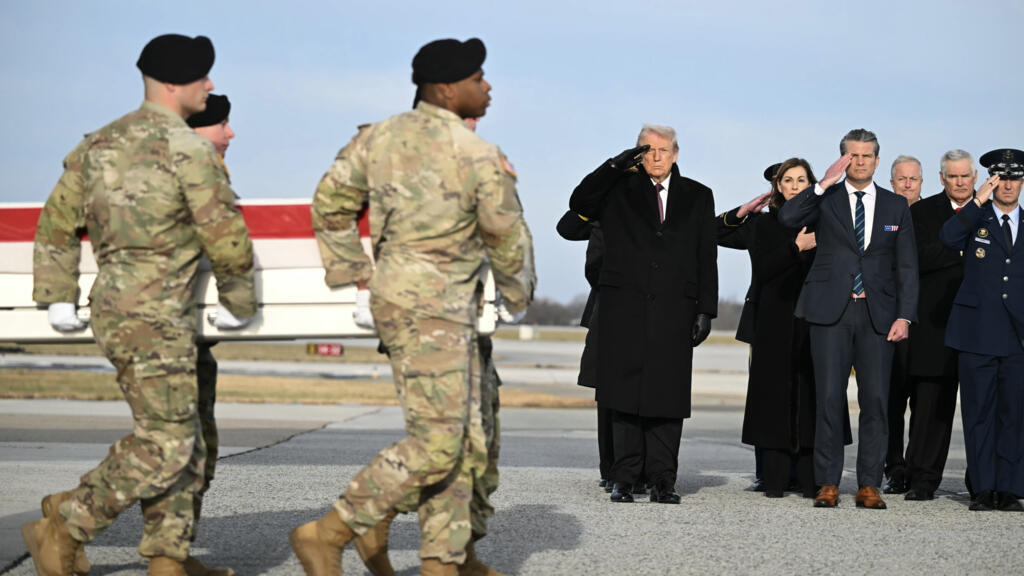
Six flag-draped caskets arrived at Dover Air Force Base on Saturday carrying the first American service members killed in fighting with Iran, their return witnessed by a president who hours earlier had threatened to escalate bombing against targets previously considered off-limits.
Donald Trump stood in a white baseball cap emblazoned with “USA” and saluted as each case was carried from the military transport. Cabinet members flanked him during the ceremony, a ritual repeated dozens of times during America’s longest wars but now marking deaths from a conflict barely a week old.
The troops died Sunday when a drone struck a command center in Kuwait, a day after Washington and Tel Aviv launched their campaign against Iran.
The attack demonstrated Tehran’s ability to hit American installations across the Gulf despite overwhelming US firepower deployed to the region in recent months.
Iran’s military used Saturday to issue a warning to Azerbaijan, demanding the former Soviet republic expel what Tehran called “Zionists” from its territory to preserve regional security. A spokesman said the message was directed at Azerbaijan as a Muslim country that should not endanger itself or Iran by hosting Israeli operations.
“We declare to Iran’s neighbouring country, the Republic of Azerbaijan, as a Muslim country, to expel the Zionists from that country in order to prevent the spread of insecurity in the region and not to endanger the security of its people and Islamic Iran,” the statement said.
The demand followed Baku’s accusation Friday that it had disrupted Iranian plans to attack infrastructure including a major oil pipeline, a synagogue and Jewish community leaders inside Azerbaijan.
Authorities provided no details about how the plots were foiled or who was detained.
Read also: UN: Women Possess Only 64% Of Men’s Legal Rights
Tehran did not respond to those allegations. Iran has long accused Israel of using Azerbaijani soil for intelligence gathering and covert operations, suspicions that intensified after drones crashed into Azerbaijan’s Nakhchivan exclave Thursday. One struck an airport, prompting Baku to blame Iran for the incident.
Iran denied responsibility and accused Israel of staging a provocation designed to inflame tensions between Tehran and its neighbor. The competing narratives reflected broader suspicions that have defined relations between the two countries for years despite their shared border and economic ties.
Israel supplies weapons to Azerbaijan and maintains close security cooperation with Baku, relationships that infuriate Iranian officials who view the partnership as a threat.
Azerbaijan, for its part, has walked a difficult line between maintaining trade with Iran and deepening military links with Israel, calculations that have grown more complex as fighting spreads.
The Dover ceremony unfolded as Trump posted on Truth Social that Iran would be “hit very hard” and that areas and groups previously spared were now under consideration for “complete destruction and certain death” due to what he called Iran’s bad behavior.
He did not specify which targets he meant or what timeline he envisioned.
Later, speaking in Florida, Trump repeated his claim that Iran had been close to acquiring a nuclear weapon and said Tehran would have used it. “They’re crazy and they would have used it. So we did the world a favour,” he said.
Defense Secretary Pete Hegseth said earlier this week the United States was “not concerned” about reports that Russia was providing intelligence to Iran on American troop positions and movements. Moscow has deep ties to Tehran but has largely avoided direct involvement in the fighting despite its geopolitical rivalry with Washington.
Read more: Oil Price Surges As Iran War Disrupts Global Energy Markets
The six deaths represent the first American combat casualties acknowledged since the conflict began, though officials have not ruled out additional fatalities among special operations forces or intelligence personnel whose missions remain classified.
Kuwait hosts thousands of US troops at installations that support operations across the Middle East.
Whether the casualties will affect public support for the campaign remains unclear. Trump has framed the war as necessary to prevent Iran from developing nuclear weapons and to eliminate what he describes as a regime that sponsors terrorism and threatens American interests globally.
Critics have questioned whether the administration has a clear strategy beyond airstrikes or whether the conflict will expand into a prolonged engagement that draws in regional powers and requires ground forces. Trump has said the fighting could last a month or more but has resisted providing detailed timelines or objectives beyond destroying Iran’s nuclear facilities.
Azerbaijan’s position has become precarious as the war intensifies. The country depends on energy exports through pipelines that could be targeted and maintains economic relationships with both Iran and Western nations that are difficult to balance during open conflict.
Iran’s warning Saturday suggested Tehran views Azerbaijani cooperation with Israel as intolerable and may take action if Baku does not sever those ties.
Whether Iran has the capacity to follow through while managing simultaneous military operations against the United States, Israel and regional adversaries is uncertain.
The Dover ceremony concluded without public remarks from Trump, who departed after the final casket was carried into a mortuary facility where remains are prepared for transfer to families. The military has not released the identities of those killed pending notification of next of kin.