
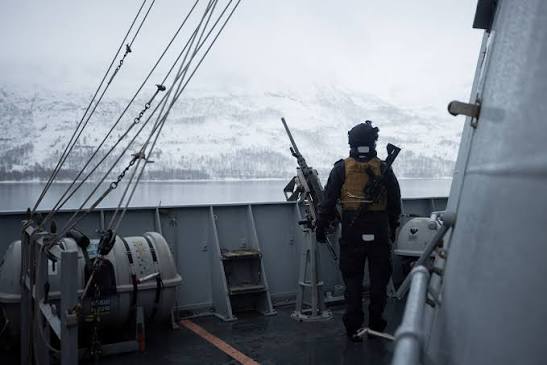
Military forces from the North Atlantic Treaty Organization on Monday launched large-scale war games in the Arctic region of Scandinavia that are aimed at simulating the defence of the region, an area that has seen tensions rise in the region amidst an uncertain strategic role for Greenland.
The war games, dubbed Cold Response, are set to take place from March 9 to March 19 and involve approximately 25,000 personnel from about 14 countries.
The majority of the activities will be conducted in the regions of Norway and Finland, both of which border Russia and are seen as integral for the defence of the High North of Europe.
The war games are set to test the readiness of NATO forces in the region, including the integration of civilian readiness.
This year’s version of the exercise focuses particularly on what the Norwegians call “total defence,” an approach that seeks to include civilian organizations, companies, and emergency services in war planning.
This, say the Norwegians, is in recognition of the fact that in modern warfare, the involvement of society is inevitable.
Read Also: Trump Heads To Davos Amid Greenland Controversy Maelstrom
Major-General Lars Lervik, the head of the Norwegian army, acknowledged that the country’s military heavily depends on the services of civilian organizations in the event of an emergency.
“We want our military to do its job of defending the country,” he was quoted by Reuters as saying before the exercise. “To do that, we are completely reliant on most aspects of society functioning as normal.”
The Cold Response drills are part of the overall Arctic Sentry mission of the North Atlantic Treaty Organization, which aims at boosting the presence of the alliance in the Arctic region.
The mission was launched in the context of tension in the relationship between the US and Denmark over the future of the vast Arctic island of Greenland, which is part of the Danish kingdom and has its own government.
US President Donald Trump has repeatedly stated that Greenland is becoming an increasingly important region in terms of strategic value, especially in terms of its geographical positioning between North America and Europe, as well as its proximity to various shipping routes and resources that are becoming more accessible as the ice cap in the Arctic melts.
President Trump has stated that the US needs to increase its presence in Greenland to address what he perceives as rising Russian and Chinese interests in the region.
Both Denmark and Greenland have dismissed the idea of Greenland being sold to the US. Denmark has stated that the political status of Greenland is not up for negotiation, while Greenland has emphasized that it is the people of Greenland who decide the future of the region.
In recent years, the Arctic region has been at the center of renewed focus by NATO nations as the region becomes an arena of increasing geopolitical rivalry.
This is partly attributed to the melting of the sea ice cap in the region, which has gradually opened up new shipping routes as well as resources in the region.
For the two countries that are members of the Alliance, namely Norway and Finland, the High North has significant security implications in the present day, given the fact that these two countries share a border with Russia.
Finland has just joined the Alliance in 2023 in the wake of the Russian invasion of Ukraine, thereby greatly expanding the Alliance’s border with Russian territory.
The exercises of the Cold Response have in the past mainly involved training in the conduct of combat operations in the midst of harsh winter weather, including amphibious landings, air operations, and large-scale troop movements in the midst of snow.
The Arctic environment is considered a critical area for training by the military given the harsh weather conditions and the fact that low temperatures and limited daylight can be quite challenging for the equipment and the troops.
The US is expected to contribute 4,000 troops to the exercise this year, and this makes the US contribution one of the largest.
Read Also: Denmark’s King Arrive Greenland In Diplomatic Show Of Support
However, the US military has confirmed that a squadron of F-35 fighter jets that were expected to participate in the exercise were withdrawn before the exercise started.
They refused to elaborate on the reason for the shift, such as whether it was linked to the war in the Middle East.
“The U.S. military is a globally deployed force and it is not abnormal for forces to be dynamically re-tasked or reallocated for a host of reasons,” a U.S. Marine Corps Forces Europe spokesperson said.
Despite the decrease in the number of aircraft, the exercise will still be extensive in terms of air, land, and sea forces.
Troops from various allied countries will be involved in a series of joint maneuvers over mountainous terrain, sea routes, and even the Arctic terrain that simulates the challenges experienced in Northern Europe.