
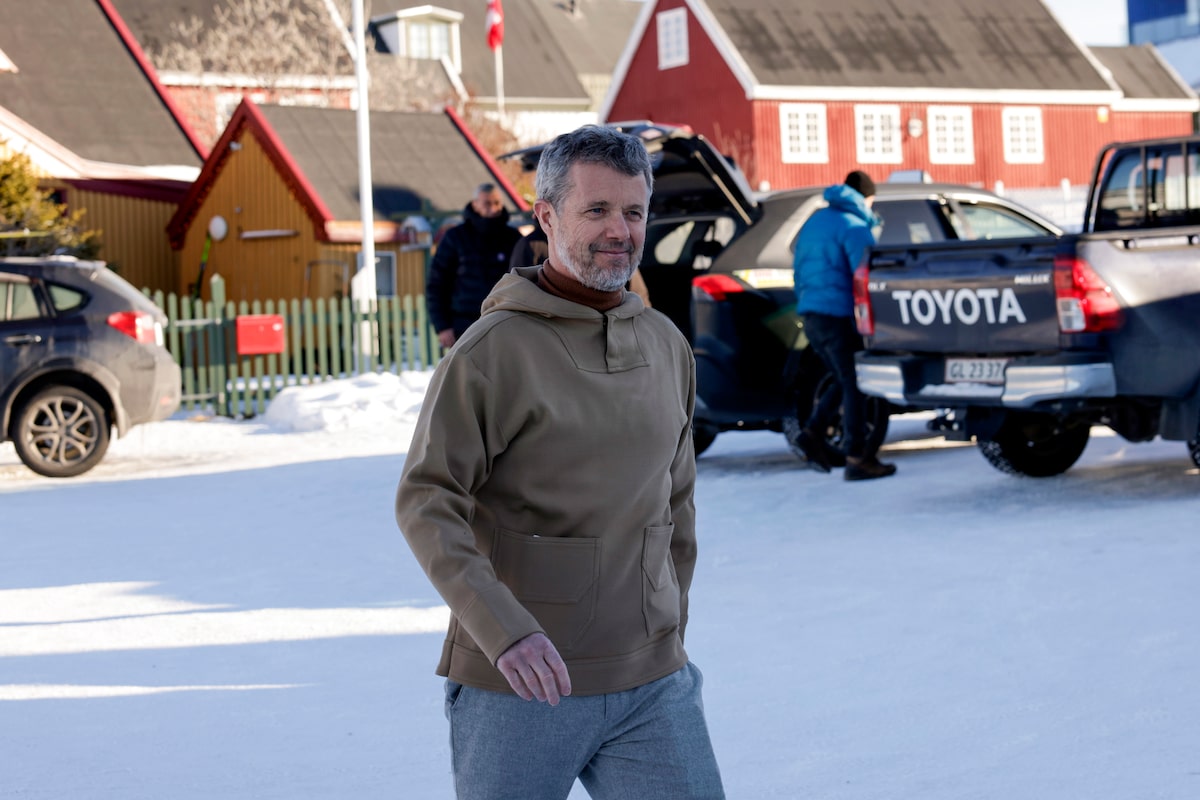
Denmark’s King Frederik arrived in Greenland’s capital Wednesday for his third visit to the Arctic territory since ascending the throne two years ago, showing unity with the region as diplomatic efforts continue, to defuse tensions over President Donald Trump’s repeated declarations that the United States must acquire the island for security reasons.
Wearing a black puffer jacket with Danish and Greenlandic flags on the left chest, the 57-year-old monarch hugged Greenlandic Prime Minister Jens-Frederik Nielsen and Parliament President Kim Kielsen upon landing at Nuuk Airport, a display of affection intended to convey Copenhagen’s solidarity with the territory of 57,000 people whose future has become entangled in geopolitical competition between Washington and its NATO allies. The three-day visit follows diplomatic talks launched last month among Greenland, Denmark, and the United States aimed at resolving the crisis that has strained transatlantic relations and raised fundamental questions about sovereignty, self-determination, and the limits of American pressure on democratic partners.
Danish Prime Minister Mette Frederiksen said Friday she and Nielsen held what she described as a constructive meeting with U.S. Secretary of State Marco Rubio during negotiations seeking to establish parameters for discussing Washington’s Arctic security concerns without entertaining Trump’s demand that Greenland join the United States. However, Frederiksen warned that Trump’s desire to acquire the island had not changed despite the diplomatic engagement, a sobering assessment that suggested the president views negotiations as tactical rather than representing any softening of his fundamental objective.
King Frederik’s itinerary includes visits Wednesday to a Nuuk school and the headquarters of Denmark’s Joint Arctic Command, which coordinates Danish military operations across Greenland and provides search-and-rescue capabilities, sovereignty patrols, and environmental monitoring in the vast territory covering more than two million square kilometers.
He will also tour Royal Greenland, the island’s largest company and a major seafood producer whose operations employ thousands and generate significant export revenues from fisheries including shrimp, halibut, and cod harvested from North Atlantic waters. Thursday the king will travel approximately 150 kilometers north to Maniitsoq on Greenland’s west coast, a town of roughly 2,500 people where fishing and tourism drive the local economy. Friday he will visit the Arctic Basic Training program in Kangerlussuaq, farther north, where Danish military personnel undergo specialized instruction in survival, navigation, and combat operations under extreme cold conditions that can reach minus 40 degrees Celsius in winter with minimal daylight.
Read Also: Greenland Military Deployments Rise Amid Trump Pressure
The Danish royal family traditionally makes annual visits to Greenland, often appearing in the island’s national dress, a white anorak for men and elaborate beaded collar in bright colors for women, complemented by sealskin boots that reflect Inuit cultural traditions. King Frederik has spent extended periods in Greenland including a four-month expedition across the island’s ice sheet, experiences that royal watchers say have deepened his personal connection to the territory and its inhabitants beyond ceremonial obligations.
The frequency of his visits since becoming king in January 2024 following Queen Margrethe II’s surprise abdication reflects the royal family’s determination to demonstrate Denmark’s commitment to Greenland at a moment when Trump’s rhetoric has raised existential questions about the relationship.
Trump has insisted repeatedly since his 2025 inauguration that acquiring Greenland represents a vital American security interest given the Arctic’s strategic importance as climate change opens new shipping routes and competition intensifies with Russia and China for access to resources and military positioning.
He has declined to rule out using military force to compel Greenland’s transfer, though he has recently modulated his rhetoric to emphasize economic benefits and downplay coercion while insisting there is “no going back” on his acquisition ambitions.
The threats have generated bipartisan outrage across Europe and deepened anxiety within NATO about American commitment to alliance norms and respect for member sovereignty. European leaders privately question whether Trump views territorial integrity and democratic principles as negotiable, while publicly expressing confidence that diplomatic channels will resolve disagreements without rupturing the transatlantic partnership that has underpinned Western security since World War II.
Administration officials have suggested Greenland’s mineral wealth including rare earth elements, its strategic geography commanding northern Atlantic sea lanes and Arctic approaches, and concerns about Chinese influence provide rationale beyond security considerations, though critics note similar arguments have historically justified colonial expansion and imperial ambitions that the postwar international order explicitly prohibits.
Read Also: Canada Moves To Establish Greenland Consulate, Sends Envoys
Greenland has substantial self-governance authority over domestic affairs while Denmark controls defense, foreign policy, and monetary systems under a home rule arrangement established in 1979 and expanded in 2009. A strong independence movement advocates full sovereignty, though economic realities complicate that aspiration—Greenland depends heavily on annual subsidies from Copenhagen exceeding $500 million that sustain public services, education, and healthcare for a small, geographically dispersed population facing high costs and limited economic diversification beyond fishing and emerging mining projects.
Some Greenlanders have expressed openness to exploring closer U.S. ties including potentially joining America if offered generous financial terms and guaranteed autonomy over language, culture, and local governance. However, polls consistently show majority opposition to being acquired by any foreign power and preference for maintaining the Danish relationship or pursuing outright independence rather than exchanging one external authority for another regardless of economic incentives Washington might offer.
Multiple opposition parties in Denmark have accused Frederiksen’s government of insufficient firmness in rejecting Trump’s demands, though the prime minister has carefully navigated between defending Greenlandic self-determination and avoiding rupture with Denmark’s most important military ally. The diplomatic balancing reflects Denmark’s vulnerability as a small nation dependent on American security guarantees yet committed to democratic principles including the right of peoples to choose their political future without external coercion.
Frederik’s visit represents what Danish officials characterize as solidarity with Greenlanders facing unprecedented pressure and uncertainty about their relationship with Denmark and their place in an increasingly contested Arctic where great power competition threatens to overwhelm local voices and interests. Whether the king’s presence reassures Greenlanders or proves insufficient absent concrete economic and political reforms addressing legitimate grievances about Danish paternalism and unfulfilled promises of equal partnership will influence whether Denmark retains Greenlandic loyalty or whether Trump’s courtship finds receptive audiences.