
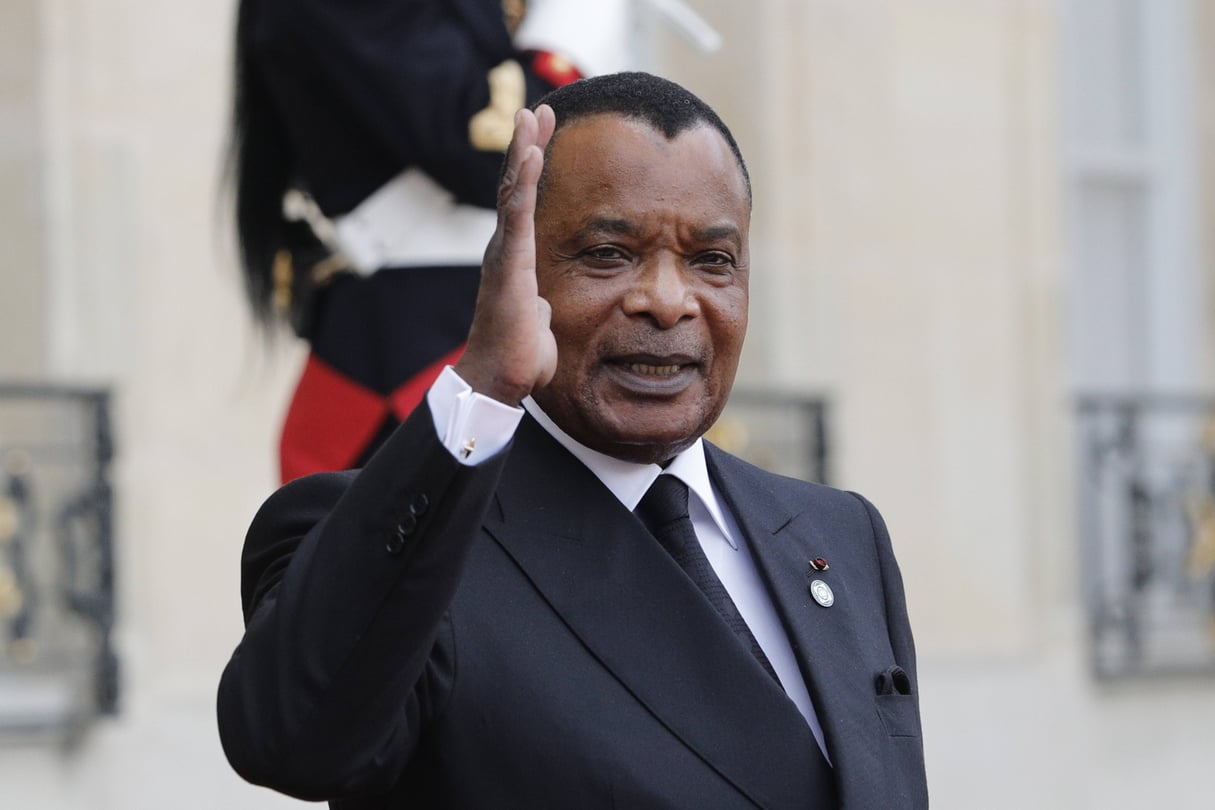
Denis Sassou Nguesso, the 82-year-old who has governed the Republic of Congo for a combined 42 years, goes to the polls on Sunday in an election analysts describe as a foregone conclusion, yet one that carries unusually high stakes, not for its outcome, but for what it sets in motion: a succession battle that could determine whether his family’s hold on power outlasts his own presidency.
Presidential elections are scheduled to be held in the Republic of Congo on March 15, 2026. Sassou Nguesso will face six candidates in a vote organized by a commission dominated by figures from his own ruling Congolese Labour Party.
Two prominent candidates from the 2016 election, General Jean-Marie Michel Mokoko and André Okombi Salissa, remain in detention after being convicted on charges related to internal security.
Several other potential challengers are in exile. In June 2025, the Ministry of Interior suspended 15 opposition parties, including several that had been planning to form a coalition to contest the elections. The practical effect was to reduce the field to six weak candidates facing a president who controls the electoral commission, the security forces, the courts, and the state broadcaster.
Sassou Nguesso was declared the winner of the 2021 presidential election with 88 percent of the vote, in which the main opposition parties boycotted due to unfair conditions. The vote was marked by low turnout and voters’ names left off voter registries.
The 2026 vote was shaping up as a near-identical exercise. Freedom House gave the Republic of the Congo a score of 2 out of 40 for political rights in its 2024 report. Remadji Hoinathy of the Pretoria-based Institute for Security Studies summarized the consensus view among political observers: “This election is a mere formality. The real stakes lie in what comes next.”
The constitutional architecture that makes Sunday’s result predictable also makes it historically terminal, at least in theory. A 2015 constitutional reform reset the presidential term counter and removed the age limit of 70, allowing Sassou Nguesso to run again in 2016 and 2021. But it capped the total number of terms at three five-year mandates. The ruling camp frames the candidacy around “stability” and “continuity” and highlights the president’s “experience” as a central argument. His campaign slogan this year is “Let us accelerate the march” — an iteration of his 2021 slogan, “Let us continue the march towards development.”
Sassou Nguesso opened his campaign in Pointe-Noire, the country’s oil capital, telling young supporters that his generation was “laying the groundwork” for them to take over — the first time the 82-year-old had spoken openly about eventual succession in a public address.
The succession question is the live political drama beneath the scripted electoral exercise. The most prominent potential successor is the president’s 50-year-old son, Denis-Christel Sassou Nguesso, Minister of International Cooperation. He has, up to now, struggled to win over party leadership.
Independent consultant Maja Bovcon, who focuses on West and Central Africa, was blunt about the risk: “Denis-Christel does not command the same authority within the ruling party as his father and is widely unpopular. His potential accession to power threatens to unleash a violent succession struggle.” He faces competition from Jean-Dominique Okemba, Secretary General of the National Security Council, and Jean-Jacques Bouya, Minister of State for Regional Development and Sassou Nguesso’s cousin. Hoinathy summarized the dynamic: “Sassou won’t leave power unless he can hand it to someone trusted in his close circle — his son or a trusted ally who guarantees stability.”
Read Also: Eastern Congo Mass Graves Discovered Following Rebel Exit
Sassou Nguesso has long maintained close ties with China and Russia, both of which are deeply involved in the Congo’s hydrocarbon and mineral sectors. China has provided financing for major investment projects, often in exchange for oil and timber, and the Congo has accumulated an estimated $3.2 billion in debt to China. Russia, meanwhile, holds a 90 percent stake in the Pointe Noire-Makoulou Pichot oil pipeline. Those ties have insulated Brazzaville from Western pressure over its democratic deficits, as both Beijing and Moscow have provided diplomatic cover against UN resolutions and bilateral sanctions at critical moments in Sassou Nguesso’s hold on power.
Read Also: Uganda Election: Museveni Seeks New Term Amid Tensions
The economy has returned to modest growth after a decade-long recession, but the gains have not reached ordinary citizens. Oil still accounts for approximately half of Congo’s GDP and 80 percent of its exports, a dependence that leaves the country acutely vulnerable to global price shocks of the kind currently being created by the US-Israel war against Iran and the Strait of Hormuz closure. While there may be little suspense as to the outcome of the country’s 2026 presidential election, there is growing intrigue regarding the intraparty succession battle that is intensifying. Competing camps are vying to take over the mantle of party leadership when Sassou Nguesso steps down. More than 52 percent of Congo’s 6.1 million people live in poverty, a figure unchanged since 2021. Youth unemployment stands at approximately 42 percent in a country where nearly half the population is under 18. “We need better health care and education,” Frédéric Nkou, a jobless voter in Brazzaville, told Reuters. “But with this new term, we will experience more of the same.”
French and US prosecutors have launched separate investigations into assets held abroad by members of the Sassou family. The family has consistently denied wrongdoing. The investigations add an external dimension to the succession calculus — any successor outside the family circle would have less incentive to protect the family’s accumulated offshore holdings, a consideration that Hoinathy and other analysts said made a purely meritocratic transition within the ruling party implausible.