
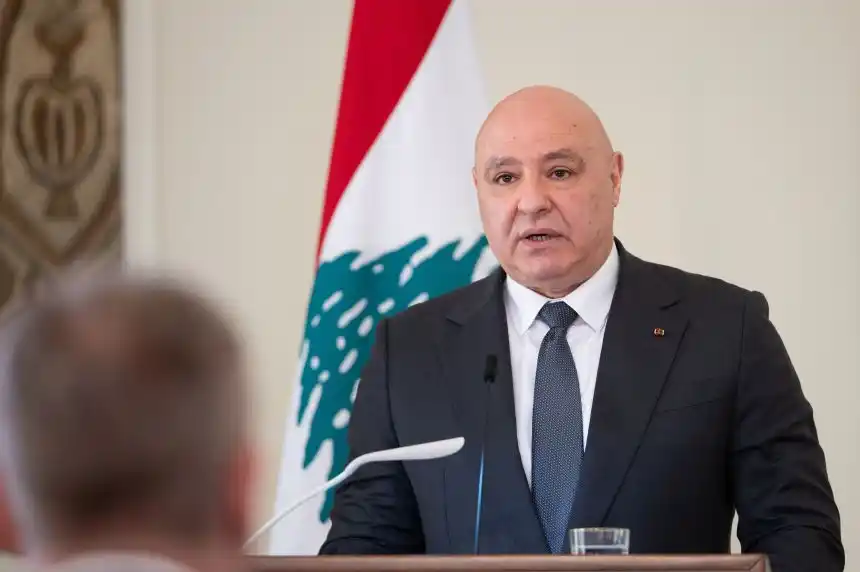
Lebanon’s government has indicated it may be prepared to pursue direct negotiations with Israel as part of a broader effort to halt the expanding confrontation involving Hezbollah, signaling a potentially significant shift in Beirut’s approach to a conflict that has rapidly destabilized the country’s southern frontier. President Joseph Aoun outlined the proposal during discussions with senior European Union officials, presenting it as a framework aimed at restoring long-term security along the Lebanese-Israeli border while addressing the growing humanitarian crisis unfolding inside Lebanon.
According to the president’s office, Beirut is open to diplomatic engagement with Israel under international sponsorship, though Lebanese authorities insist such talks cannot proceed while Israeli military operations continue. The country has endured a surge in air strikes over recent days, a development Lebanese officials say has compounded an already severe displacement emergency affecting hundreds of thousands of civilians.
Read Also: Ukraine Retakes 400km² As Russia Bombs Sloviansk, Talks Stall
The proposal presented by Aoun outlines a four-part framework intended to simultaneously halt hostilities and reshape the security structure in southern Lebanon. Central to the plan is the establishment of a comprehensive truce between Israel and Hezbollah. Under this arrangement, the Iran-backed armed group would relinquish its weapons, while international partners would assist the Lebanese Armed Forces in restoring full authority over areas historically dominated by the militia.
Lebanese officials argue that such measures could create the conditions necessary for direct negotiations between Beirut and Tel Aviv. The discussions, they suggest, would be conducted under international oversight and aimed at implementing what Aoun described as “permanent security and stability arrangements” along the border.
The proposal emerges against the backdrop of one of the most serious escalations between Israel and Hezbollah in recent years. Lebanese authorities report that Israeli air strikes over the past nine days have caused widespread devastation, killing hundreds and forcing a mass exodus from affected communities. The United Nations estimates that more than 700,000 people have been displaced, including roughly 200,000 children.
Large numbers of those uprooted by the fighting have sought refuge in temporary shelters or public buildings, while others remain stranded without basic necessities. In some areas, families have been forced to flee with little warning as bombardments intensified.
Aoun emphasized the scale of the humanitarian strain in remarks delivered during the virtual meeting with European officials. He warned that many displaced residents are now living in extremely precarious conditions, with limited access to shelter, food, and medical care.
Alongside his call for diplomatic engagement, the Lebanese president delivered unusually sharp criticism of Hezbollah, reflecting growing tensions between the state and the powerful armed movement that has long played a dominant role in the country’s political and military landscape.
Aoun characterized Hezbollah as an armed faction operating outside the authority of the Lebanese state and accused it of disregarding the country’s national interests. According to the president, the group’s actions risk dragging Lebanon deeper into regional confrontation while exposing civilians to the consequences of military retaliation.
The comments follow a formal declaration by the Lebanese government last week stating that Hezbollah’s military operations are illegal. Despite the statement, officials in Beirut acknowledge that the state currently lacks the military capacity to forcibly disarm the organization without substantial international support.
Israel, meanwhile, has shown little indication that it is prepared to engage in negotiations under the conditions proposed by Lebanon. Israeli officials have repeatedly emphasized that the disarmament of Hezbollah remains the central objective of their military campaign.
Israeli Prime Minister Benjamin Netanyahu addressed the Lebanese government directly in a public message last week, arguing that Beirut bears responsibility for enforcing existing ceasefire arrangements and dismantling Hezbollah’s military infrastructure.
Diplomatic signals from Israel have also underscored skepticism regarding Lebanon’s willingness or ability to take decisive action against the group. Israel’s ambassador to France, Joshua Zarka, said he was unaware of any concrete steps taken by Beirut to move toward Hezbollah’s disarmament.
From the Israeli perspective, the continuation of military operations is tied directly to what officials describe as Hezbollah’s ongoing efforts to rebuild its capabilities along the border.
A fragile ceasefire brokered in November 2024 with mediation from the United States and France had briefly reduced tensions between Israel and Lebanon. Yet the agreement has struggled to hold, with Israel conducting near-daily strikes it says are aimed at preventing Hezbollah from rearming.
The latest escalation was triggered after Hezbollah launched rockets and drones toward northern Israel shortly after the beginning of a joint American-Israeli military operation targeting Iran. The armed group framed the attack as retaliation for the killing of Iran’s Supreme Leader, Ayatollah Ali Khamenei, as well as for continued Israeli strikes across the region.
Lebanese authorities, however, have portrayed the incident differently. Aoun suggested that Hezbollah’s actions effectively set a trap for the Lebanese state, drawing the Israeli military into a renewed confrontation that Beirut is ill-equipped to manage.
Israel responded by expanding its campaign against Hezbollah, carrying out repeated air strikes and special operations inside Lebanese territory. Israeli officials say the operations will continue until the group’s military capacity has been dismantled.
Hezbollah has maintained that it will persist in its attacks on Israel regardless of the cost, a position that raises the prospect of prolonged conflict along the already volatile border.
The human toll continues to rise as the fighting intensifies. Lebanese health officials report that at least 486 people have been killed in Israeli strikes since the latest escalation began. Israeli authorities say two soldiers have been killed in combat operations in southern Lebanon.
For civilians caught between the opposing forces, the renewed hostilities have revived memories of earlier wars and deepened fears about the future.
Read Also: Australia Grants Refuge To Five Iranian Women Soccer Players
Ahmed al-Halabi, a father of two from the Dahieh district of so
uthern Beirut, described fleeing his home in the middle of the night after nearby missile strikes shook the neighborhood. Along with his extended family, he sought refuge in a school building in central Beirut that has been converted into a shelter for displaced residents.
He said the experience has been particularly devastating for his children, who have now endured multiple episodes of conflict in their young lives.
According to al-Halabi, the psychological impact on children living through repeated cycles of violence is profound. Adults may learn to cope with the instability, he said, but the trauma experienced by younger generations is far harder to overcome.
As diplomatic tensions mount and military operations continue, Lebanon’s proposal for negotiations introduces a potential pathway toward de-escalation. Whether such a framework can gain traction, however, will depend on the willingness of regional actors—and Hezbollah itself—to accept a fundamentally different security arrangement along one of the Middle East’s most volatile frontiers.