
Australia committed advanced surveillance aircraft and air-to-air missiles to Gulf states confronting Iranian strikes, a deployment Prime Minister Anthony Albanese defended Tuesday as necessary to protect 115,000 Australians living across a region where twelve countries have come under attack in just over a week.
A Royal Australian Air Force E7A Wedgetail reconnaissance plane and 85 supporting personnel will operate over the Gulf for the next four weeks to help secure airspace and assist what Albanese described as “collective self-defence.” Canberra will also send advanced medium-range missiles to the United Arab Emirates following a phone call between Albanese and Emirati President Mohammed bin Zayed Al Nahyan.
The decision drew immediate criticism from the opposition Greens, who warned Australia risks entanglement in what Senator Larissa Waters called another US-led “forever war.” Australia lost more than 50 personnel during the invasions of Afghanistan and Iraq, conflicts that stretched across two decades and left scars the country has struggled to process.
“Australians do not want to get dragged into Trump and Netanyahu’s illegal war on Iran,” Waters said in a statement. “Labor shouldn’t be sending troops to help a military that’s killed 150 schoolchildren in a primary school bombing. That will only escalate an illegal conflict that’s already spiralling out of control, and leave Australia trapped in yet another forever war.”
Read also: Australia Grants Asylum To Iranian Women’s Soccer Players
Albanese stressed the deployment carries strictly defensive objectives and does not include ground troops in Iran. “My government has been clear: We are not taking offensive action against Iran, and we are clear we are not deploying Australian troops on the ground in Iran,” he told reporters.
The prime minister said 24,000 Australians live in the UAE alone, part of a broader expatriate population scattered from Cyprus through the Gulf that has come under threat as Iranian missiles and drones target installations across the region. “Helping Australians means also helping the United Arab Emirates and other Gulf nations defend themselves against what are unprovoked attacks,” he said.
Roughly 2,600 Australians have evacuated the Middle East since fighting began, though Albanese acknowledged “significant challenges” remain for those who want to leave but have not yet found transport out.
Waters accused the government of operating without limits in appeasing US President Donald Trump and Israeli Prime Minister Benjamin Netanyahu. “Every day Trump and Netanyahu’s demands of Australia keep growing,” she said. “It was refuelling US spy planes yesterday, a recon jet and missiles today, and could be ever more troops tomorrow. Labor has no red lines when it comes to appeasing Donald Trump and Benjamin Netanyahu.”
The Wedgetail aircraft provides long-range surveillance and airborne early warning capabilities, tracking aircraft and missiles across vast distances.
The platform has been used in coalition operations before, including during the campaign against Islamic State in Iraq and Syria.
Read more: France Deploys Carrier Group, Plans Hormuz Escort Mission
How the deployment fits into broader coalition efforts to counter Iranian strikes remains unclear. Albanese did not specify which other countries are coordinating air defense operations or whether Australian assets will operate under a unified command structure.
Britain authorized American forces to launch strikes from British installations against Iranian missile sites earlier this week, expanding the conflict’s geographic scope and raising questions about which other US allies might contribute military resources.
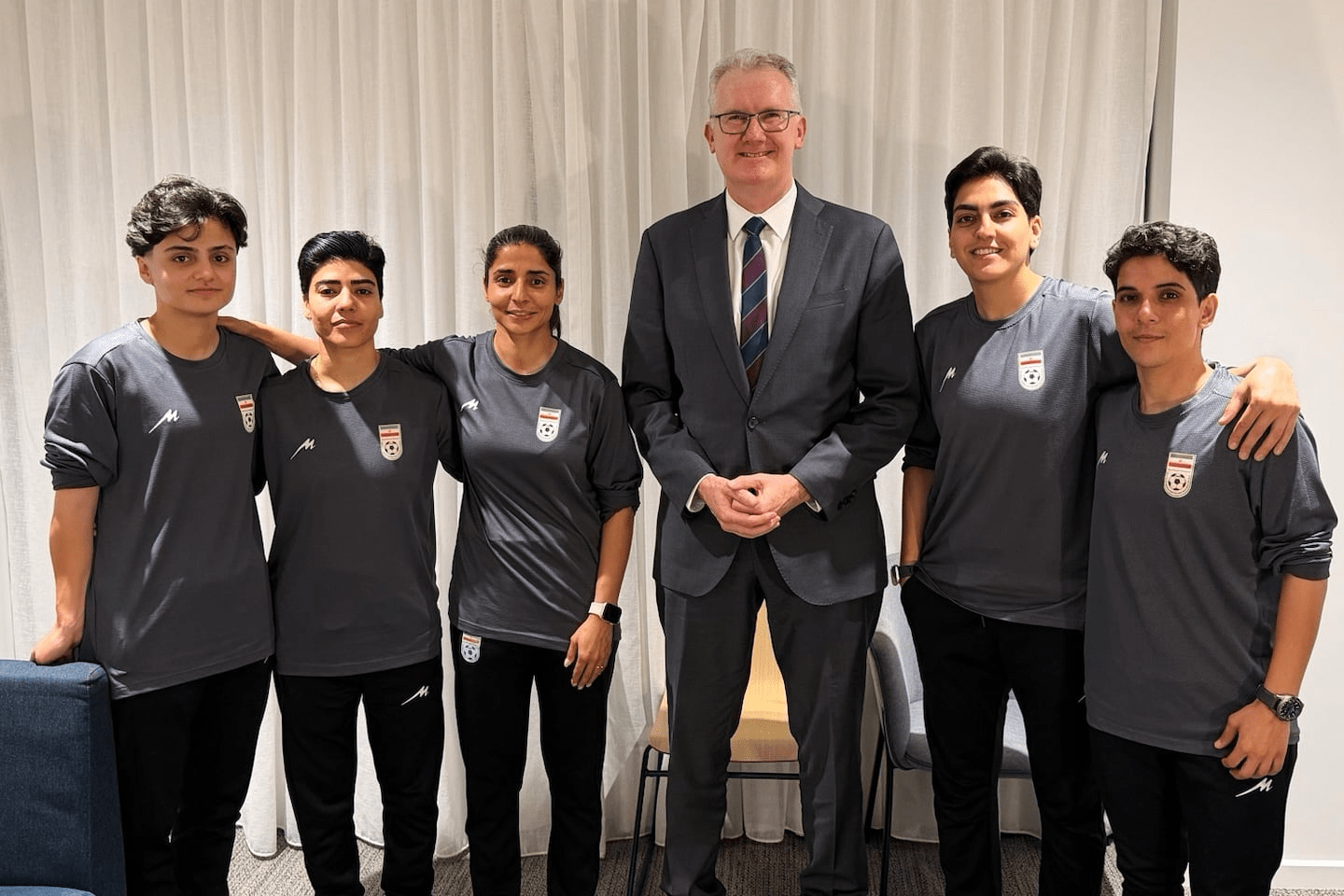
Separately, Albanese announced Canberra granted asylum to five members of Iran’s women’s football team who were in Australia for the Asian Football Confederation Women’s Asian Cup 2026 in Queensland. The players received humanitarian visas and were moved to safe locations with assistance from Australian Federal Police.
“Australians have been moved by the plight of these brave women,” Albanese said. “They’re safe here, and they should feel at home here.”
The asylum decision reflects concerns about what awaits the players if they return to Iran, where authorities have cracked down on women’s rights and punished those perceived as challenging the Islamic Republic’s restrictions. Iranian women’s sports teams have faced pressure to conform to government ideology, with athletes who speak out risking detention or worse.
Iran’s conflict in the Middle East began nine days ago when American and Israeli forces killed Supreme Leader Ayatollah Ali Khamenei in airstrikes on Tehran.
Iranian retaliation has targeted installations across a dozen countries, disrupting air travel, forcing evacuations and triggering emergency air defense operations that have strained military resources across the Gulf.
“Iran’s reprisal attacks continue to escalate, already at a scale and depth we haven’t seen before,” Albanese said. “Twelve countries across the region, from Cyprus through to the Gulf, are continuing to be targeted.”
Whether Australia’s commitment represents the limit of its military involvement or the beginning of deeper engagement will depend partly on how the conflict evolves and what additional requests Washington and regional partners make. Waters suggested demands could escalate, citing a pattern of incremental commitments that eventually lock countries into prolonged operations.
Australia’s military has participated in coalition operations across the Middle East for decades, though public support for such missions has waned since the Iraq and Afghanistan wars ended without clear victories.
Polling has shown Australians skeptical of new overseas deployments, particularly when objectives and exit strategies remain undefined.
The government’s emphasis on defensive operations and a four-week timeline appears designed to limit political exposure while addressing immediate threats to Australians living in the region. Whether those boundaries hold if fighting continues beyond the initial deployment period remains uncertain.