
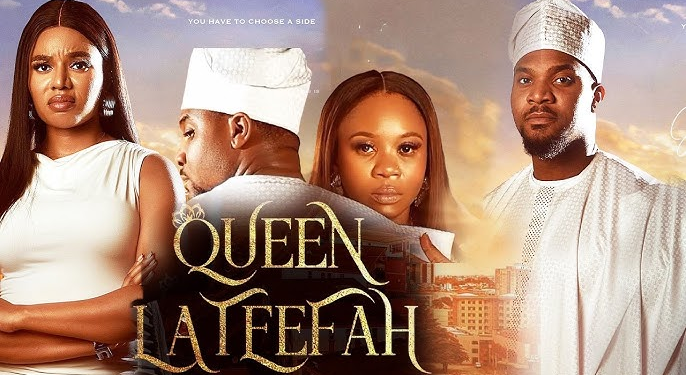
Official Trailer:
Nollywood has long understood the dramatic power of ambition—the intoxicating rise, the devastating fall, and the complicated journey back toward relevance. Yet every so often a film arrives that handles these themes with a sharper sense of social observation. Queen Lateefah is one such film: a confident, stylish drama that explores the fragile architecture of status in modern Lagos.
Directed by Adeoluwa Owu and anchored by a commanding performance from Wumi Toriola, the film enters a familiar Nollywood terrain—wealth, prestige, and the quiet rivalries that animate elite society. But it quickly distinguishes itself by examining what happens when privilege collapses and reputation becomes the battleground on which survival is negotiated.
Lateefah begins the story as a woman firmly situated within Lagos’ upper social circles. She moves through a world of curated appearances, private gatherings, and networks built on influence and visibility. In this environment, identity is inseparable from public perception. Status is not merely enjoyed—it is performed, protected, and constantly reaffirmed.
The illusion of permanence soon shatters. A scandal connected to her family sends shockwaves through the social ecosystem that once embraced her. Overnight, the same spaces that celebrated her success become arenas of scrutiny and quiet distance. Friends become cautious observers, and the privileges she once took for granted begin to evaporate.
Read also: Iconic Harry Potter Actor Sir Michael Gambon Dies At 82
What makes Queen Lateefah particularly engaging is the way it refuses to frame this collapse as simple tragedy. Instead, the film transforms the narrative into a study of strategic resilience. Lateefah does not retreat from the world that has rejected her; she studies it. She learns its shifting rules, recalibrates her position, and begins the deliberate process of rebuilding influence.
This transformation is where Wumi Toriola’s performance becomes especially compelling. Her portrayal avoids the exaggerated emotional rhythms that sometimes define melodrama. Instead, she gives Lateefah a quiet intensity—an intelligence that registers every subtle shift in power around her. Pride, vulnerability, and determination coexist within the character, creating a portrait of someone navigating humiliation without surrendering ambition.
The supporting cast deepens the film’s social texture. Actors such as Kunle Remi and Femi Adebayo bring nuanced performances that highlight the complicated loyalties within Lagos’ elite circles. Relationships evolve not through grand declarations but through small gestures and carefully chosen words. Alliances form, dissolve, and re-emerge, often driven as much by opportunity as by genuine connection.
Read more: Stop Projecting Nigerians As Uncivilized, Yul Tells Producers
Visually, Queen Lateefah demonstrates Nollywood’s increasing cinematic confidence. Rather than relying solely on dialogue to communicate social hierarchy, the film allows environments to speak. Elegant homes, fashion choices, and meticulously staged events reveal the subtle codes that define prestige. These spaces are not merely decorative; they function as extensions of the characters’ identities.
When Lateefah’s position weakens, those same environments acquire a different emotional weight. Rooms once associated with influence now feel like reminders of what has been lost. The visual contrast underscores the precarious nature of status in a city where reputation can shift with startling speed.
Beyond its narrative drama, the film also serves as an observation of contemporary Nigerian society. Lagos is portrayed as a city driven by ambition, visibility, and relentless competition. Success is rarely private—it is displayed, scrutinized, and negotiated within a complex network of expectations.
Watch the Full Movie Here (our Telegram link)
Lateefah understands this ecosystem perhaps better than anyone around her. Her journey becomes an exploration of how identity can be reconstructed through perception, strategy, and persistence. The audience is left to decide whether her transformation represents genuine empowerment or simply mastery of a social system built on appearances.
The film’s success also reflects Nollywood’s growing global momentum. Nigerian cinema has steadily expanded beyond its traditional production model, embracing theatrical releases, streaming platforms, and increasingly polished visual storytelling. Queen Lateefah illustrates how the industry continues to evolve while maintaining its instinct for emotionally resonant narratives.
Yet the film’s most powerful quality lies in its emotional universality. Beneath the glamour of wealth and rivalry is a familiar human experience: the challenge of rebuilding after loss. Most viewers will recognize the uneasy moment when the identity they once relied upon no longer holds.
Lateefah’s story simply unfolds on a more dramatic stage.
By the film’s closing moments, the audience may find themselves reflecting not only on Lateefah’s fate but also on the broader realities of ambition in modern society. In Lagos, as the film quietly suggests, reinvention is not merely a possibility—it is often a necessity.
In capturing that tension between downfall and resilience, Queen Lateefah offers more than entertainment. It presents a thoughtful portrait of a society where reputation is fragile, power is negotiated, and survival belongs to those willing to adapt.