
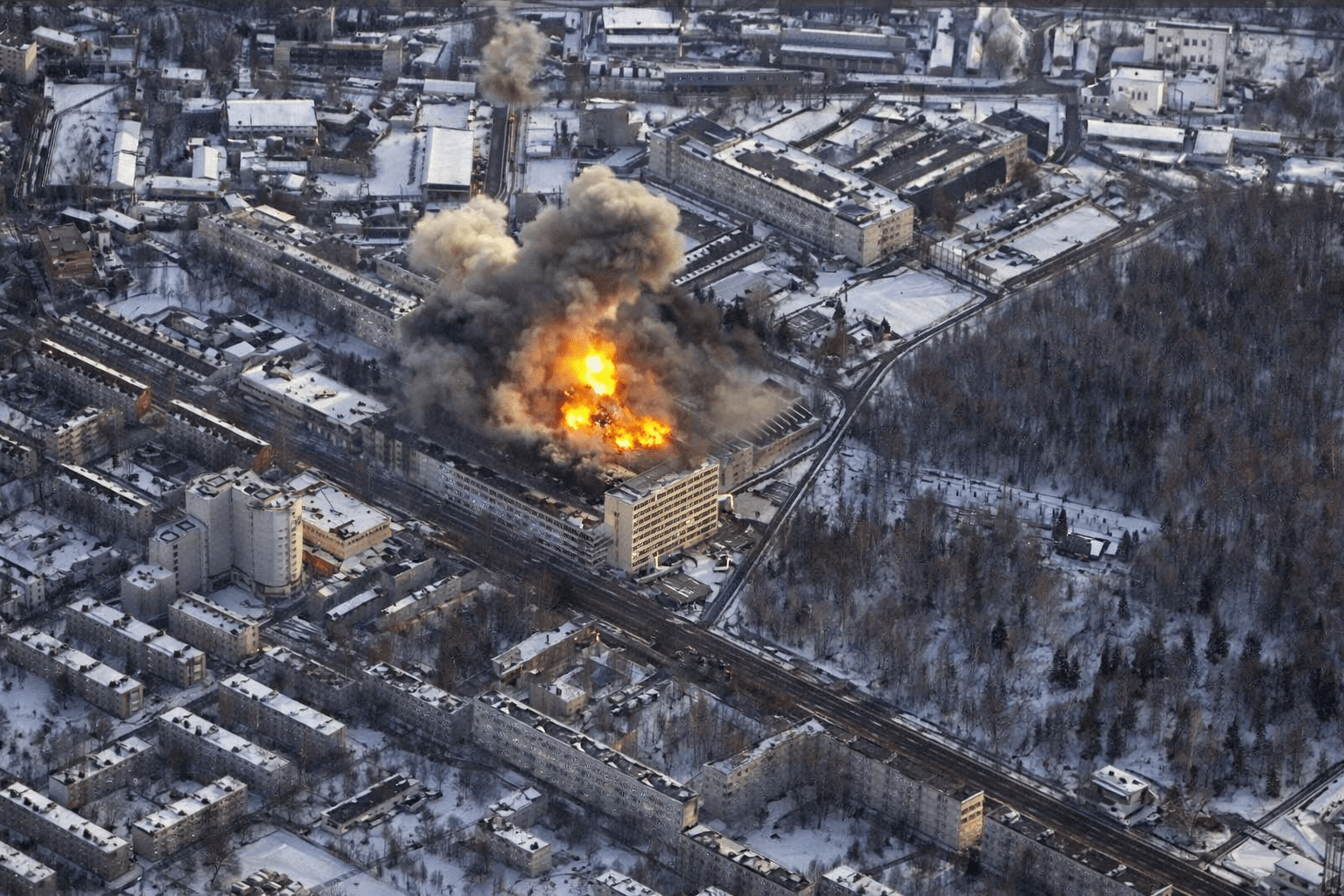
Ukrainian forces destroyed a significant portion of the Kremniy El microelectronics plant in Bryansk on Tuesday using British-supplied Storm Shadow cruise missiles, targeting a facility that Kyiv’s military said is responsible for producing the semiconductor components that guide Russia’s Iskander ballistic missiles and a range of other precision weapons.
The strike, confirmed by President Volodymyr Zelensky and released on video by Ukraine’s General Staff, represents one of the deepest and most strategically targeted attacks on Russian military-industrial infrastructure since the full-scale invasion began in February 2022.
Russian regional governor Aleksandr Bogomaz confirmed the attack and said six people were killed and 37 injured. He described it as a “terrorist missile attack” and urged residents in Bryansk’s Sovetsky district, where the plant is located, to remain indoors and close their windows due to smoke in the area.
He did not initially identify the plant by name. Local social media groups reported that the factory’s main assembly hall had sustained heavy damage and that people had been trapped under rubble, while residents separately confirmed a strike on the plant’s administrative building.
The Kremniy El facility is Russia’s second-largest microelectronics producer, with approximately 90 percent of its output directed to the Russian defence ministry. Ukraine’s General Staff described the plant as a critically important node in the production chain for Russia’s high-precision weapons, specialising in discrete semiconductor devices and integrated microchips — the components it said serve as the “brains and nervous system” of modern armaments, including Iskander missiles. The strike specifically targeted production of the control block used in the Izdelie-30 cruise missile, the same type used three days earlier in an attack on a residential building in Kharkiv that killed eleven people, including a thirteen-year-old girl and a nine-year-old boy.
Zelensky confirmed the operation in a nightly address and in a media briefing in which he said Commander-in-Chief Oleksandr Syrskyi had personally informed him of the outcome. “Our soldiers struck one of the key Russian military factories in Bryansk,” he said. “This factory produced electronics and components for Russian missiles. The very missiles that strike our cities, our villages and civilians.” He called the strike “a completely justified response to the aggressor.”
Open-source intelligence analysts from the Ukrainian community CyberBoroshno reconstructed the missile flight path, tracing the Storm Shadows from their point of entry into Bryansk Oblast at 16:52 local time through the Pogar district and the Trubchevsk area to the plant itself, where the first impact was recorded at 16:59. The analysts documented seven individual strikes on the facility. Aerial reconnaissance following the attack was conducted by operators from the Raid unit of Ukraine’s 413th Regiment of the Unmanned Systems Forces, which flew a drone over Bryansk without interference to assess battle damage.
Read Also: Russia Kills Seven in Kharkiv, Ukraine Residential Block
The Storm Shadow cruise missile, which weighs approximately 1,300 kilograms and carries a 450-kilogram warhead, uses a combination of inertial navigation, GPS, and terrain-following systems to strike hardened fixed targets at low altitude, making it difficult to intercept with conventional air defences.
The weapon has a declared export range of 250 kilometres, though its operational reach is assessed at considerably more. Ukrainian forces had previously struck the Kremniy El plant six times using drones, but those attacks had been considered less effective against the facility’s hardened production infrastructure. Tuesday’s cruise missile strike, by contrast, destroyed the main production workshop and caused structural damage across multiple buildings, according to the General Staff’s damage assessment.
Kremlin spokesman Dmitry Peskov said in Moscow that the involvement of British-supplied weapons made London’s role in the attack impossible to overlook.
“It is obvious that the launch of these missiles was impossible without British specialists,” he said, without elaborating on the claim’s factual basis. He added that preventing what he described as “barbaric actions by the Kyiv regime” was among the stated objectives of Russia’s military operation in Ukraine.
Russia has throughout the war denied that its own strikes constitute attacks on civilian infrastructure, even as Ukrainian authorities have documented repeated missile and drone impacts on hospitals, residential blocks, and energy facilities. A United Nations inquiry published on March 10 concluded that Russia’s forced deportation and transfer of Ukrainian children throughout the full-scale war amounts to crimes against humanity. Moscow has rejected that characterisation.
Read Also: Ukraine Retakes 400km² As Russia Bombs Sloviansk, Talks Stall
On the same day as the Bryansk strike, Russian attacks continued across Ukrainian territory. A drone strike in Kharkiv, Ukraine’s second-largest city and one of the most frequently targeted, killed two people and wounded five others. A separate Russian attack on Slovyansk in eastern Ukraine the previous day killed four people and injured sixteen. Ukrainian military reporting indicated nine people were killed and 44 injured by Russian strikes across the country in the twenty-four hours to March 11.
Zelensky confirmed that a further round of Russia-Ukraine-US negotiations could take place next week, with talks initially scheduled in the United Arab Emirates postponed by the American side, partly in connection with the intensification of the conflict in the Middle East. Switzerland has been proposed as an alternative venue.
The negotiations, led by the Trump administration, have so far failed to produce a ceasefire framework. The central obstacle remains Washington’s proposal that Ukraine formally relinquish Russian-occupied portions of the Donetsk and Luhansk regions — an offer Kyiv has publicly and repeatedly rejected, arguing that conceding occupied territory would set a precedent that could invite further aggression.
Russia has threatened to seize those territories by force if Ukraine refuses to cede them at the negotiating table. The front line in eastern Ukraine has remained largely static for several months, with Russia recording incremental advances and Ukraine conducting counter-operations.
A full damage assessment of the Kremniy El plant has not yet been released. Ukraine’s General Staff said the assessment was ongoing and that further details would follow.