
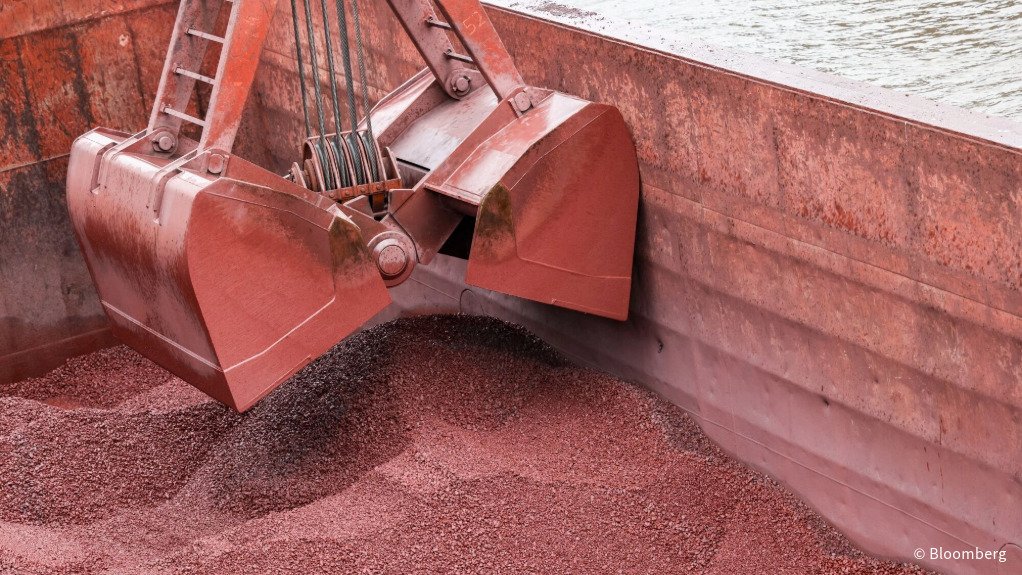
China’s state-backed iron ore procurement agency has extended purchasing restrictions to BHP’s most commercially significant Pilbara products, Mac fines, Newman fines, and Newman lumps, escalating a contract standoff that has now entered its sixth month with no resolution disclosed and an expanding volume of unsellable ore accumulating at Chinese ports.
China Mineral Resources Group, known as CMRG, directed several traders this week to reduce new seaborne purchases of the three flagship BHP grades, according to two people with knowledge of the matter who spoke on condition of anonymity.
Unlike the restricted products that preceded them, Jimblebar Blend Fines, banned in September, and Jinbao fines, restricted in November, Mac fines, Newman fines, and Newman lumps are BHP’s highest-volume exports to China and central to the company’s revenue. BHP supplies roughly 13 percent of China’s total iron ore imports, making its Pilbara product suite indispensable to a steel industry that processes around one billion tonnes of crude steel annually. BHP declined to comment on the latest restrictions. CMRG did not respond to media requests.
The widening of the curbs moves the dispute into materially different commercial territory. The September and November bans targeted lower-volume, lower-grade products whose restriction, while symbolically significant, was unlikely to significantly impact overall market dynamics given the comparatively smaller trade quantities involved. The new restrictions encompass the products that move real volume. Traders who spoke to Reuters on condition of anonymity said they were already working to liquidate existing port stocks.
“We are planning to sell off all Newman fines at ports in the next few days and will get off Mac fines as well, even if it’s not under this wave of restriction now, as you do not know when they would prohibit you from taking delivery of Mac fines,” one trader said. Customers have been told they may take delivery of existing cargoes within five working days, two sources said.
Jimblebar stocks at major Chinese ports had climbed to a record 9.8 million tonnes by February 26, up 457 percent from late September when the first ban took effect, according to two separate trade sources. The accumulation is a direct consequence of CMRG’s restrictions: mills that had previously used Jimblebar fines switched to Rio Tinto’s Pilbara Blend Fines as a substitute, rapidly drawing down that inventory instead. Portside stocks of Newman fines stood at 3.17 million tonnes this week, up 55 percent from October, according to one trader, as the market anticipates further restrictions could soon make those grades equally difficult to sell.
Two iron ore traders told Reuters separately that they had been instructed by CMRG to seek prior permission before purchasing any BHP seaborne cargoes. Both said they had filed applications months earlier and had yet to receive a response. The silence, industry analysts said, is itself a form of leverage.
The dispute is fundamentally about price and currency denomination rather than any declared objection to BHP’s product quality. At its core, the standoff reflects divergent preferences over price discovery: BHP has traditionally favoured quarterly benchmark pricing negotiated between major suppliers and buyers, while CMRG prefers mechanisms aligned to real-time market prices — a structure that would allow China to capitalise on periods of weakened demand to push pricing lower. As a partial concession, BHP agreed in late 2025 to settle 30 percent of its spot ore trade with China in renminbi rather than US dollars — a structural shift that had long been among Beijing’s demands — while maintaining dollar-denominated pricing for long-term supply contracts. That concession did not end the negotiations.
BHP acknowledged in its half-year results for the period ended December 31, 2025, that contract negotiations with CMRG had begun to affect realised prices.
“We are currently negotiating annual contract terms with the China Mineral Resources Group,” BHP stated. “During negotiations, we continue to optimize product placement distribution channels and take actions within our operations to preserve operational flexibility and productivity. This has seen some impact to realised price.” The company said it would not comment on the specifics of the talks.
Iron ore remains Australia’s single most valuable export, generating more than $100 billion annually in recent years, and routinely contributes up to five percent of Australia’s gross domestic product. The pricing pressure embedded in the CMRG standoff is already registering in national accounts: Australian government forecasts project a drop in iron ore export earnings from $116 billion in the 2024-25 financial year to approximately $107 billion in 2026-27, partly attributable to softer realised prices caused by the dispute.
Read Also: Chinese Man Held In Kenya Over 2,000-Ant Smuggling Attempt
In response to the port stockpile problem, BHP has sought buyers beyond China. The company shipped Jimblebar ore to Malaysia and Vietnam in January 2026 and in December 2025, diverting product that would previously have flowed into Chinese ports. The volume that can realistically be absorbed by non-Chinese markets, however, is constrained. China accounts for approximately 70 percent of global seaborne iron ore demand, and no combination of alternative buyers comes close to replacing that volume at scale.
Market reaction to the latest development was notable in its direction, if not its magnitude. Benchmark April iron ore futures on the Singapore Exchange rose more than four percent to $108.95 per tonne in afternoon trading on Thursday, their highest level since January, as traders priced in anticipated supply tightness. Gains were limited by weak mill operating rates in North China, where average daily hot metal output — the most closely watched proxy for iron ore demand — fell 2.4 percent to 2.28 million tonnes by March 5, its lowest reading since December. The divergence between financial market pricing and physical demand conditions has become a defining characteristic of this dispute: the restrictions tighten supply expectations even as China’s steelmaking sector shows continued output restraint.
Read Also: China’s NPC Ends With Reduced Economic Growth Target
CMRG does not hold formal operational authority over individual Chinese mills or traders, but its directives carry the effective weight of state policy given its government affiliation and the political consequences of non-compliance. The organisation was established in July 2022 with the explicit mandate of consolidating China’s historically fragmented iron ore procurement across hundreds of mills, and deploying that aggregated buying power to extract better contract terms from the three dominant global suppliers — BHP, Rio Tinto, and Vale. The BHP dispute is the first full test of that mandate at scale, and its outcome will determine whether CMRG’s model of state-directed procurement leverage is capable of materially shifting the terms on which globally traded iron ore is priced.
Iron ore remains the backbone of BHP’s earnings even as the company pursues a strategic pivot toward copper, with the division’s EBITDA falling 26 percent in the most recent half-year results, partly driven by a 22 percent drop in prices. The company’s copper division has crossed the threshold of generating more than half of the group’s profit for the first time, but the iron ore business remains too large and too central to be insulated from the CMRG pressure by diversification alone.
No timeline for the resumption of formal negotiations has been publicly indicated by either party. BHP has said negotiations are “ongoing,” declining further detail. CMRG has not publicly commented on the dispute since its inception.