
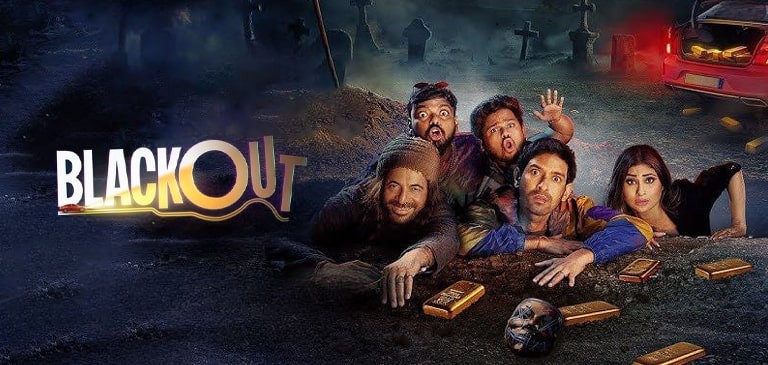
Official Trailer:
Urban thrillers often rely on chaos as a storytelling device, plunging their characters into situations where ordinary routines suddenly spiral into extraordinary danger. The Hindi-language film Blackout builds its entire narrative around such a moment of disruption. Set against the uneasy stillness of a citywide power failure, the film explores how darkness—both literal and psychological—can expose the fragile boundaries between control and desperation in modern urban life.
The story follows a crime journalist whose professional curiosity and personal impulses collide during one fateful night. What begins as an unexpected encounter soon escalates into a sequence of unpredictable events involving money, deception, and survival. The blackout itself becomes more than a plot device; it functions as a metaphorical curtain that conceals motives, distorts judgment, and allows hidden aspects of human nature to surface.
From the outset, the film establishes a tone that blends suspense with dark humour. This tonal duality is central to its narrative identity. Rather than presenting danger in purely grim terms, Blackout often frames tension through irony and situational absurdity. The result is a story that keeps audiences uncertain about whether to laugh at the protagonist’s predicament or fear for his safety.
Read Also: Mercy: Justice In The Age Of Algorithms
At the centre of this narrative is Vikrant Massey, whose performance carries much of the film’s emotional and psychological weight. Massey portrays a man who is intelligent yet impulsive, confident yet increasingly overwhelmed by circumstances beyond his control. His character’s journey is defined less by heroic action than by reluctant adaptation. Each decision he makes seems to lead him deeper into a labyrinth of complications, reflecting the film’s broader theme that modern urban life can turn unpredictably perilous within moments.
Massey’s portrayal is particularly effective in scenes that highlight the character’s internal conflict. He navigates fear, opportunism, and moral hesitation with a subtlety that prevents the role from slipping into caricature. The performance captures the uneasy balance between self-preservation and ethical responsibility, suggesting that survival in extreme situations often demands uncomfortable compromises.
Opposite him, Mouni Roy adds a layer of intrigue and unpredictability to the narrative. Her character embodies the ambiguity that defines much of the film’s storytelling. She is neither entirely trustworthy nor overtly antagonistic, existing instead within a grey area that keeps both the protagonist and the audience uncertain of her intentions. Roy’s screen presence contributes to the film’s atmosphere of tension, where every interaction feels loaded with potential consequences.
Another notable presence is Sunil Grover, whose involvement introduces elements of dark comedy that prevent the narrative from becoming oppressively intense. Grover’s performance illustrates how humour can coexist with suspense, offering moments of relief while simultaneously reinforcing the unpredictability of the situation. His character’s reactions to unfolding events often reflect the absurdity inherent in human attempts to maintain composure during crisis.
Watch the Full Movie Here: Movie Hub
From a directorial standpoint, Blackout embraces the visual language of contemporary urban thrillers while maintaining a distinctly Indian sensibility. Much of the film unfolds at night, allowing shadows, dimly lit streets, and flickering artificial lights to shape its visual texture. The cinematography frequently uses handheld shots and tight framing to create a sense of immediacy, placing viewers alongside the protagonist as he navigates unfamiliar and increasingly dangerous terrain.
The city itself functions as a silent character within the film. Normally vibrant and energetic, it becomes eerily subdued during the blackout, transforming familiar spaces into zones of uncertainty. This shift reinforces the film’s exploration of how quickly societal order can dissolve when technological infrastructure fails. In this environment, anonymity becomes both a shield and a threat.
Pacing plays a significant role in sustaining the film’s suspense. The narrative unfolds almost in real time, mirroring the relentless progression of events during the night. Each encounter leads to another complication, creating a chain reaction that keeps the story in constant motion. While certain sequences linger slightly longer than necessary, this deliberate tempo also enhances the sense of psychological entrapment experienced by the protagonist.
Beyond its immediate thrills, Blackout engages with broader themes about urban isolation and moral ambiguity. The film suggests that modern city life, despite its crowded spaces and technological connectivity, often leaves individuals emotionally detached from one another. When crisis strikes, characters are forced to rely on instinct rather than social support, revealing both resilience and selfishness in equal measure.
Read Also: Before “I Do”: When Love Faces The Truth
Within the wider landscape of contemporary Bollywood cinema, the film reflects an ongoing shift toward genre experimentation. While traditional Hindi films have long been associated with musical spectacle and melodrama, recent years have seen a growing interest in darker, more grounded narratives that blend suspense with social observation. Blackout aligns with this movement by offering a story that is both entertaining and reflective of changing audience tastes.
Ultimately, what distinguishes the film is its emphasis on consequence. The events of a single night ripple outward, reshaping how the protagonist perceives himself and the world around him. By the time dawn approaches, the blackout has illuminated more than it has concealed, exposing truths that daylight might otherwise have hidden.
In its closing moments, Blackout leaves viewers contemplating the fragile illusion of control that defines modern existence. Life, it suggests, can shift direction without warning, and survival often depends not on strength or intelligence alone, but on the willingness to confront uncertainty. Through its blend of suspense, humour, and psychological tension, the film offers a compelling reminder that sometimes the darkest nights reveal the clearest reflections of who we truly are.