
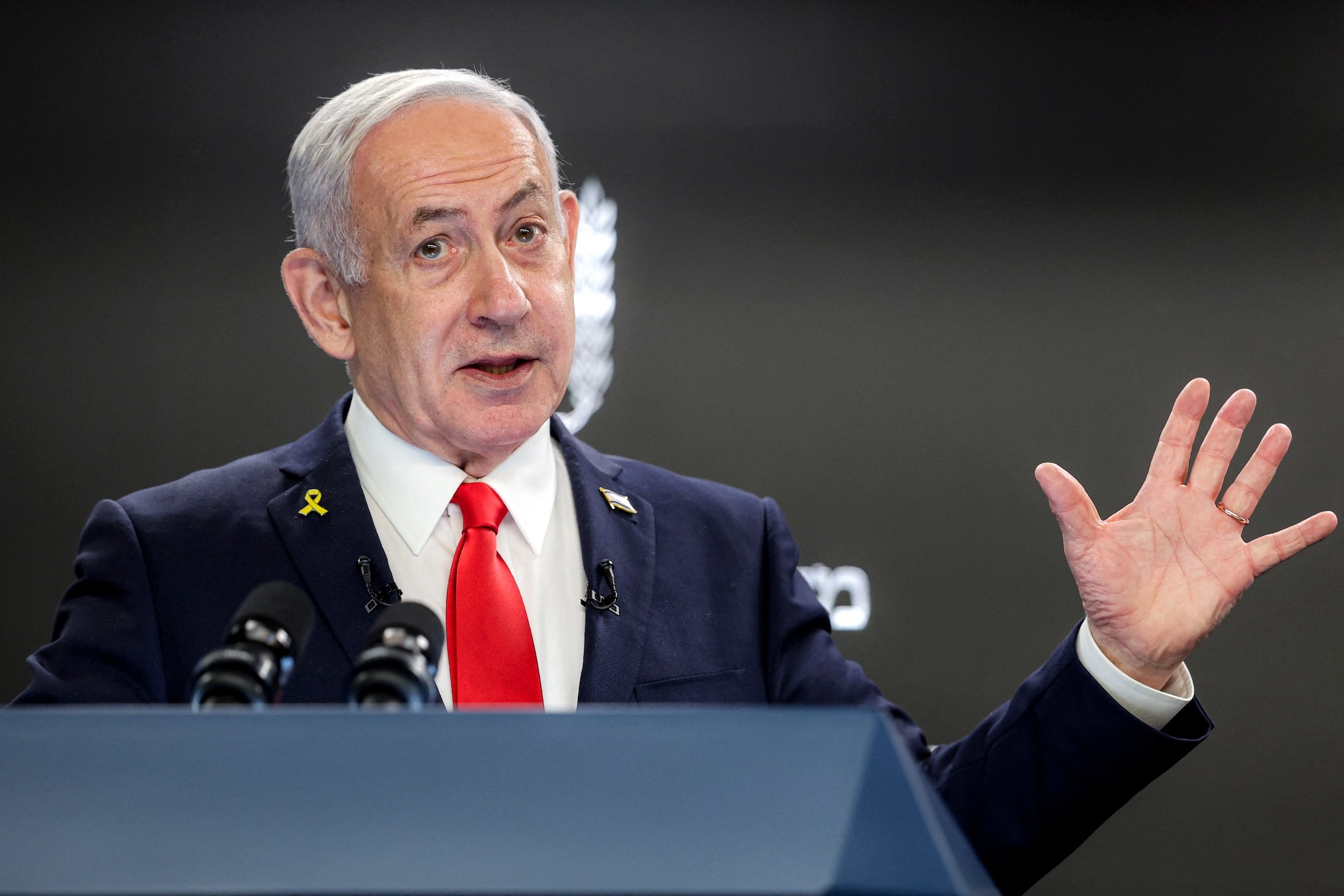
Benjamin Netanyahu stepped before cameras Thursday to declare Israel’s military position stronger than at any point in its history, using a news conference to catalogue what he described as irreversible damage inflicted on Iran across nearly two weeks of coordinated strikes with the United States, while leaving little ambiguity about his intentions toward the country’s new supreme leader and the commanders around him.
The Israeli prime minister said the campaign, which he dated to its launch on February 28, had achieved objectives that Israeli planners had long considered out of reach.
Among them: the killing of senior Iranian nuclear scientists and the severe degradation of both the Islamic Revolutionary Guard Corps and the Basij paramilitary forces that form the institutional backbone of the Islamic Republic’s internal and external security architecture. “Iran is no longer the same Iran,” Netanyahu said — a formulation he appeared to offer not merely as military assessment but as political verdict.
He claimed the strikes had intercepted Iran’s efforts to move its nuclear and ballistic missile programmes underground, a development he framed as strategically decisive. Whether that claim can be independently verified remains unclear; Iran has not confirmed the assertion and international inspectors have had no access to relevant sites since the conflict began.
On the question of Ayatollah Mojtaba Khamenei — who assumed the position of supreme leader following his father’s death in the early days of the conflict — Netanyahu was pointed without being explicit.
Asked whether Khamenei and Hezbollah chief Naim Qassem faced the same fate as other Iranian and allied figures eliminated since February, the prime minister said he would not be taking out “life insurance” on either man.
He went further in his characterisation of Khamenei, describing him as a functionary of the Revolutionary Guards rather than an independent authority, and noting that the supreme leader had been reduced to issuing statements read aloud by a news anchor on state television rather than appearing in public himself.
Read also: Spain Withdraws Ambassador To Israel, Rift Deepens
Netanyahu directed part of his remarks toward ordinary Iranians, invoking the protest movements that had periodically shaken the Islamic Republic — most recently in January — as evidence of a population at odds with its government. “We are standing by your side,” he said, before adding: “But at the end of the day this is up to you, it’s in your hands.” The language tracked closely with statements issued repeatedly by US President Donald Trump, who has called on Iranians to overthrow their government and declared that “the hour of their freedom is at hand.”
The prime minister also pointed to what he described as an unexpected geopolitical dividend of the conflict: the forging of new regional alignments that would have been unthinkable before the war began. He did not name specific countries but suggested that the shared threat posed by Iran had created openings for Israel in parts of the Arab world where normalisation had previously stalled.
The Abraham Accords of September 2020 had initially signalled a new era of Israeli integration into the region, but that momentum had collapsed under the weight of Israel’s military campaign in Gaza. Whether the current conflict has genuinely reopened those channels — or whether Netanyahu was projecting an optimism useful for domestic consumption — was not immediately clear.
The domestic political dimension was not lost on analysts watching the conference. Al Jazeera’s correspondent Nour Odeh, reporting from Ramallah, described the event as a carefully staged attempt to repackage the war’s narrative ahead of Israeli parliamentary elections scheduled for November.
Netanyahu, she said, had entered the conflict expecting a surge in public support that would carry him through the vote — but polling published the same day as his news conference showed him losing ground rather than gaining it. “The latest polls that came out just as he was speaking saw him losing a seat,” Odeh said.
Read also: Lebanon Signals Openness To Direct Talks With Israel
She also noted that Israel’s military censor continues to restrict domestic coverage of incoming missile and drone strikes on Israeli territory, leaving residents who have witnessed destruction firsthand frustrated by the gap between what they experience and what reaches the public.
Beyond Israel’s borders, the broader regional picture has continued to deteriorate. Iran has launched drone and missile strikes on Gulf countries in recent days, forcing several oil terminals to suspend operations and unsettling governments that had maintained a careful distance from the conflict.
Tehran has insisted its attacks are directed exclusively at American assets in the region, but Gulf states say the strikes have caused damage and shattered confidence in the security environment regardless of the stated intent.
The United Nations Security Council moved Wednesday to formally condemn Iran’s conduct, adopting a resolution sponsored by the Gulf Cooperation Council that demanded Tehran immediately halt its attacks on Gulf countries and Jordan.
Netanyahu made no reference to a timeline for concluding operations or entering any form of negotiation.