
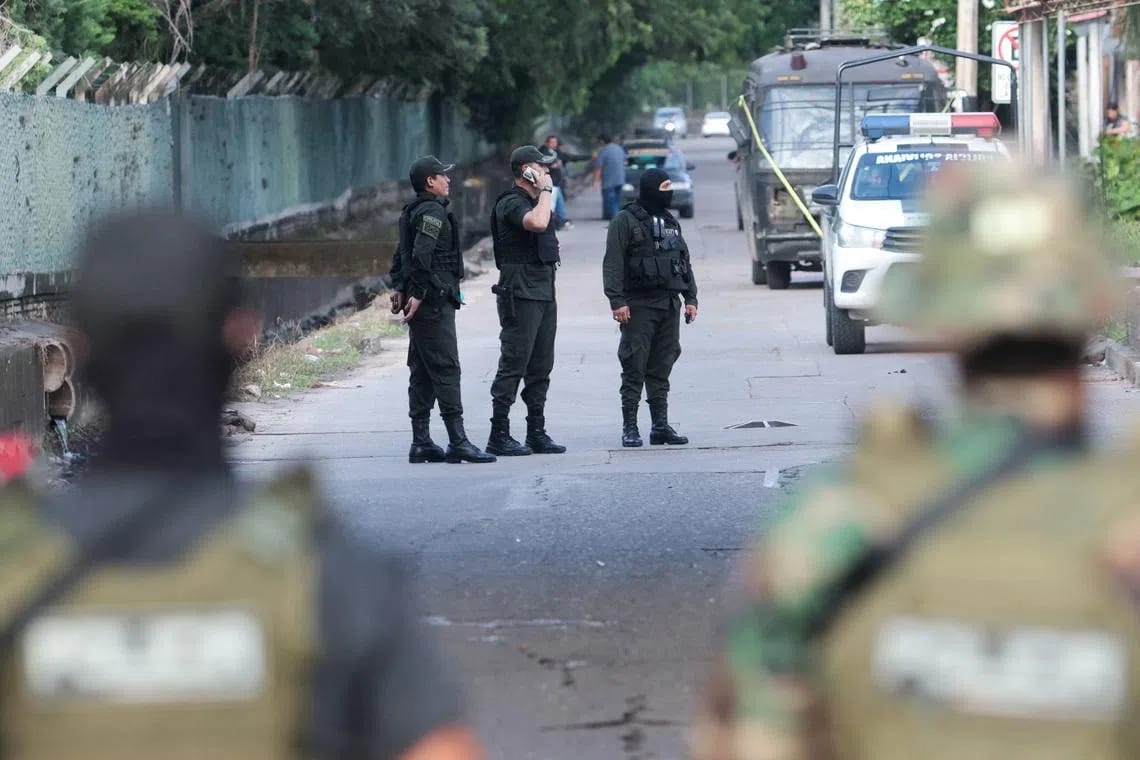
Hundreds of police officers swarmed a compound in Santa Cruz de la Sierra on Friday morning and captured one of South America’s most wanted fugitives, delivering Bolivian President Rodrigo Paz a trophy arrest weeks after his government restored cooperation with US drug enforcement agencies.
Sebastian Enrique Marset Cabrera, a 34-year-old Uruguayan whom prosecutors accuse of running a transnational cocaine network that shipped tonnes of drugs to Europe and beyond, was transferred into American custody hours after the raid.
He was seen boarding a US-tagged plane, though the Drug Enforcement Administration did not participate in the operation, which was led by Bolivian forces.
No casualties were reported during the capture, which Paz hailed as a turning point in confronting organized crime.
“One of the drug traffickers and criminals considered among the four biggest on the continent has fallen,” Paz said at a news conference in La Paz. “The capture of Mr Marset marks a turning point in the fight against organised crime, and it also reaffirms the government’s determination to confront international and domestic mafias.”
The arrest follows another major kingpin operation last month in Mexico, where forces killed Nemesio Oseguera Cervantes, known as “El Mencho,” leader of the Jalisco New Generation Cartel. That raid triggered retaliatory attacks across Mexico, underscoring the risks of targeting cartel leadership even as governments ramp up enforcement.
Read also: El Mencho’s Death Sparks Cartel Violence Across Mexico
Marset faces money laundering charges filed in the United States in March 2024 for allegedly using American financial institutions to process millions in drug proceeds. Prosecutors say he led the First Uruguayan Cartel, an organization responsible for shipping cocaine worldwide, including to Belgium and Portugal.
A drug bust at Belgium’s Antwerp port turned up nearly 16 tonnes of cocaine linked to his network. Prosecutors have also alleged Marset sought advice via text message on how to dispose of enemies’ bodies.
Both Paraguay and Bolivia had sought him on criminal charges. Bolivia posted a $100,000 reward for information leading to his capture in 2023. The United States offered $2 million in May last year for help arresting or convicting him.
Marset appeared to embrace his notoriety. The Washington Post reported he stamped drug shipments with the label “The King of the South.” Media accounts described him as a football enthusiast who invested in lower-level teams across Latin America and Europe.
He had been on the run since July 2023, when he evaded a planned detention operation. In 2021, authorities in Dubai briefly stopped him for traveling under a fake passport, but Uruguayan officials issued new documents that allowed him to leave—a decision that sparked outrage.
Paraguay said Friday it would seek extradition so Marset could stand trial there as well.
The arrest reflects a broader political shift across South America, where right-wing governments have replaced longtime leftist administrations in recent elections. Paz was sworn in last November, ending nearly 20 years of leadership by Bolivia’s Movement for Socialism party.
His government has demonstrated willingness to partner with Washington on drug enforcement. In late February, Bolivia reinstated ties with the DEA after a rupture that began in 2008, when the previous government expelled the agency over accusations it interfered in domestic affairs.
President Donald Trump hosted Paz and other right-wing Latin American leaders at his Mar-a-Lago resort in Florida recently to discuss joint efforts against cartels and criminal networks. Stephen Miller, one of Trump’s top advisers, outlined a hardline stance that frames traffickers not as criminals but as combatants.
“The cartels that operate in this hemisphere are the ISIS and the al-Qaeda of the Western Hemisphere and should be treated just as brutally and just as ruthlessly as we treat those organisations,” Miller said. “We have learned after decades of effort is that there is not a criminal justice solution to the cartel problem.”
The rhetoric signals a potential shift toward military approaches to drug enforcement, though specifics remain unclear.
Past US interventions in Latin America using military force against drug production have produced mixed results, often destabilizing regions without substantially reducing supply.
Whether Marset’s arrest disrupts cocaine flows or simply creates opportunities for rivals to expand depends partly on how his organization responds. Criminal networks have historically proven resilient to leadership removals, with lieutenants stepping up or competitors filling vacancies.
The DEA’s absence from Friday’s operation suggests Bolivian authorities wanted credit for the capture while maintaining cooperation frameworks with Washington. Paz’s government faces pressure to demonstrate results on security issues while managing sensitivities around US involvement in domestic law enforcement.
Paraguay’s extradition request sets up potential competition with American prosecutors over who tries Marset first. Such disputes have complicated past cases involving multinational defendants wanted in multiple jurisdictions.
Marset’s transfer to US custody may accelerate proceedings, giving Washington leverage in determining where prosecution occurs.
American courts often secure convictions and impose lengthy sentences in drug trafficking cases, outcomes that allied governments sometimes struggle to deliver.
The timing of the arrest—coming amid renewed US focus on Western Hemisphere drug enforcement—may not be coincidental. Trump’s administration has signaled it views cartels as national security threats requiring aggressive action, a framing that aligns with right-wing governments seeking military or intelligence support.