
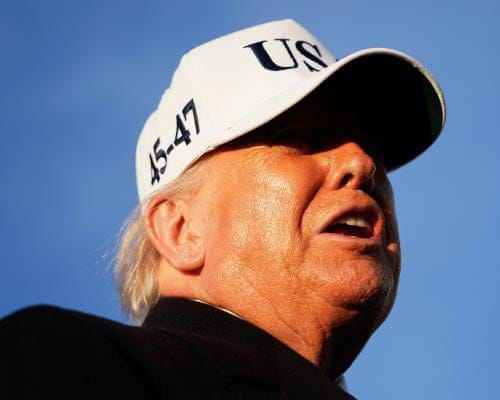
Donald Trump on Saturday demanded that nations dependent on oil flowing through the Strait of Hormuz share the burden of keeping it open, as Iranian attacks have all but sealed the waterway and pushed global crude prices up 40 percent since the US-Israeli war on Iran began.
The US president, posting on social media, said Washington would help secure the passage but made clear he expects major oil-importing nations to do their part.
He named China, France, Japan, South Korea and Britain as countries he hoped would send warships to the strait — a 34-mile-wide chokepoint through which a fifth of the world’s crude oil and liquefied natural gas normally flows.
“This should have always been a team effort, and now it will be,” Trump wrote.
The call shifts Washington’s posture on one of the conflict’s most economically consequential fronts. Since US and Israeli forces launched strikes on Iran, Tehran has choked off the strait and hit Gulf energy facilities, sending oil markets into a sustained surge that has rattled governments from Tokyo to Paris. Trump’s message Saturday was direct: the countries bearing the cost of that disruption need to help fix it.
His posts carried a striking internal tension. Trump declared that Iran had been “completely decimated” militarily and economically, yet in the same breath acknowledged that a weakened Iran could still menace the waterway indefinitely. “It’s easy for them to send a drone or two, drop a mine, or deliver a close range missile somewhere along, or in, this Waterway, no matter how badly defeated they are,” he wrote — an admission that sat uneasily beside his claims of total victory.
On the military side, Trump showed no sign of easing pressure. He said US forces would continue “bombing the hell out of the shoreline” and shooting Iranian boats out of the water, vowing the strait would be opened “one way or the other.”
Read also: Israel-Lebanon Direct Talks Set, Kushner To Lead US Role
American warplanes struck Iran’s Kharg Island on Friday in one of the campaign’s most consequential moves yet. The facility processes nearly all of Iran’s crude oil exports, and its disruption alone has amplified pressure on global energy supplies. Trump stopped short of ordering strikes on Kharg’s oil infrastructure during Friday’s raids but warned it remains a target “should Iran, or anyone else” continue interfering with shipping through the strait. The threat extends beyond Tehran — a pointed message to any third party tempted to exploit the chaos.
The administration has said tanker escorts through the strait will begin soon, with the US Navy providing direct protection for commercial vessels while simultaneously engaging Iranian forces along the shoreline.
Allied governments have responded to the widening conflict with caution, and the gap between what Trump is asking for and what partners are willing to offer remains wide. European nations have been particularly careful to avoid being seen as endorsing the offensive campaign against Iran, even as they acknowledge the shipping crisis demands a response.
French President Emmanuel Macron visited a French aircraft carrier deployed to the Mediterranean on Monday, describing allied preparations as a strictly “defensive” mission aimed at restoring freedom of navigation. The framing was deliberate — France is willing to protect commercial shipping lanes, Macron signalled, but not to be drawn into the broader conflict. A British warship departed southern England on Tuesday heading for the eastern Mediterranean, the Ministry of Defence citing the need to strengthen regional defences after a drone struck the UK’s Akrotiri air base in Cyprus.
Read more: Hamas Urges Iran To Spare Gulf States, Amid Qatar Pressure
Whether those deployments evolve into the kind of active, coordinated strait patrol Trump envisions is another matter. Assembling a credible multinational naval presence takes time, political consensus, and a shared willingness to absorb risk — none of which are guaranteed given the divisions the US-Israeli campaign has exposed among Western allies.
The Hormuz Strait’s importance to global energy security is difficult to overstate. Wedged between Iran to the north and Oman and the UAE to the south, it has no realistic alternative for Gulf oil exporters moving crude in volume. Prolonged disruption there translates almost immediately into price spikes felt by consumers worldwide, which is precisely why the 40 percent surge since the conflict began has concentrated minds in capitals far removed from the battlefield.
Trump’s demand that oil-dependent nations contribute to securing the passage fits a broader pattern in his foreign policy — insisting that countries benefiting from American military reach help pay for it. Whether framed as NATO burden-sharing or strait security, the argument is the same: the United States will not underwrite the world’s stability for free.
Iran had not publicly responded to Saturday’s posts at the time of writing.