
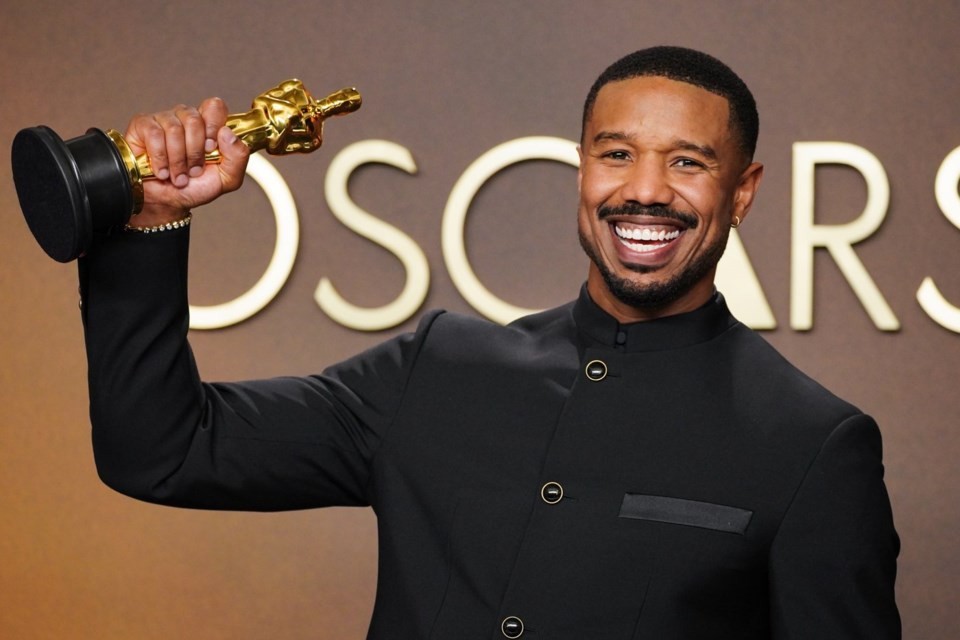
Michael B. Jordan won the Best Actor Oscar on Sunday for his dual performance in “Sinners,” becoming the fifth Black man to claim Hollywood’s most coveted acting prize and ending a long wait for an award that his career had long seemed to be building toward.
Jordan, 39, took the Academy Award at the 98th annual ceremony in Hollywood for playing twin brothers Smoke and Stack in Ryan Coogler’s supernatural drama set in the racially segregated American South of the 1930s. The win came on his first Oscar nomination, backed by the momentum of a SAG Award victory two weeks earlier that had shifted the race decisively in his favour.
He joins Sidney Poitier, Denzel Washington, Forest Whitaker and Will Smith in the narrow history of Black men recognised by the Academy in the category. “I stand here because of the people who came before me,” Jordan told the audience, visibly moved.
The victory was not a foregone conclusion heading into Sunday night. Timothée Chalamet had been considered the frontrunner for most of the awards season on the strength of his performance in “Marty Supreme.” Jordan also bested Leonardo DiCaprio in “One Battle After Another,” Wagner Moura in “The Secret Agent” and Ethan Hawke in “Blue Moon” — a field that would have produced a credible winner at almost any other ceremony.
“Sinners” gave Jordan the kind of role that tests an actor in ways a single performance cannot. Smoke and Stack are World War I veterans who return to Mississippi after years working in organised crime in Chicago, seeking something simpler — a juke joint where the locals can drink and listen to the blues during Prohibition. The premise is grounded and specific. Then white vampires arrive, hungry for blood and music both, and the film tilts into something stranger and more violent, demanding that Jordan hold two distinct men in focus simultaneously while the world around them collapses.
Read also: Legendary Godfather Actor Robert Duvall Dies Aged 95
That he pulled it off surprised no one who has followed his partnership with Coogler. The two men have worked together on every film Coogler has directed, building across a decade a shared vocabulary of complicated, wounded masculinity. They began with “Fruitvale Station” in 2013, in which Jordan played Oscar Grant, a young Black man killed by a police officer — a performance of quiet devastation that announced him as something more than a promising television actor. Coogler then cast him as Adonis Creed in the “Creed” boxing series, a man fighting the shadow of a father he never knew, and as Killmonger in “Black Panther,” the Marvel villain whose menace derived entirely from comprehensible grief.
Coogler described Jordan’s hold on screen as a matter of instinctive charisma. “As soon as you put the camera on him, you just naturally care about the guy,” the director told the New York Times last April. For Jordan, who has spoken candidly about the structural obstacles facing Black performers in Hollywood, the collaboration provided something more than opportunity. Coogler, he said in the same interview, gave him “the reassurance and the confidence that I needed” at moments when he doubted the path forward existed.
The road to Sunday night was long and not always linear. Jordan was born in California in February 1987 and raised in Newark, New Jersey, where his mother pushed him into modelling at 11. Small commercial work led to minor television roles, and at 15 he appeared in a season of HBO’s “The Wire” — an early signal that he could hold his own in demanding material. Stints on “All My Children” and “Friday Night Lights” followed before the big screen called with “Red Tails” in 2012, a film about the Tuskegee Airmen. “Fruitvale Station” came the following year, and the Coogler collaboration that would define his career was underway.
Read also: Maxwell To Refuse Congressional Questions, Lawyer Says
His first superhero role, as Johnny Storm in the 2015 “Fantastic Four” reboot, was largely written off. “Black Panther” repaired whatever damage that misfire caused, and its sequel cemented his place in the Marvel universe. He has since moved into producing, with credits on “Just Mercy” and “Without Remorse,” and directed the third “Creed” instalment himself.
Jordan has spoken publicly about going to therapy after inhabiting Killmonger — a character, he has said, whose darkness required deliberate effort to shed. He described himself to GQ last year as a “workaholic” whose longest relationship lasted a year, and has otherwise kept his private life tightly guarded in an industry that trades on personal exposure.
Next up is an adaptation of “The Thomas Crown Affair,” in which Jordan will direct and star as the gentleman thief previously played by Steve McQueen and Pierce Brosnan, with a theatrical release expected in 2027. But the project he says he is most looking forward to is something else entirely — a film he will direct without appearing in at all.
For one night, though, the camera was on him. And as Coogler has always maintained, you could not look away.